Saturday, November 3, 2018

Facebook reorganizes Oculus for AR/VR’s long-haul

Facebook is again looking to whip Oculus into shape for its 10-year journey towards making virtual reality mainstream. According to two sources, Facebook reorganized its AR and VR team this week from a divisional structure focused around products to a functional structure focused around technology areas of expertise. While no one was laid off, the change could eliminate redundancies by uniting specialists so they can iterate towards long-term progress rather than being separated into groups dedicated to particular gadgets.

Facebook confirmed the reorg to TechCrunch, with a spokesperson providing this statement: “We made some changes to the AR/VR organization earlier this week. These were internal changes and won’t impact consumers or our partners in the developer community.” Oculus CTO John Carmack and Oculus co-founder/newly-promoted Head of PC VR Nate Mitchell will remain in their leadership positions within VP of AR/VR Andrew ‘Boz’ Bosworth’s hardware wing of the company.

The shift obviously communicates that Facebook believes Oculus could be running more effectively. Organizing the company around areas of expertise rather than broader divisions is probably more appropriate for a moonshot effort that can’t afford redundancies, on the other hand, keeping expertise siloed could isolate new approaches and advancements from reaching other teams. As the company builds out its first full lineup of headsets, there seems to be significant overlap in the tech problems and products bring tackled by those working on mobile and PC products.

TechCrunch reported earlier this week that the company is planning to release a new Rift headset as early as 2019, possibly called the Rift S, which will featured upgraded displays and an inside-out tracking system. The company’s “Rift 2” project, codenamed Caspar, was left behind in the reorganization, a source tells us. We can’t confirm whether any other products or concepts have been shelved.

While an immersive virtual world that users can hang out and communicate in certainly seems to fit Facebook’s broader mission, the company has spent the better part of the past few years deciding how a costly, ambitious venture like Oculus fits into its corporate structure.

First, things went smoothly. The company and its empowered co-founders were building out a developer network and prepping for the launch of their Rift headset after creating a successful partnership with Samsung for the Gear VR. Then, the company’s good fortune turned as the Rift headset was racked by expensive delays and Oculus failed to ship the company’s Touch motion controllers at launch losing some initial ground to HTC. 

By the end of 2016, it was announced that co-founder Brendan Iribe was out as CEO and that the company would be reorganizing around divisions focused on things like PC VR, mobile and content with Xiaomi exec Hugo Barra coming aboard as VP of VR to lead the new effort working directly beneath CEO Mark Zuckerberg. An additional layer of oversight has been built in since then, with Bosworth was put in charge of the company’s consumer hardware ambitions with Oculus as a central pillar. His title is now VP of AR/VR.

The absorption of Oculus deeper into Facebook’s corporate structure was a trend that soon replicated itself as the company looked to rein in the independent teams under a more cohesive vision. The culmination of this was a major executive reshuffle earlier this year that changed the landscape for how divisions within the company were managed.

Now, they’re changing things up even more.

Oculus Go

The new structure sounds like it could coordinate efforts around more general lines like hardware and software allowing insights to flow more intuitively across Facebook’s planned devices.

Given the slow adoption of VR and engineering challenges of AR headsets, which at TechCrunch’s LA conference last month Facebook’s head of AR Ficus Kirkpatrick confirmed it was building, this structure could help Oculus iterate its way to long-term success rather than just getting the next product out the door.

If Facebook is going to beat companies solely focused on AR like Magic Leap, and potential incumbent invaders like Apple if it so chooses, it needs to maximize efficiency. And if it’s going to get both developers and users excited about these next-generation computing platforms, it will have to produce products that make cutting-edge technologies feel unified and accessible. That’s a lot easier when everyone’s not stepping on each other’s virtual shoes.


from RSSMix.com Mix ID 8176981 https://techcrunch.com/2018/11/03/oculus-organization/
http://www.gadgetscompared.com
from Tumblr http://ikonografico.tumblr.com/post/179733153966
via http://www.gadgetscompared.com

The iPhone is reportedly getting 5G in 2020

The first 5G phones are set to start arriving next year. Motorola plans to bring next-gen connectivity via a Mod for the Z3, and companies like LG and OnePlus have promised to deliver the tech baked into handsets at some point in 2019. iPhone users, on the other hand, may have to wait a bit longer.

The technology is, of course, an inevitability for Apple (along with everyone else, really), so it’s just a question of when. A new report from Fast Company (via the Verge) puts the timing around a year and half out.

The “source with knowledge of Apple’s plans” put the 5G iPhone’s arrival at some point in 2020, with Intel supplying the tech this time out. Apparently Apple and Intel are going through a bit of a rough patch of late, courtesy of heat/battery issues with the 8060 5G modem. Of course, things aren’t rough enough for the company to hit up Qualcomm again.

Given the on-going battle between the two companies, that’s probably a bridge too far. Instead, Apple’s holding out for Intel’s 8161 chip. 5G presents a solid opportunity for Intel to regain some of the substantial ground it ceded to Qualcomm in the mobile market the last time out.


from RSSMix.com Mix ID 8176981 https://techcrunch.com/2018/11/03/the-iphone-is-reportedly-getting-5g-in-2020/
http://www.gadgetscompared.com
from Tumblr http://ikonografico.tumblr.com/post/179726613411
via http://www.gadgetscompared.com

Friday, November 2, 2018

Sequoia leads $10M round for home improvement negotiator Setter

You probably don’t know how much it should cost to get your home’s windows washed, yard landscaped or countertops replaced. But Setter does. The startup pairs you with a home improvement concierge familiar with all the vendors, prices and common screwups that plague these jobs. Setter finds the best contractors across handiwork, plumbing, electrical, carpentry and more. It researches options, negotiates a bulk rate and, with its added markup, you pay a competitive price with none of the hassle.

One of the most reliable startup investing strategies is looking at where people spend a ton of money but hate the experience. That makes home improvement a prime target for disruption, and attracted a $10 million Series A round for Setter co-led by Sequoia Capital and NFX. “The main issue is that contractors and homeowners speak different languages,” Setter co-founder and CEO Guillaume Laliberté tells me, “which results in unclear scopes of work, frustrated homeowners who don’t know enough to set up the contractors for success, and frustrated contractors who have to come back multiple times.”

Setter is now available in Toronto and San Francisco, with seven-plus jobs booked per customer per year costing an average of over $500 each, with 70 percent repeat customers. With the fresh cash, it can grow into a household name in those cities, expand to new markets and hire up to build new products for clients and contractors.

I asked Laliberté why he cared to start Setter, and he told me “because human lives are made better when you can make essential human activities invisible.” Growing up, his mom wouldn’t let him buy video games or watch TV so he taught himself to code his own games and build his own toys. “I’d saved money to fix consoles and resell them, make beautiful foam swords for real live-action games, buy and resell headphones — anything that people around me wanted really!” he recalls, teaching him the value of taking the work out of other people’s lives.

Meanwhile, his co-founder David Steckel was building high-end homes for the wealthy when he discovered they often had ‘home managers’ that everyone would want but couldn’t afford. What if a startup let multiple homeowners share a manager? Laliberté says Steckel describes it as “I kid you not, the clouds parted, rays of sunlight began to shine through and angels started to sing.” Four days after getting the pitch from Steckel, Laliberté was moving to Toronto to co-found Setter.

Users fire up the app, browse a list of common services, get connected to a concierge over chat and tell them about their home maintenance needs while sending photos if necessary. The concierge then scours the best vendors and communicates the job in detail so things get done right the first time, on time. They come back in a few minutes with either a full price quote, or a diagnostic quote that gets refined after an in-home visit. Customers can schedule visits through the app, and stay in touch with their concierge to make sure everything is completed to their specifications.

The follow-through is what sets Setter apart from directory-style services like Yelp or Thumbtack . “Other companies either take your request and assign it to the next available contractor or simply share a list of available contractors and you need to complete everything yourself,” a Setter spokesperson tells me. They might start the job quicker, but you don’t always get exactly what you want. Everyone in the space will have to compete to source the best pros.

Though potentially less scalable than Thumbtack’s leaner approach, Setter is hoping for better retention as customers shift off of the Yellow Pages and random web searches. Thumbtack rocketed to a $1.2 billion valuation and had raised $273 million by 2015, some from Sequoia (presenting a curious potential conflict of interest). That same ascent may have lined up the investors behind Setter’s $2 million seed round from Sequoia, Hustle Fund and Avichal Garg last year. Today’s $10 million Series A also included Hustle Fund and Maple VC. 

The toughest challenge for Setter will be changing the status quo for how people shop for home improvement away from ruthless bargain hunting. It will have to educate users about the pitfalls and potential long-term costs of getting slapdash service. If Laliberté wants to fulfill his childhood mission, he’ll have to figure out how to make homeowners value satisfaction over the lowest sticker price.


from RSSMix.com Mix ID 8176981 https://techcrunch.com/2018/11/02/setter-home/
http://www.gadgetscompared.com
from Tumblr http://ikonografico.tumblr.com/post/179701177136
via http://www.gadgetscompared.com

Bumble drops its $400M lawsuit against Match, but this battle isn’t over

Bumble and Match’s ongoing legal battles are continuing today. According to a statement released by Match Group this morning, Bumble is dropping its $400 million lawsuit against Match, which had claimed Match fraudulently obtained trade secrets during acquisition talks. However, Bumble is preparing to refile its suit at the state level, we’re hearing.

If you haven’t been following, the two companies have been doing battle in the court system for some time after Match Group failed to acquire Bumble twice — once in a deal that would have valued it at over $1 billion.

Bumble claimed Match then filed a lawsuit against it to make Bumble appear less attractive to other potential acquirers. Match’s suit claims Bumble infringed on patents around things like its use of a stack of profile cards, mutual opt-in and its swiped-based gestures — things Tinder had popularized in dating apps.

Bumble subsequently filed its own lawsuit in March 2018, this one claiming that Match used acquisition talks to fraudulently obtaining trade secrets. It says this is not a countersuit, but its own separate suit. (This is the one being discussed today by the companies.)

Match says it wasn’t served papers for Bumble’s suit. But Bumble CEO Whitney Wolfe had said they delayed serving papers to give Match a chance to settle.

After a failure to settle, Bumble announced on September 24, 2018 that it would be serving Match, and shared news of its IPO plans. The $400 million suit claims Match had asked for “confidential and trade secret information” in order to make a higher acquisition offer for Bumble, but that no subsequent offer came as result.

Match says Bumble asked the courts to drop its lawsuit just a few weeks after this announcement, and believes the whole thing is just a PR stunt around Bumble’s IPO.

Match today says it’s not opposed to the lawsuit being dropped. But it is now seeking declaratory judgements that will force these issues to be litigated in the right forums, it says. Match is looking for a judgement that would force this suit to be litigated in the Court of England or Wales.

It points out that Bumble had filed its state petition in Dallas County, rather than respond with counterclaims to Match’s suit in the Western District of Texas — “less than 100 miles from Bumble’s Austin headquarters.”

It asked the case to be transferred to federal courts in the Western District, where its IP case is pending.

Now, Match says that Bumble is asking the courts to drop its claims against Tinder’s parent company.

“We’re not opposing their request to dismiss their own claims, but we’re seeking declaratory judgements that will force these issues to be litigated in the right forums,” says a Match spokesperson. “As we say in section 132 of the amended counterclaim: ‘Match will not simply wait until Bumble decides whether or not it wants to pursue these claims – likely in connection with Bumble’s next media blitz. Match intends to litigate these baseless allegations now, and Match intends to conclusively disprove them.‘”

Bumble responded this morning by saying it plans to continue to defend its business against Match.

“Match’s latest litigation filings are part of its ongoing campaign to slow down Bumble’s momentum in the market. Having tried and failed to acquire Bumble, Match now seems bent on trying to impair the very business it was so desperate to buy,” a Bumble spokesperson says. “Bumble is not intimidated and will continue to defend its business and users against Match’s misguided claims.”

It declined to comment on how, but we understand that the change from a state court system to federal courts is in play here. Bumble wanted to litigate at the state level, which means it has to dismiss its claims in the federal courts. Match could then accurately say Bumble’s lawsuit is being dropped, but that doesn’t necessarily mean Bumble’s plans have changed.

We understand that Bumble is preparing to refile its case in the state court system, but it hasn’t done so yet, because the court has to allow them to first dismiss this suit.


from RSSMix.com Mix ID 8176981 https://techcrunch.com/2018/11/02/match-says-bumble-is-dropping-its-400m-lawsuit-but-this-battle-isnt-over/
http://www.gadgetscompared.com
from Tumblr http://ikonografico.tumblr.com/post/179697903041
via http://www.gadgetscompared.com

Apple News will launch a real-time election results hub on November 6

Apple is preparing to launch a new way for its customers to track election results. At 8 PM ET on November 6, the company will swap out the existing Midterm Elections section in the Apple News app and replace it with a new Election Night section instead. This section will also replace Apple News’ Digest tab at the bottom-center of the app, in order to lead users directly to the special section where they’ll be able to track the live results, updates on key races, latest developments and more.

The company is partnering with the Associated Press for its real-time election results, as do many news organizations thanks to AP’s history and experience with verifying results.

Here, Apple will use that AP data to inform a number of dynamic infographics, as well as offer a complete list of federal election results in every state, including House and Senate seats.

These results will update every minute, or you can just “refresh” the page manually to force the update at any time.If the balance of power in either the House or the Senate is determined by way of the incoming results, Apple News will publish a special alert at the top of the feed and a pop up notification, as well.
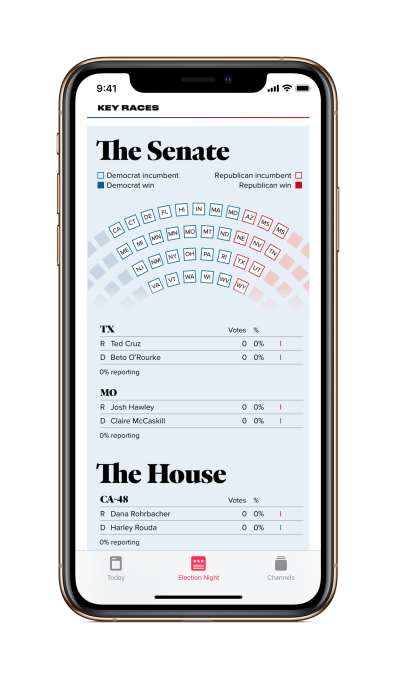
The Key Races section, meanwhile, offers another set of live updating infographics, showing the live results from the most interesting House, Senate or Gubernatorial races.

Another section will focus on the latest developments — meaning breaking news headlines and stories related to election night coverage. This will feature news from a variety of sources, including Axios, Politico, The Washington Post, Fox News, CNN, The New York Times, CBS and others.CBS News, CNN and Fox News will also contribute video clips to the Election Night hub, while ABC will offer a live video feed. Another live video feed from NBC News will appear in a widget alongside the Live Results infographic.

Apple says users won’t have to authenticate with their TV provider on election night to watch the videos in the hub.

A diversity of news sources was important to Apple, which wanted to have a range of options for people to read, as well as a way to present the news so people could see how it’s being processed across the ideological spectrum.

More importantly, all the news coverage in the hub isn’t being driven by algorithms. For Apple News’ team, Election Night is an all-hands-on-deck type of situation involving real human editors. In fact, human editorial oversight is a key difference between Apple’s approach to news aggregation and curation, compared with competitors like Google, Twitter and Facebook — all of which have come under fire for their outsized roles in the spread of information, and, at times, disinformation.

Apple has been taking the opposite approach, by staffing up an editorial team of former journalists instead of leaving news curation to technology.

Apple News is available across iPhone, iPad and, as of this year, Mac devices.


from RSSMix.com Mix ID 8176981 https://techcrunch.com/2018/11/02/apple-news-will-launch-a-real-time-election-tracker-on-november-6/
http://www.gadgetscompared.com
from Tumblr http://ikonografico.tumblr.com/post/179691393036
via http://www.gadgetscompared.com

Instagram’s next cash cow: instant Promote ads for Stories

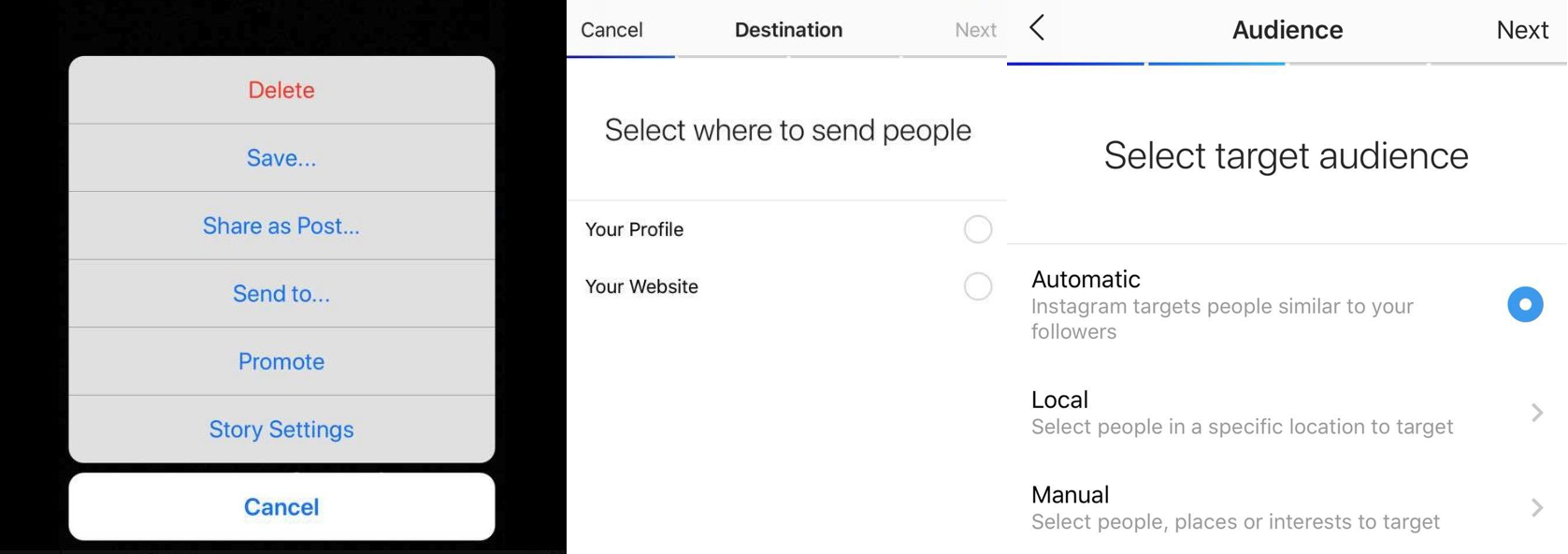
Instagram hopes dollars from the long-tail of small businesses and social media stars can help it pull its weight in the Facebook family. A new ad type called “Promote” for Stories allows Instagram business pages to show their ephemeral slideshows to more users without doing much work. Admins can choose to auto-target users similar to their followers, people in a certain location, or use all of Instagram’s targeting parameters to inject their Story into the Stories queue of more users as an ad that can also link to business’ Instagram profile or website.

Facebook confirms to TechCrunch that Promote for Stories works similarly to Facebook’s Boost option that lets them pay to instantly show their feed posts to more users. “I can confirm that we are testing this feature globally. We don’t have an immediate timeline for 100 percent rollout, but will keep you posted” an Instagram spokesperson told me. Screenshots of Promote were first shared by social consultant Matt Navarra.

Instagram tests new Promote Stories ads. Image Credit: Matt Navarra

Instagram already has 2 million active advertisers, compared to Facebook’s 6 million. But designing and targeting ads, especially full-screen video Stories ads, can be daunting to small businesses and public figures. Promote offers an easy way to turn their existing Stories into ads.

The feature could unlock more spend at a crucial time when Facebook’s revenue growth is in massive decline. It dropped from 59 percent in Q3 2016 to 49 percent in Q3 2017 to 33 percent in Q3 2018 as it hits saturation in lucrative developed countries and runs out of News Feed space. Facebook warned Wall Street about revenue deceleration, as sharing shifts from feeds to Stories and advertisers have to adapt, but turning local merchants and influencers into paying customers could smooth that transition.

Instagram Analytics Launches In Beta

In other Instagram business news, today it launched Instagram Analytics in beta as part of Facebook Analytics. The tool goes beyond Instagram’s existing Insights tool that just counted different types of engagement with an account and its content, such as new followers, website clicks, post impressions and Story exits.

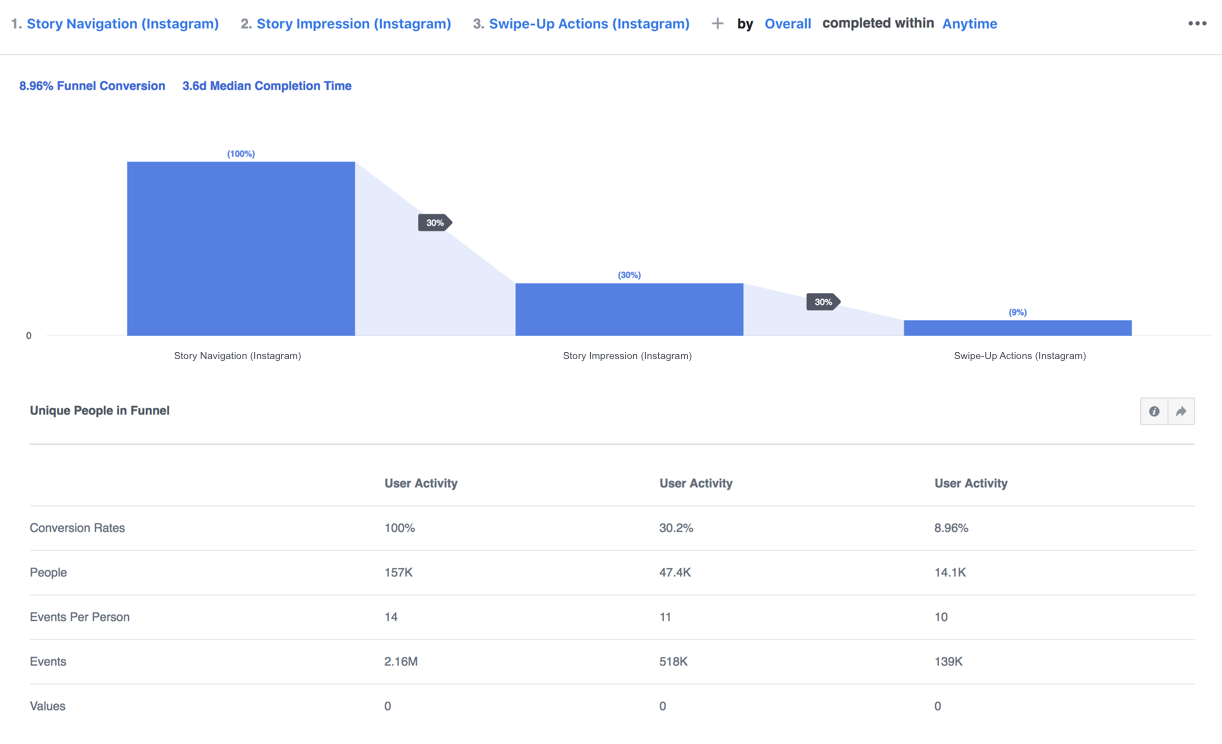
With Instagram Analytics, business accounts can track life time value and retention rates for people who do or don’t interact with their content, and create audience segments to see if people who commented on a particular post generate more value for them. They can also analyze how their Instagram audience overlaps with people who visit their site, download their app or like their Facebook Page.

The more Instagram analytics businesses have access to, the better they’ll be able to prove that their investment in the platform is paying off. Being able to see exactly how followers move through a conversion funnel will result in higher confidence in campaigns and translate into more ad and content spend.

IGTV hopes for virality with Stories previews

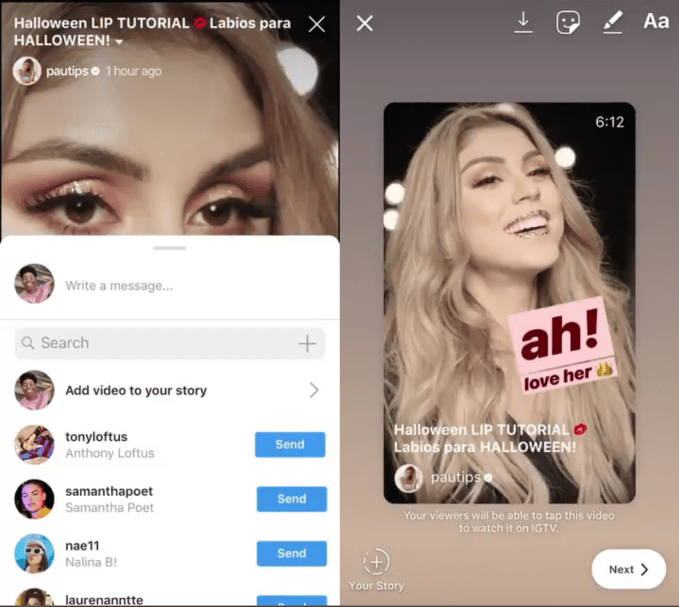
And there’s one final piece of Instagram news for the day. IGTV hasn’t quite blown up like Instagram Stories since launching in June, but a combination could bring some much needed attention to the app’s longer form video hub. Instagram today launched the ability to share a preview image of an IGTV video to your Instagram Story. Friends can tap through to actually watch the full video on IGTV.

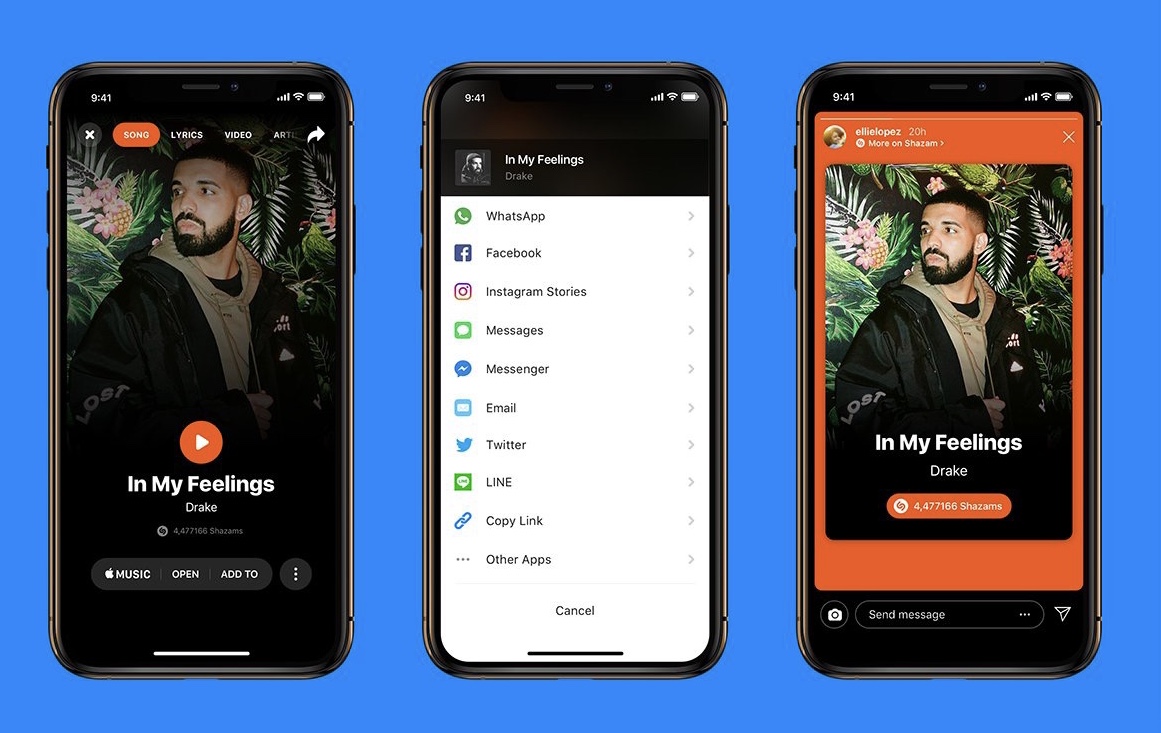
The IGTV previews don’t actually play, they’re just a static sticker. Shazam launched its own Instagram Stories integration today that works similarly to the IGTV previews, as well as SoundCloud and Pandora’s partnerships. Shazam lets you share a preview image of a song to your Instagram Story, but to actually hear any music you have to click through to Shazam. That makes these integrations inferior to Instagram’s own native music-sharing feature that actually lets you add a soundtrack to your Stories that friends can hear as they watch.

Shazam now can share song preview images to Instagram Stories, but you have to tap through to hear anything

IGTV has also recently added a History tab that shows what you’ve recently watched. This could be helpful for getting back to your favorite clips or jumping to a new episode of a show you’re hooked on.

Facebook CEO Mark Zuckerberg said on Tuesday’s earnings call that “People really want to watch a lot of video”, and the company plans to invest more in premium Facebook Watch content. But so far, it’s niether publicly announced any deals to pay for IGTV content, nor has opened any direct monetization options to creators. With viewership taking time to grow, there just aren’t enough incentives for creators to invest in producing polished, longer-form vertical video when there’s nowhere else to put it but IGTV. Virality through these previews could convince them there’s big fan-base growth opportunities available if they stick with IGTV.

These updates show that the departure of Instagram’s co-founders hasn’t slowed down the company’s innovation. Former Facebook News Feed VP Adam Mosseri kept up a brisk pace of product launches, and now with Instagram he seems determined to keep users, creators and businesses glued to what’s quickly becoming the social giant’s premier property.


from RSSMix.com Mix ID 8176981 https://techcrunch.com/2018/11/01/instagram-analytics-promote-stories/
http://www.gadgetscompared.com
from Tumblr http://ikonografico.tumblr.com/post/179678380626
via http://www.gadgetscompared.com

Thursday, November 1, 2018

Walmart adds an AR scanner to its iOS app for product comparisons

Walmart is giving augmented reality a shot. The retailer today announced the launch of a new AR scanning tool in its iPhone application which will help customers with product comparisons. However, unlike a typical barcode scanner meant only to compare prices on one item at a time, Walmart’s AR scanner can be panned about across store shelves, offering details on pricing and customer ratings beneath the products it sees.

The technology was first developed by a team at an internal Walmart hackathon using Apple’s ARKit technology. At the time, their idea was to create a scanning experience that worked faster and felt faster when used by customers. They also wanted to build a scanner that offered more than just price comparisons.

“Walmart store shoppers love using our mobile app barcode scanner as a price checker. Our team sees the potential of this product as so much more, though,” explains Tim Sears, senior engineering manager at Walmart Labs, in a post announcing the feature’s launch. “When a customer launches the scanner, they get a direct connection between the digital and the physical world that their screen and camera lens creates for them,” he says.

The team won the hackathon, then went on to further redesign the experience to become the one that’s live today in Walmart’s application.

To use the scanner, you launch the feature in the Walmart app, then point it at the products on the shelf you want to compare. As you move the phone between one item and the other, the product tile at the bottom of the screen will update with information, including the product name, price and star rating across however many reviews it has received on Walmart.com. A link to related products is also available.

The AR scanner was designed to anchor dots to what you’ve scanned, but uses smaller dots instead of anchoring the entire content to the product itself to overcome the problems that could occur when multiple items are scanned together in a close space.

Despite the supposed advantages of AR scanning over a simpler barcode scan, it still remains to be seen to what extent consumers will adopt the feature now that it’s live.

Walmart isn’t the only retailer to give AR a go. Others have used it in various ways, including Amazon, Target, Wayfair and many more. But in several cases, AR’s adoption by retailers have been focused on visualizing products in your home, or — in the case of Target’s AR “studio” — makeup on your face.

Walmart’s AR scanner goes after a more practical use.

The AR Scanner is in the latest version of the Walmart iOS app (18.20 and higher), and works on iPhones that run at least iOS 11.3. This latter requirement is due to its use of ARKit 1.5, but will limit the audience largely to those with newer iPhones.


from RSSMix.com Mix ID 8176981 https://techcrunch.com/2018/11/01/walmart-adds-an-ar-scanner-to-its-ios-app-for-product-comparisons/
http://www.gadgetscompared.com
from Tumblr http://ikonografico.tumblr.com/post/179664750886
via http://www.gadgetscompared.com