Wednesday, December 9, 2020

MTG acquires mobile racing game studio Hutch Games for up to $375 million

Sweden’s MTG is making a significant acquisition in the mobile gaming industry. The company is acquiring Hutch Games, the London-based game studio behind popular mobile racing games such as Rebel Racing, F1 Manager and Top Drives.

The acquisition is an important one for MTG as the company is spending $275 million right away and setting aside another $100 million for performance-based payments.

If you’re not familiar with MTG, you probably know its portfolio companies. Over the past few years, MTG has acquired ESL and DreamHack to become an esports leader.

MTG has also acquired InnoGames and Kongregate for their popular web-based and mobile games. And it sounds like MTG isn’t done just yet, as the company plans to acquire more companies in the near future.

MTG explains why the acquisition makes sense in its announcement. Hutch Games isn’t focused on a single game. It has built a portfolio of successful games, which is always a good sign for future growth.

The game studio has also licensed some well-known brands, such as F1. And MTG believes that F1 Manager, Top Drives and Rebel Racing still have a lot of growth potential. Free-to-play mobile games have become games-as-a-service, so you want to keep them popular over the long run.

When it comes to long-term potential, Hutch Games also has more games in the pipeline for 2021 and 2022. Finally, it’s a cost-effective studio, as most employees are developers.

During the first nine months of 2020, Hutch Games generated $56.3 million in revenue and $13.3 million in earnings before interest and taxes (EBIT). Hutch Games investors included Backed VC, Index Ventures, Initial Capital and angel investor Chris Lee.

As you can see, free-to-play games can be lucrative. That’s why there will be some consolidation in the future. Some companies will use their deep pockets or take advantage of debt to build out big portfolios and the real estate of your home screen, one game at a time.


from RSSMix.com Mix ID 8176981 https://techcrunch.com/2020/12/09/mtg-acquires-mobile-racing-game-studio-hutch-games-for-up-to-375-million/
http://www.gadgetscompared.com
from Tumblr https://ikonografico.tumblr.com/post/637067674641465345
via http://www.gadgetscompared.com

Tuesday, December 8, 2020

Reliance’s Jio Platforms says it will roll out 5G in second half of 2021

Reliance’s Jio Platforms, the largest telecom operator in India, plans to roll out a 5G network in the country in the second half of 2021, top executive Mukesh Ambani announced on Tuesday.

“India is today among the best digitally connected nations in the world. In order to maintain this lead, policy steps are needed to accelerate early rollout of 5G, and to make it affordable and available everywhere. I assure you that Jio will pioneer the 5G revolution in India in the second half of 2021,” said Ambani, who controls Jio Platforms’ parent firm Reliance Industries, at a trade conference.

The announcement comes as a surprise as India has yet to grant spectrum for 5G network to telecom networks in the country. At this moment, it is also unclear when India will begin auctioning the 5G spectrum.

Ambani, who is India’s richest man, said he was hopeful that the rollout of 5G network in India will enable the world’s second-largest internet market to lead what he termed as the fourth industrial revolution. “Jio Platforms, with its family of over 20 startup partners, has built world-class capabilities in artificial intelligence, cloud computing, big data, machine learning, internet of things, blockchain, etc.,” he said.

The telecom operator, which has raised over $20 billion this year from a roster of high-profile investors, including Facebook and Google, said the company is also hopeful that its bouquet of services in education, healthcare, financial services and new commerce categories “once proven in India, will be offered to the rest of the world to address global challenges.”

Gopal Vittal, the chief executive of Airtel (India’s second-largest telecom operator), said the company was hopeful that India would have established a nationwide 5G network in two to three years. He, however, did not share a timeline for when the rollout of 5G on his network would begin. (In a recent earnings call, Vittal had warned that the proposed price of the spectrum of 5G was “very, very expensive” — something that won’t support any kind of business model.)

During his speech, Ambani also urged industry players to rely on locally produced hardware and components. “As the digitalisation of the Indian economy and Indian society picks up speed, the demand for digital hardware will grow enormously. We cannot rely on large-scale imports in this area of critical national need.”

Airtel has previously said that it is open to the idea of collaborating with global firms for components. “Huawei, over the last 10 or 12 years, has become extremely good with their products to a point where I can safely today say their products at least in 3G, 4G that we have experienced is significantly superior to Ericsson and Nokia without a doubt. And I use all three of them,” said Sunil Mittal, the founder of Airtel, at a conference earlier this year. In the same panel, U.S. commerce secretary Wilbur Ross had urged India and other allies of the U.S. to avoid Huawei.

Vittal today also urged that India should adopt the global 5G standard. “There is sometimes talks that India must have its own 5G standard. This is an existential thread which could lock India out of the global ecosystem and slow down the pace of innovation. We could let down our citizens if you allow that to happen.”

On today’s panel, which was attended by Mittal as well as Indian Prime Minister Narendra Modi, Ambani said stakeholders also need to think about ways to serve nearly 300 million people who are still on 2G networks in India. “Urgent policy steps are needed to ensure that these underprivileged people have an affordable smartphone, so that they too can benefit from Direct Benefit Transfer into their bank accounts, and actively participate in the Digital Economy,” he added.


from RSSMix.com Mix ID 8176981 https://techcrunch.com/2020/12/08/reliance-jio-platforms-says-it-will-roll-out-5g-in-india-in-second-half-of-2021/
http://www.gadgetscompared.com
from Tumblr https://ikonografico.tumblr.com/post/636969522632572928
via http://www.gadgetscompared.com

Sunshine Contacts may have given out your home address, even if you’re not using the app

A third-party contacts app you’re not using may be handing out your home address to its users. In November, former Yahoo CEO and Google veteran Marissa Mayer and co-founder Enrique Muñoz Torres introduced their newly rebranded startup Sunshine, and its first product, Sunshine Contacts. The new iOS app offers to organize your address book by handling duplicates and merges using AI technology, as well as fill in some of the missing bits of information by gathering data from the web — like LinkedIn profiles, for example.

But some users were surprised to find they suddenly had home addresses for their contacts, too, including for those who were not already Sunshine users.

TechCrunch reached out to Sunshine to better understand the situation, given the potential privacy concerns.

We understand there are several ways that users may encounter someone’s home address in the Sunshine app. A user may already have the address on file in their phone’s address book, of course, or they may have opted in to allow Sunshine to scan their inbox in order to extract information from email signature lines. This is a feature common to other personal CRM solutions, too, like Evercontact.

In the event that someone had signed an email with their home address included in this field, that data could then be added to their contact card in the Sunshine app. In this case, the contact card is updated in the Sunshine Contacts app, which then syncs with your phone’s address book. But this data is not distributed to any other app users.
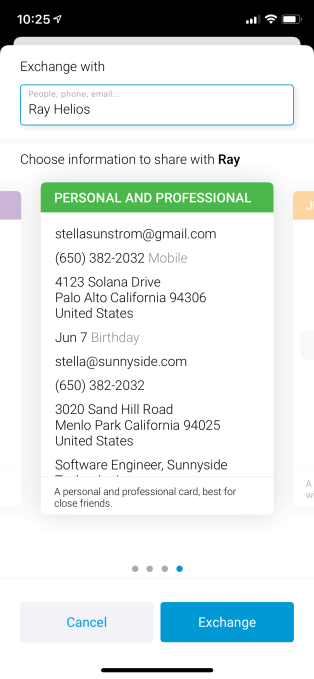
Image Credits: Sunshine

The app also augments contact cards with information acquired by other means. For example, it may use the information you do have to complete missing fields — like adding a last name, when you had other data that indicated what someone’s full name is, but hadn’t completed filling out the card. The app may also be able to pull in data from a LinkedIn profile, if available.

For home addresses, Sunshine is using the Whitepages API.

The company confirmed to TechCrunch it’s augmenting contact cards with home addresses under some circumstances, even if that contact is not a Sunshine Contacts user. Sunshine says it doesn’t believe this to be any different from a user going to Google to look for someone’s contact information on the web — it’s just automating the process.

Of course, some would argue when you’re talking about automating the collection of home addresses for hundreds or potentially thousands of users — depending on the size of your personal address book database — it’s a bit different than if you went googling to find your aunt’s address so you can mail a Christmas card or called your old college roommate to find out where to send their birthday gift.

However, Sunshine clarified to TechCrunch that it won’t add the home address except in cases when it determines you have a personal connection to the contact in question.

Here, though, Sunshine enters a gray area where the app and its technology will try to figure out who you know well enough to need a home address.

Before adding the address, Sunshine requires you to have the contact’s phone number on file in your address book, not just their email. That would eliminate some people you only have a loose connection with through work, for instance. And it only updates with the home address if the partner API is able to associate that address with a phone number you have.
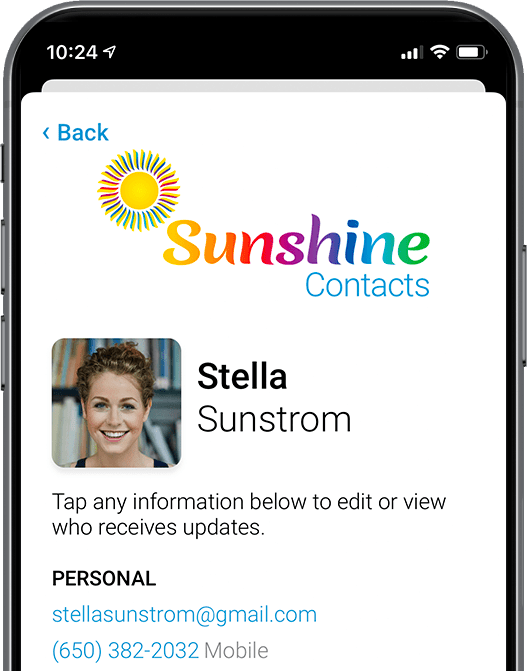
Image Credits: Sunshine

In addition, Sunshine says that it’s generally able to understand the type of phone number you have on file — like if it’s a residential or business line, or if it’s a landline or mobile number. (It uses APIs to do this, similar to StrikeIron’s though not that particular one.) It also knows who the phone number belongs to. Using this information and further context, the app tries to determine if a phone number is a personal or a professional number and it will try to understand your relationship with the person who owns that number.

In practice, what this means is that if all the information you had on file for a contact was professional information — where they worked, a job title, a work email and a phone number, perhaps — then that person’s contact card would not be updated to include their home address, too.

And because many people use their personal cell for work, Sunshine won’t consider someone a “personal” relationship just because you have their mobile phone number. For example, if you had only a contact’s name and a cell number, you wouldn’t be able to use the app to get their home address.

The result of all this automated analysis is that Sunshine, in theory, only updates contact cards with home addresses where it’s determined there’s a personal relationship.

This, of course, doesn’t take into account some scenarios like bad exes, stalking or a general desire for privacy. Arguably, there are times when someone may have a lot of personal information for a contact in their address book, but the contact in question would rather not have their home address distributed to that person.

The only way to prevent this, presumably, would be to opt out at the source: Whitepages.com. (Once you have your profile URL from the Whitepages website, you can use this online form to have your information suppressed.)
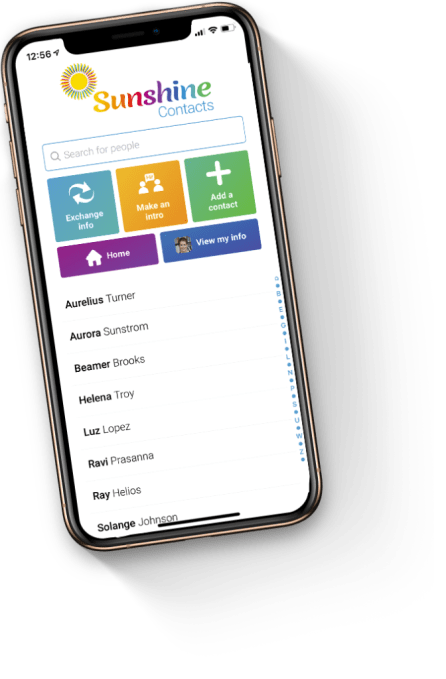
Image Credits: Sunshine

The way the app functions raises questions about what is truly private information these days.

Sunshine points out that people’s home addresses are not as hidden from the world as they may think, which makes them fair game.

It’s true that our home addresses are often publicly available. Although it’s been years since most of us have had a telephone directory dropped on our doorstep with phone and address listings for people in our city, home addresses today are relatively trivial to find when you know where to look online.

In addition to public records — like voter registration databases — there are web-based people finders, too.

Sunshine’s partner, Whitepages.com, makes visitors pay for its data, but others like TruePeopleSearch.com don’t have the same paywall. With someone’s first and last name and city, its website provides access to someone’s home address, prior addresses, cell phone, age and the names of family members and other close associates. (TruePeopleSearch is not a Sunshine partner, we should clarify.)

Even though this data is “public,” it’s uncomfortable to see it casually distributed in an app, as that makes it even easier to get to than before.

Plus, after years of being burned by data breaches and data privacy scandals, people tend to be more protective of their personal information than before. And, had they been asked, many would probably decline to have their home addresses shared with Sunshine’s user base. Generally speaking, people appreciate the courtesy of having someone come ask for a home address, when it’s needed — they may not want an app creeping the web to find it and hand it out.

Sunshine Contacts is in an invite-only beta in the U.S., so the company has time to reconsider how this feature is implemented based on user feedback before it becomes widely available.


from RSSMix.com Mix ID 8176981 https://techcrunch.com/2020/12/08/sunshine-contacts-may-have-given-out-your-home-address-even-if-youre-not-using-the-app/
http://www.gadgetscompared.com
from Tumblr https://ikonografico.tumblr.com/post/636969523416793088
via http://www.gadgetscompared.com

Monday, December 7, 2020

Tinder makes it easier to report bad actors using ‘unmatch’ to hide from victims

Last month, Bumble introduced a new feature that would prevent bad actors from using the dating app’s “unmatch” feature to hide from victims. Now Tinder has done something similar. The company announced on Friday it will soon roll out an update to its app that will make it easier for users to report someone who has used the unmatch feature in an effort to get away with their abuse. But in Tinder’s case, it’s only making it easier for users to learn how to report the violation, rather than giving the victims a button in the chat interface to report the abuse more directly.

Tinder notes that users have always been able to report anyone on the app at any time — even if the person had used the unmatch feature. But few users likely knew how to do so, since there weren’t obvious explanations in the app’s user interface about how to report a chat after it disappeared.

With the update, Tinder says it will soon add its “Safety Center” shield icon within the Match List, where the chats take place. This will direct users to the Safety Center in the app, where they can learn how to report users who aren’t displayed on the Match List because they used the unmatch feature.

Image Credits: Tinder

The updates to both Tinder and Bumble came about following an investigation by the Australian Broadcasting Corporation, which found that 48 out of 231 survey respondents who had used Tinder said they had reported other users for some kind of sexual offense. But only 11 of those reports had received any replies, and even fewer offered specific information about what was being done.

The story had also explained how bad actors would take advantage of the dating app’s “unmatch” feature to hide from their victims. After unmatching, their chat history would disappear from the victim’s phone, which would have allowed the user to more easily report the abuse to Tinder or even to law enforcement, if needed.

Though Tinder was the focus of the story, Bumble quickly followed up to say it was changing how unmatching on its app would work. Instead of having the chat disappear when unmatched, Bumble users are now shown a message that says the other person has ended the chat. Here, they’re given the option to also either delete the chat or report it.

The ability to report the chat directly from the messaging inbox is what makes Bumble’s solution more useful. Tinder, on the other hand, is just redirecting users to what’s essentially its help documentation — the Tinder Safety Center — to learn how to go about making such a report. The addition of this extra step could end up being a deterrent to making these reports, as it’s less straightforward than simply clicking a button that reads “Report.”

Tinder also didn’t address the other issues raised by the investigation, which said many reports lacked follow-up or clear information about what actions Tinder was taking to address the issues.

Instead, the company says that it will continue to acknowledge when reports are received to let the member making the report know an appropriate action will be taken. Tinder added it will also direct users to trained resources for crisis counseling and survivor support; remove accounts it finds have been reported for violent crimes; and will continue to work with law enforcement on investigations, when required. These actions, however, should be baseline features for any dating app, not points of pride.

Tinder stressed, too, that it would not remove the unmatch feature, which is necessary for safety and privacy of its members. That seems to miss the point of what users’ complaints were about. Tinder users were not angry or concerned that an unmatching feature existed in the first place, but that it was being used by bad actors to avoid repercussions for their abuse.

The company didn’t say precisely when the changes to the dating app would roll out, beyond the “coming weeks.”

Today, Tinder parent company also announced a partnership with RAINN, a large anti-sexual violence organization, to conduct “a comprehensive review of sexual misconduct reporting, moderation, and response across Match Group’s dating platforms” and “to work together to improve current safety systems and tools.”

The organization will review Tinder, Hinge, and Plenty of Fish to determine what best practices should be. Match says the partnership begins today and will continue through 2021.

“Every person deserves safe and respectful experiences, and we want to do our part to create safer communities on our platforms and beyond,” said Tracey Breeden, Head of Safety and Social Advocacy for Match Group, in a statement. “By working together with courageous, thought-leading organizations like RAINN, we will up level safety processes and strengthen our responses for survivors of sexual assault. Safety challenges touch every corner of society. We are committed to creating actionable solutions by working collaboratively with experts to innovate on meaningful, industry-led safety approaches,” she added.


from RSSMix.com Mix ID 8176981 https://techcrunch.com/2020/12/07/tinder-makes-it-easier-to-report-bad-actors-using-unmatch-to-hide-from-victims/
http://www.gadgetscompared.com
from Tumblr https://ikonografico.tumblr.com/post/636878912959447040
via http://www.gadgetscompared.com

Saturday, December 5, 2020

This Week in Apps: The year’s best apps, 2020’s biggest downloads, the App Store’s newest hire

Welcome back to This Week in Apps, the TechCrunch series that recaps the latest in mobile OS news, mobile applications and the overall app economy.

The app industry is as hot as ever, with a record 204 billion downloads and $120 billion in consumer spending in 2019. People now spend three hours and 40 minutes per day using apps, rivaling TV. Apps aren’t just a way to pass idle hours — they’re also a big business. In 2019, mobile-first companies had a combined $544 billion valuation, 6.5x higher than those without a mobile focus.

This week, Apple and Google announced their editorially curated lists detailing the best apps of the year, and Apple also revealed those that were downloaded the most. Apple also made a notable new hire for an App Store role and opened up its anticipated App Store Small Business Program to developers.

Top Stories

Best Apps of the Year

Image Credits: Apple

Both Apple and Google released their “best apps of 2020” year-end lists and there were some similarities between the two, as well as some differences. Both companies’ lists reflected the tough and stressful year 2020 has been, with everyone being stuck at home during a pandemic that changed how we worked, attended school, connected with friends and family, and entertained ourselves.

Apple and Google, as a result, both selected at least one “de-stressing” app among their year-end winners. In Apple’s case, it was Endel, an iOS app that won for Apple Watch App of the Year. Google, however, awarded sleep app LoĂłna the title of best app of the year.

Disney+ also made both Apple and Google’s lists, the former as Apple TV App of the Year and the latter as the User’s Choice for app of the year. The new streaming service was a godsend for families with younger children, who often struggled in 2020 to keep kids entertained. New releases like Onward and Mulan in 2020 helped give families something to look forward to, while Marvel and Star Wars content, including new series “The Mandalorian,” were hits with streamers, as well.

Another pandemic-prompted choice was Zoom, which won as iPad App of the Year. Though Zoom was around before the coronavirus outbreak, it’s now become a part of our everyday lexicon as an interchangeable term for “online video meeting” — as in, “let’s do a zoom call about that.” The iPad app at least made these endless virtual meetings a little less painless.

And home workout companion Wakeout! become Apple’s iPhone app of the year, as most people gave up the gym due to coronavirus risks. The app’s quick one-minute breaks helped users stay moving, even when stuck at home for days on the couch or working on their laptop in bed.

Image Credits: Genshin Impact (screenshot via Sensor Tower)

Meanwhile, gacha-based action role-playing game Genshin Impact won as “best game” of the year on both Apple and Google’s lists. While a cynical take is that the app stores wanted to point users to a huge moneymaker — the game reportedly earned $245 million its first month and nearly $400 million in two months on mobile — it also highlights consumers’ desire for console-like experiences on mobile.

The game, however, has been heavily criticized for its gacha game monetization techniques, which though common to games in China, Japan and South Korea, are basically gambling mechanics. And addictive ones at that. But as a Wired report noted, some of this comes down to cultural differences. U.S. users grew up on cartridge games, not arcade games, where you were constantly inserting more money to keep playing. Western users just aren’t as comfortable with this “spend to keep playing” business model, which they feel is predatory.

Apple’s other top apps of the year included perennial favorite Fantastical as Apple’s Mac App of the Year; Legends of Runeterra as iPad Game of the Year; Disco Elysium as Mac Game of the Year; Dandara Trials of Fear as Apple TV Game of the Year; and Sneaky Sasquatch as the Apple Arcade Game of the Year.

Google’s list also included SpongeBob: Krusty Cook-Off as users’ choice for best game, and it highlighted a variety of top titles in various gaming subgenres in a dedicated section of its Play Store.

2020’s most downloaded apps

Apple also gave a peek into the “best” apps of the year, as determined by app downloads. The pandemic played a role here as well, making Zoom the most-downloaded iPhone app of 2020.

Also of note, TikTok was the biggest social media app by downloads, ahead of all the Facebook-owned apps making the list, including Facebook, Instagram and Messenger. Square’s Cash App hit No. 10, as the pandemic saw increased demand for contactless payments and direct giving to people in need.

The most-downloaded apps and games of 2020 were, as follows:

Top Free iPhone Apps

  1. ZOOM Cloud Meetings
  2. TikTok
  3. Disney+
  4. YouTube
  5. Instagram
  6. Facebook
  7. Snapchat
  8. Messenger
  9. Gmail
  10. Cash App

Top Paid iPhone Apps

  1. TouchRetouch
  2. Procreate Pocket
  3. Dark Sky Weather
  4. Facetune
  5. HotSchedules
  6. AutoSleep Track Sleep
  7. The Wonder Weeks
  8. SkyView
  9. Shadowrocket
  10. Sky Guide

Top Free iPhone Games

  1. Among Us!
  2. Call of Duty: Mobile
  3. Roblox
  4. Subway Surfers
  5. Ink Inc. – Tattoo Drawing
  6. Magic Tiles 3: Piano Game
  7. Brain Test: Tricky Puzzles
  8. Brain Out
  9. Coin Master
  10. Cube Surfer!

Top Paid iPhone Games

  1. Minecraft
  2. Plague Inc.
  3. Heads Up!
  4. Monopoly
  5. Bloons TD6
  6. Geometry Dash
  7. NBA 2K20
  8. Grand Theft Auto: San Andreas
  9. The Game of Life
  10. True Skate

Top Free iPad Apps

  1. ZOOM Cloud Meetings
  2. Disney+
  3. YouTube
  4. Netflix
  5. Google Chrome
  6. TikTok
  7. Amazon Prime Video
  8. Gmail
  9. Hulu
  10. Google Classroom

Top Paid iPad Apps

  1. Procreate
  2. GoodNotes 5
  3. Notability
  4. Duet Display
  5. Teach Your Monster
  6. LumaFusion
  7. Affinity Designer
  8. Toca Hair Salon 3
    9: Toca Life: Hospital
  9. Toca Kitchen 2

Top Free iPad Games

  1. Among Us!
  2. Roblox
  3. Magic Tiles 3: Piano Game
  4. Ink Inc. – Tattoo Drawing
  5. Call of Duty: Mobile
  6. Subway Surfers
  7. Dancing Road: Color Ball Run!
  8. Tiles Hop – EDM Rush
  9. Mario Kart Tour
  10. Save The Girl!

Top Paid iPad Games

  1. Minecraft
  2. Monopoly
  3. Bloons TD 6
  4. Plague Inc.
  5. Geometry Dash
  6. The Game of Life
  7. Five Nights at Freddy’s
  8. Human: Fall Flat
  9. Stardew Valley
  10. Terraria

Top Arcade Games

  1. Sneaky Sasquatch
  2. Hot Lava
  3. Skate City
  4. Sonic Racing
  5. PAC-MAN Party Royale
  6. SpongeBob: Patty Pursuit
  7. Oceanhorn 2
  8. Crossy Road Castle
  9. WHAT THE GOLF?
  10. LEGO Brawls

Josh Elman joins Apple to focus on App Store discovery 

VC Josh Elman announced this week he was joining Apple in a role that will see him helping customers “discover the best apps for them.” In other words, app discovery.

Elman’s background includes RealNetworks, LinkedIn, Zazzle, Facebook and Twitter, and later moved into VC. Elman worked at venture firm Greylock in 2011 as a principal, and by 2013 he had become a general partner. While there, he invested in SmartThings, as well as social networks like Musical.ly (now the massive No. 2 app of the year, TikTok), Nextdoor, Houseparty and Discord. He later moved to fast-rising fintech startup Robinhood and now, he’s heading to Apple.

Weekly News

Platforms

  • Apple opens up enrollment into the App Store Small Business Program. The program will reduce App Store commissions to 15% for qualified developers with revenues under $1 million.
  • Google announced Android’s winter update will include an expanded Emoji Kitchen in Gboard, auto-narration for Google Play Book without narration, a “Go Tab” in Google Maps for frequent destinations, Android Auto soon arriving in more countries, support for app sharing in Nearby Share and Voice Access improvements.
  • Google launches the first version of Android Studio Arctic Fox (2020.3.1) on the Canary channel, along with Android Gradle plugin (AGP) version 7.0.0-alpha01. The release is also notable for moving to a year-based system more aligned with IntelliJ IDEA, the IDE upon which Android Studio is built. Going forward, the number scheme will work like this: <Year of IntelliJ Version>.<IntelliJ major version>.<Studio major version>. The new version of Android Studio includes over 200 improvements and bugs, including those in the code editor, app inspection tools, layout editor and the embedded emulator.

Services

Security & Privacy

  • Twitter now supports hardware security keys for iPhones and Android.
  • Google Authenticator app for iOS adds a dark theme and support for bulk 2FA account transfers, helpful for switching between devices.
  • Google launches Android Enterprise Essentials, an MDM for SMBs that will require their employees to use a lock screen and encryption to protect company data and can remotely wipe devices. It also prevents users from installing apps outside the Google Play Store via the Google Play Protect service.

Accessibility

  • iPhones can now automatically recognize and label buttons and UI features for blind users using Screen Recognition in iOS 14.
  • Android’s winter update, similarly, will introduce a new version of Voice Access that will use ML to understand interface labels and buttons on devices.

Apps in the News

  • Google now lets anyone contribute to Google Maps’ Street View using the Street View app and Android phone that supports ARCore.
  • Telegram is the first third-party app to use Apple’s Announce Messages with Siri feature for AirPods.
  • Google adds the messaging feature every iMessage user dreams of: the ability to schedule sending of messages in Google’s Messages app.
  • Reddit reveals DAUs for first time: 52 million.
  • Google Assistant can now reply to messages from WhatsApp, Google Voice and more.
  • Google Maps gets a Facebook-like news feed with business updates, local reviews and more.
  • TikTok tests three-minute long videos. (But we don’t need longer versions of its viral hits like M to the B).
  • Triller claims 321 million downloads and 65 million MAUs. (Former employees have accused the TikTok rival of inflating its numbers, which Triller denies.)
  • Evernote rolls out a redesign on Android. The updates include a new note editor, faster search and improved navigation.
  • Google’s learn-to-code app Grasshopper is now available in Spanish.
  • WhatsApp will now allow users to set custom wallpapers, adds doodle wallpaper in more colors and adds new stickers.
  • E-commerce app Wish accused of selling counterfeit products. 
  • 7-Eleven adds its own mobile wallet to its app to allow customers, including cash customers, a contactless way to pay at its stores using their phone.
  • Match-owned dating app Hinge refreshes design and adds a “Standouts” feature to show users outstanding prompts and photo prompts from their best potential matches, and can answer with a new paid feature, Roses.
  • Quibi is really gone now.

Trends

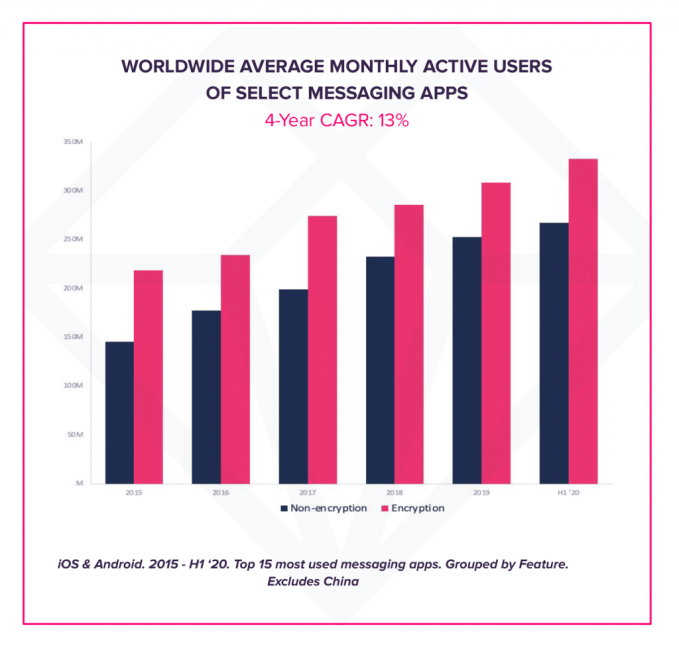
Image Credits: App Annie

  • App download rates have declined by 4% since 2015, but active engagement has grown.
  • Messaging app usage is up 13% (four-year CAGR), and users spend 67% more time in messaging apps than in social media apps.
  • Messaging apps that offer privacy features see, on avgerage, 30% more active users than alternatives.
  • Q3 smartphone sales down 5.7% in Q3 to 366 million.
  • Mobile shopping climbed 25% on Black Friday to $3.6 billion. 
  • U.S. shopping app downloads on Black Friday reached a record 2.8 million per Sensor Tower, or 2.7 million per App Annie. App Annie also said shopping shopping app downloads topped 2.3 million on Thanksgiving and 2.1 million on Cyber Monday.
  • On Black Friday, Walmart was the No. 1 U.S. shopping app download, followed by Amazon. On Cyber Monday, that was reversed, also per App Annie.
  • In-app revenue was 150% higher on Black Friday than the average of the previous 30 days, says AppsFlyer.
  • App Store and Google Play consumer spending topped $100 billion from January 1-November 29, Sensor Tower says.

Funding and M&A

  • Salesforce buys Slack for $27.7 billion.
  • VSCO acquires the tech and team from the AI-powered video editing app Trash to move further into the video market. Deal terms weren’t available, but Trash was backed by $3.3 million.
  • Teen banking app Step raises $50 million. The app is TikTok star Charli D’Amelio’s first startup investment. Other investors included lead Coatue; returning investors from Stripe, Crosslink Capital, Collaborative Fund and Will Smith’s Dreamers VC; and celeb investors D’Amelio, Justin Timberlake and The Chainsmokers, Eli Manning, Kelvin Beachum, Larry Fitzgerald and Andre Iguodala.
  • Ivanti acquired security firms, including enterprise mobile security firm MobileIron and corporate VPN provider Pulse Secure. Ivanti bought MobileIron for $872 million in stock.
  • U.K. challenger banking app Monzo adds £60 million in funding.
  • AR gaming startup Krikey raises undisclosed funding, including from Jio Platforms. The company has raised $22 million to date.
  • Wellory raises $4.5 million for its anti-diet nutrition app.
  • Airbnb to IPO with shares priced between $44 and $50.
  • ESL app for kids Novakid raises $4.25 million.
  • Virtual fitness app Salut raises $1.25 million.
  • Video app Supergreat, a TikTok for beauty products, raises $6.5 million.
  • Mental health app Intellect raises undisclosed round led by Insignia VP.

Review

We tried the Apple Watch Family Setup with a tween. They weren’t impressed with the apps or the controls, but did like the Memoji. No Roblox group chat on the small screen? Boo.

Downloads

Iconboard

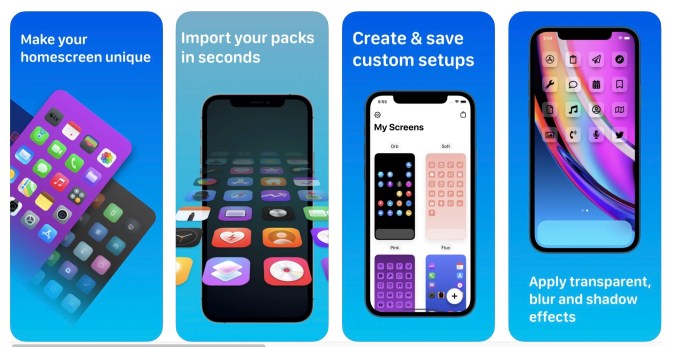
Image Credits: Iconboard

If you find it too frustrating to use Apple’s Shortcuts to build your own custom icons, you can turn to Iconboard instead. This newly launched app lets you design a style for your icons and apply it to all of your icons at once. It can even create invisible icons to give you a way to space out items on your screen.

Cardlet

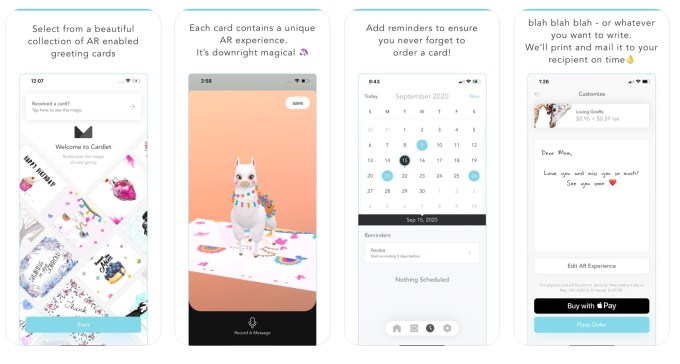
Image Credits: Cardlet

While I’ve been enjoying Punkpost’s custom designs for when I’m too lazy…err I mean busy…to send my own handwritten notes and cards, Cardlet is ready to give my go-to app a run for the money. Like Punkpost, Cardlet will send a real paper card on your behalf, but it adds a modern-day touch: The app includes a hidden AR experience that brings the card to life when viewed with the camera.

Heynote

Image Credits: Heynote

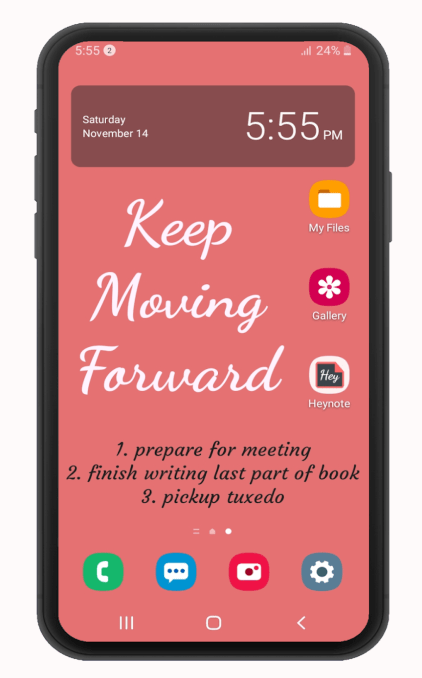
Some people don’t trust to-do lists, reminders or calendar notifications to always get the job done. When there’s something we really need to remember, we stick it directly on our home screen. (Okay, this one may only appeal to a small niche of scatterbrained users like me.) But if you have, in the past, also designed your own temporary wallpaper just so you won’t forget a super critical appointment, the Android app Heynote, (hat tip to Android Police!) might help. Instead of a widget or reminder, this app lets you put custom text directly on your home screen as a custom wallpaper. Doctor appt. at 11 AM? You can’t forget it when it’s there every single time you look at your phone.


from RSSMix.com Mix ID 8176981 https://techcrunch.com/2020/12/05/this-week-in-apps-the-years-best-apps-2020s-biggest-downloads-the-app-stores-newest-hire/
http://www.gadgetscompared.com
from Tumblr https://ikonografico.tumblr.com/post/636693950833557504
via http://www.gadgetscompared.com

Thursday, December 3, 2020

Android’s winter update adds new features to Gboard, Maps, Books, Nearby Share and more

Google announced this morning Android phones will receive an update this winter that will bring some half-dozen new features to devices, including improvements to apps like Gboard, Google Play Books, Voice Access, Google Maps, Android Auto, and Nearby Share. The release is the latest in a series of update bundles that now allow Android devices to receive new features outside of the usual annual update cycle.

The bundles may not deliver Android’s latest flagship features, but they offer steady improvements on a more frequent basis.

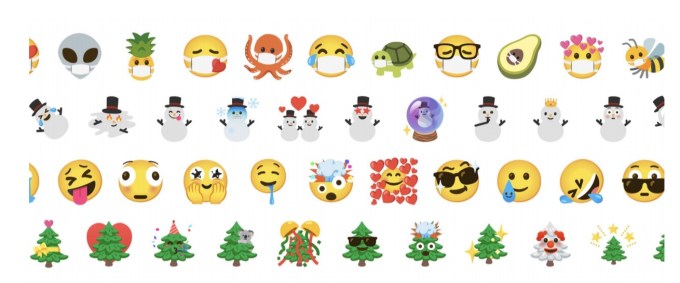
One of the more fun bits in the winter update will include a change to “Emoji Kitchen,” the feature in the Gboard keyboard app that lets users combine their favorite emoji to create new ones that can be shared as customized stickers. To date, users have remixed emoji over 3 billion times since the feature launched earlier this year, Google says. Now, the option is being expanded. Instead of offering hundreds of design combinations, it will offer over 14,000. You’ll also be able to tap two emoji to see suggested combinations or double tap on one emoji to see other suggestions.

Image Credits: Google

This updated feature had been live in the Gboard beta app, but will now roll out to Android 6.0 and above devices in the weeks ahead.

Another update will expand audiobook availability on Google Play Books. Now, Google will auto-generate narrations for books that don’t offer an audio version. The company says it worked with publishers in the U.S. and U.K. to add these auto-narrated books to Google Play Books. The feature is in beta but will roll out to all publishers in early 2021.

An accessibility feature that lets people use and navigate their phone with voice commands, Voice Access, will also be improved. The feature will soon leverage machine learning to understand interface labels on devices. This will allow users to refer to things like the “back” and “more” buttons, and many others by name when they are speaking.

The new version of Voice Access, now in beta, will be available to all devices worldwide running Android 6.0 or higher.

An update for Google Maps will add a new feature to one of people’s most-used apps.

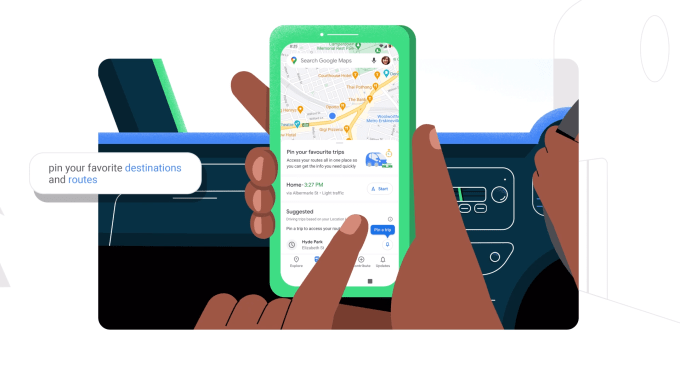
In a new (perhaps Waze-inspired) “Go Tab,” users will be able to more quickly navigate to frequently visited places — like a school or grocery store, for example — with a tap. The app will allow users to see directions, live traffic trends, disruptions on the route, and gives an accurate ETA, without having to type in the actual address. Favorite places — or in the case of public transit users, specific routes — can be pinned in the Go Tab for easy access. Transit users will be able to see things like accurate departure and arrival times, alerts from the local transit agency, and an up-to-date ETA.

Image Credits: Google

One potentially helpful use case for this new feature would be to pin both a transit route and driving route to the same destination, then compare their respective ETAs to pick the faster option.

This feature is coming to both Google Maps on Android as well as iOS in the weeks ahead.

Android Auto will expand to more countries over the next few months. Google initially said it would reach 36 countries, but then updated the announcement language as the timing of the rollout was pushed back. The company now isn’t saying how many countries will gain access in the months to follow or which ones, so you’ll need stay tuned for news on that front.

Image Credits: Google

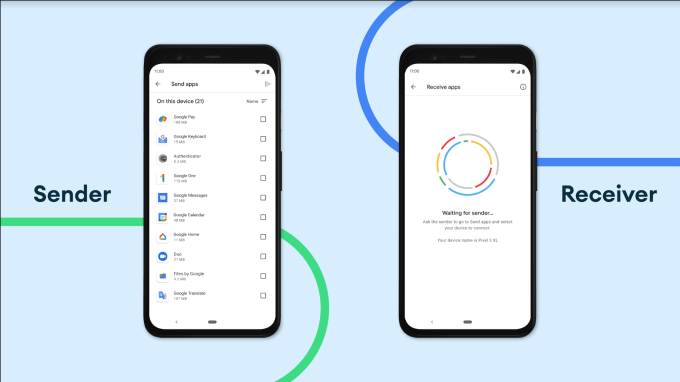
The final change is to Nearby Share, the proximity-based sharing feature that lets users share things like links, files, photos and and more even when they don’t have a cellular or Wi-Fi connection available. The feature, which is largely designed with emerging markets in mind, will now allow users to share apps from Google Play with people around them, too.

To do so, you’ll access a new “Share Apps” menu in “Manage Apps & Games” in the Google Play app. This feature will roll out in the weeks ahead.

Some of these features will begin rolling out today, so you may receive them earlier than a timeframe of several “weeks,” but the progress of each update will vary.


from RSSMix.com Mix ID 8176981 https://techcrunch.com/2020/12/03/androids-winter-update-adds-new-features-to-gboard-maps-books-nearby-share-and-more/
http://www.gadgetscompared.com
from Tumblr https://ikonografico.tumblr.com/post/636520289621180416
via http://www.gadgetscompared.com

iPhones can now automatically recognize and label buttons and UI features for blind users

Apple has always gone out of its way to build features for users with disabilities, and Voiceover on iOS is an invaluable tool for anyone with a vision impairment — assuming every element of the interface has been manually labeled. But the company just unveiled a brand new feature that uses machine learning to identify and label every button, slider, and tab automatically.

Screen Recognition, available now in iOS 14, is a computer vision system that has been trained on thousands of images of apps in use, learning what a button looks like, what icons mean, and so on. Such systems are very flexible — depending on the data you give them, they can become expert at spotting cats, facial expressions, or as in this case the different parts of a user interface.

The result is that in any app now, users can invoke the feature and a fraction of a second later every item on screen will be labeled. And by “every,” they mean every — after all, screen readers need to be aware of every thing that a sighted user would see and be able to interact with, from images (which iOS has been able to create one-sentence summaries of for some time) to common icons (home, back) and context-specific ones like “…” menus that appear just about everywhere.

The idea is not to make manual labeling obsolete — developers know best how to label their own apps, but updates, changing standards, and challenging situations (in-game interfaces, for instance) can lead to things not being as accessible as they could be.

I chatted with Chris Fleizach from Apple’s iOS accessibility engineering team, and Jeff Bigham from the AI/ML accessibility team, about the origin of this extremely helpful new feature. (It’s described in a paper due to be presented next year.)

“We looked for areas where we can make inroads on accessibility, like image descriptions,” said Fleizach. “In iOS 13 we labeled icons automatically – Screen Recognition takes it another step forward. We can look at the pixels on screen and identify the hierarchy of objects you can interact with, and all of this happens on device within tenths of a second.”

The idea is not a new one, exactly; Bigham mentioned a screen reader, Outspoken, which years ago attempted to use pixel-level data to identify UI elements. But while that system needed precise matches, the fuzzy logic of machine learning systems and the speed of iPhones’ built-in AI accelerators means that Screen Recognition is much more flexible and powerful.

It wouldn’t have been possibly just a couple years ago — the state of machine learning and the lack of a dedicated unit for executing it meant that something like this would have been extremely taxing on the system, taking much longer and probably draining the battery all the while.

But once this kind of system seemed possible, the team got to work prototyping it with the help of their dedicated accessibility staff and testing community.

“VoiceOver has been the standard bearer for vision accessibility for so long. If you look at the steps in development for Screen Recognition, it was grounded in collaboration across teams — Accessibility throughout, our partners in data collection and annotation, AI/ML, and, of course, design. We did this to make sure that our machine learning development continued to push toward an excellent user experience,” said Bigham.

It was done by taking thousands of screenshots of popular apps and games, then manually labeling them as one of several standard UI elements. This labeled data was fed to the machine learning system, which soon became proficient at picking out those same elements on its own.

It’s not as simple as it sounds — as humans, we’ve gotten quite good at understanding the intention of a particular graphic or bit of text, and so often we can navigate even abstract or creatively designed interfaces. It’s not nearly as clear to a machine learning model, and the team had to work with it to create a complex set of rules and hierarchies that ensure the resulting screen reader interpretation makes sense.

The new capability should help make millions of apps more accessible, or just accessible at all, to users with vision impairments. You can turn it on by going to Accessibility settings, then VoiceOver, then VoiceOver Recognition, where you can turn on and off image, screen, and text recognition.

It would not be trivial to bring Screen Recognition over to other platforms, like the Mac, so don’t get your hopes up for that just yet. But the principle is sound, though the model itself is not generalizable to desktop apps, which are very different from mobile ones. Perhaps others will take on that task; the prospect of AI-driven accessibility features is only just beginning to be realized.


from RSSMix.com Mix ID 8176981 https://techcrunch.com/2020/12/03/iphones-can-now-automatically-recognize-and-label-buttons-and-ui-features-for-blind-users/
http://www.gadgetscompared.com
from Tumblr https://ikonografico.tumblr.com/post/636520288112230400
via http://www.gadgetscompared.com