Thursday, September 6, 2018

Robinhood aims at IPO as the fintech startup seeks CFO

Now valued at $5.6 billion, zero-fee stock trading app and cryptocurrency exchange Robinhood is starting preparations to go public. Just a year and a half ago, it was still largely under the radar. But then it raised a $110 million Series C at a $1.3 billion valuation in April 2017 and then just a year later scored a $363 million Series D, both led by Russian firm DST Global. Combined with the growth of its premium subscription for trading on margin called Robinhood Gold, the startup now has the firepower and revenue to make a viable Wall Street debut.

Today during Robinhood CEO Baiju Bhatt’s talk at TechCrunch Disrupt SF, he revealed that his company is on the path to an IPO and has begun its search for a chief financial officer. It’s also undergoing constant audits from the SEC, FINRA and its security team to make sure everything is kosher and locked up tight.

The CFO hire could help the five-year-old Silicon Valley startup pitch itself as the cheaper youthful alternative to E*Trade and traditional stock brokers. They’d also have to convince potential investors that even though cryptocurrency prices are in a downturn, allowing people to trade them for cheaper than competitors like Coinbase is a powerful user acquisition funnel.

Robinhood now has 5 million customers tracking, buying and selling stocks, options, ETFs, American depositary slips receipts of international companies and cryptos like Bitcoin and Ethereum. That’s twice as many customers as its incumbent competitor E*Trade despite it having 4,000 employees compared to Robinhood’s 250.

The startup has raised a total of $539 million to date from prestigious investors like Andreessen Horowitz, Kleiner Perkins, Sequoia and Google’s Capital G, allowing it to rapidly roll out products before its rivals can react. This rapid rise in valuation can go to some founders’ heads, or crush them under the pressure, but Bhatt cited “friendship” with his co-CEO Vlad Tenev as what keeps him sane.

The startup has three main monetization streams. First, it earns interest on money users keep in their Robinhood account. Second, it sells order flow to stock exchanges that want more liquidity for their traders. And it sells Robinhood Gold subscriptions which range from $10 per month for $2,000 in extra buying power to $200 per month for $50,000 in margin trading, with a 5 percent APR charged for borrowing over that. Gold was growing its subscriber count at 17 percent per month earlier this year, showing the potential of giving trades away for free and then charging for extra services.

But Robinhood is also encountering renewed competition as both startups and incumbents wise up. European banking app Revolut is building a commission-free stock trading, and Y Combinator startup Titan just launched its app that lets you buy into a  managed portfolio of top stocks. Finance giant JP Morgan now gives customers 100 free trades in hopes of not being undercut by Robinhood.

Over on the crypto side, Coinbase continues to grow in popularity despite its 1.4 percent to 4 percent fees on trades. It’s rapidly expanding its product offering and the two fintech startups are destined to keep clashing. Robinhood may also be suffering from the crypto downturn, which is likely dissuading the mainstream public from dumping cash into tokens after seeing people lose fortunes as Bitcoin and Ethereum’s prices tumbled this year.

There’s also the persistent risk of a security breach that could tank Robinhood’s brand. Meanwhile, the startup uses both human and third-party software-based systems to moderate its crypto chat rooms to make sure pump and dump schemes aren’t running rampant. Bhatt says he’s proud of making cryptocurrency more accessible, though he didn’t say he felt responsible for prices plummeting, which could mean many of Robinhood Crypto’s users have lost money.
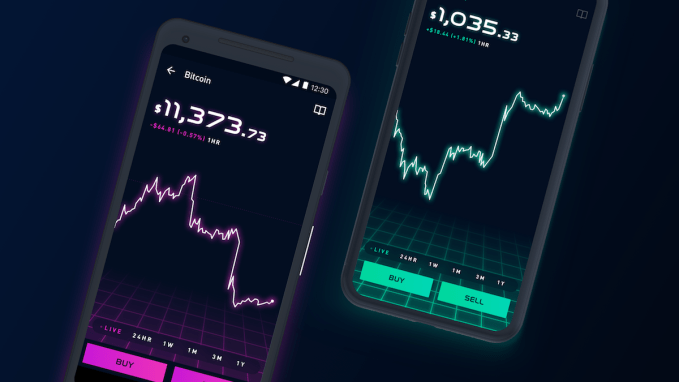
Fundamentally, Robinhood is using software to make the common but expensive behavior of stock trading much cheaper and more accessible to a wider audience. Traditional banks and brokers have big costs for offices and branches, trading execs and TV commercials. Robinhood has managed to replace much of that with a lean engineering team and viral app that grows itself. Once it finds its CFO, that could give it an efficiency and growth rate that has Wall Street seeing green.


from RSSMix.com Mix ID 8176981 https://techcrunch.com/2018/09/06/robinhood-ipo/
http://www.gadgetscompared.com
from Tumblr http://ikonografico.tumblr.com/post/177817858741
via http://www.gadgetscompared.com

Fido Alliance adds a biometrics certification program to help fight spoofing

In a move aimed at upping standards across biometric user verification systems, the industry consortium, Fido Alliance, has launched a certification program for biometrics systems.

“The goal of the Biometric Certification Component Program is to provide a framework for the certification of biometric subsystems that can in turn be integrated into FIDO Certified authenticators,” it writes on its website.

While biometric verification systems such as fingerprint readers have been pretty widely adopted in the mobile space already — with Apple introducing its fingerprint biometric, Touch ID, to the iPhone a full five years ago; followed, last fall, by a facial recognition biometric (Face ID) for its high end iPhone X — the Alliance says that, up to now, there hasn’t been a standardized way to validate the accuracy and reliability of biometric recognition systems in the commercial marketplace. Which is where it’s intending the new certification program to come in.

While few would doubt the robustness of Apple’s biometrics components (and testing regime), the sprawlingly diverse Android marketplace hosts all sorts of OEM players — which inevitably raises the risk of some lesser quality components (and/or processes) slipping in.

And in recent years there have been plenty of examples of poorly implemented biometrics, especially in the mobile space — with hackers easily able to crack into various Android devices that were using facial or iris recognition technology in trivially bypassable ways.

In 2017, for example, Chaos Computer Club members used a print out of an eye combined with a contact lens to fox iris scanners on the Samsung Galaxy S8. And that was one of the most sophisticated biometric hacks. Others have just required a selfie of the person to be held up in front of a ‘face unlock’ system to get an easy open sesame.

Where the not-for-profit Alliance comes in — an industry group whose board includes security exec reps from the likes of Amazon, Google and Microsoft, among others — is it’s on a mission to reduce reliance on passwords for digital security because they inject friction into the online experience.

And biometrics do tend to be convenient, given they are attached to each person. Which is why they have been increasingly finding their way into smartphones and all sorts of other consumer electronics — from wearables to car tech, helped by component costs shrinking as biometrics adoption grows.

But it’s no good trying to speed up ID verification if the alternatives being reached for are badly implemented — and end up actively damaging security.

It certainly doesn’t have to be that way.

Apple’s biometrics are not so easily mocked. And while Touch ID is vulnerable to spoofing, like pretty much any fingerprint reader, its depth-mapping Face ID tech is by far the most sophisticated biometric implementation in the consumer electronics space to date. And hasn’t been meaningfully hacked (well, barring attacks by identical twins/strikingly similar looking family members).

So there’s clearly a world of difference (and, well, cost) between a well architected biometric recognition system which puts security considerations front and center, vs the awful sloppy stuff we’ve seen in recent years — where OEMs were just rushing to compete.

Biometrics has certainly often been treated more as a convenience gimmick for device marketing purposes, rather than viewed as a route to evolve (and even potentially enhance) device security.

The Alliance’s certification program is using accredited independent labs to test that biometric subcomponents meet what it dubs “globally recognized performance standards for biometric recognition performance and Presentation Attack Detection (PAD)” — and thus that they are “fit for commercial use”.

PAD refers to various methods that can be used to try to attack and circumvent biometric systems, such as using silicon or gelatine fingerprints, or deploying harvested facial or video imagery of the device owner.

So it looks like the Alliance’s hope for the program is to ‘upskill’ biometric implementations — or at least weed out the really stupid stuff.

“For customers, such as regulated online service providers, OEMs and enterprises, it provides a standardized way to trust that the biometric systems they are relying upon for fingerprint, iris, face and/or voice recognition can reliably identify users and detect presentation attacks,” it writes.

Speed is another goal too, as it says prior to this certification program due diligence was carried out by enterprise customers (or at least by those “who had the capacity to conduct such reviews”) — which required biometric vendors to repeatedly prove performance for each customer.

Whereas going forward vendors can use the program to test and certify just once to validate their system’s performance and re-use that third-party validation across the market — gaining what the Alliance bills as” substantial time and cost savings”.

Commenting in a statement, Brett McDowell, executive director of the Alliance, said: “While border control and law enforcement markets have mature assessment programs for their biometric systems, we were surprised that no such program existed for this rapidly growing consumer market.”

“With biometrics being a popular option for mobile and web applications implementing Fido Authentication, there is a growing need for those service providers to appropriately assess the risk of fraud from lost or stolen devices,” he added.

Currently only one lab has been accredited to perform components testing for the program.

The lab, iBeta, is located in the U.S. but a spokeswoman for the Fido Alliance told us: “The Alliance is actively working to bring in additional labs.”

She added that the Alliance will update this list as more are added.


from RSSMix.com Mix ID 8176981 https://techcrunch.com/2018/09/06/fido-alliance-adds-a-biometrics-certification-program-to-help-fight-spoofing/
http://www.gadgetscompared.com
from Tumblr http://ikonografico.tumblr.com/post/177807833666
via http://www.gadgetscompared.com

Wednesday, September 5, 2018

Stealthy wants to become the WeChat of blockchain apps

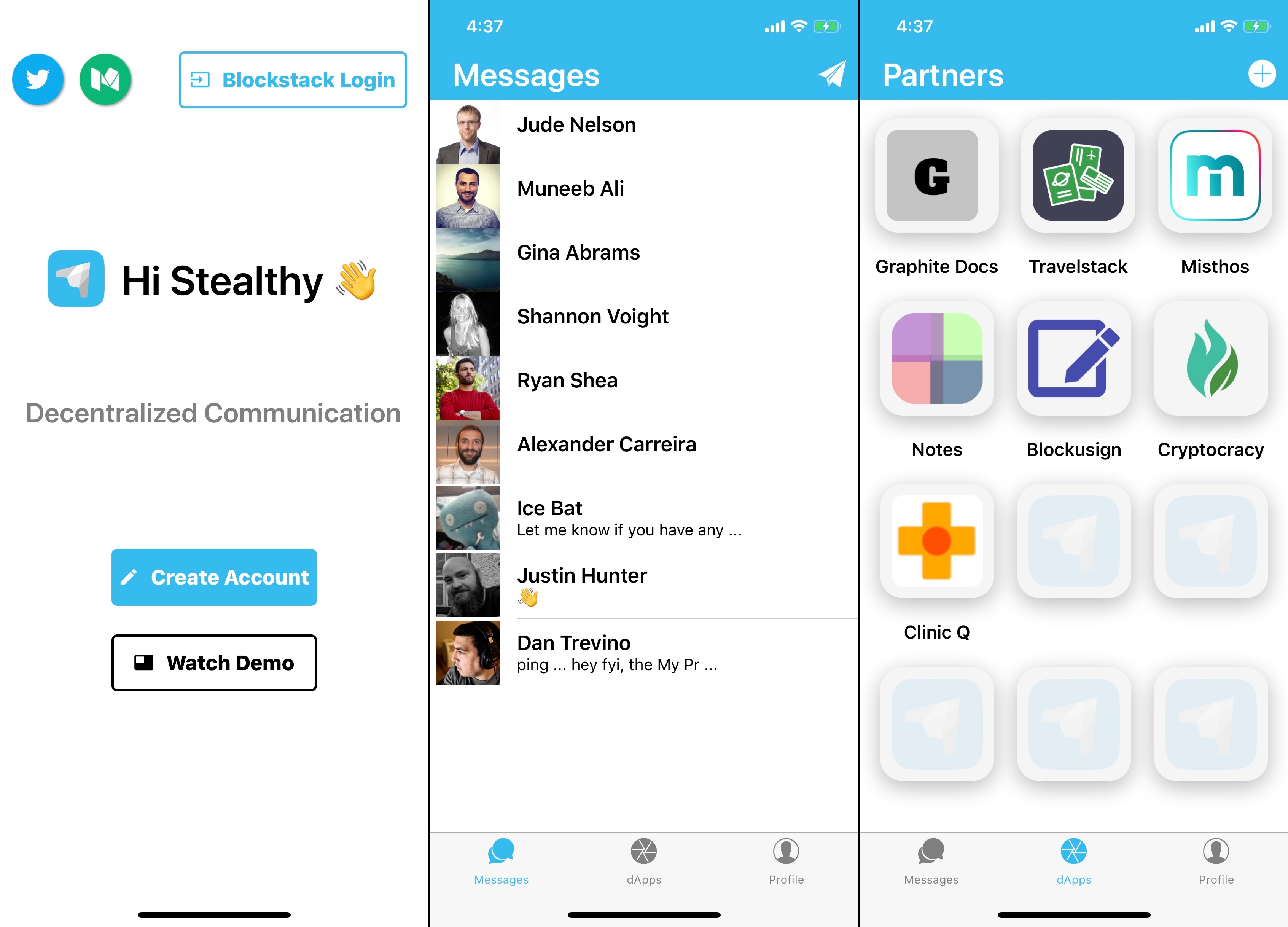
Meet Stealthy a new messaging app that leverages Blockstack’s decentralized application platform to build a messaging app. The company is participating in TechCrunch’s Startup Battlefield at Disrupt SF and launching its app on iOS and Android today.

On the surface, Stealthy works like many messaging apps out there. But it gets interesting once you start digging to understand the protocol behind it. Stealthy is a decentralized platform with privacy in mind. It could become the glue that makes various decentralized applications stick together.

“We started Stealthy because Blockstack had a global hackathon in December of last year,” co-founder Prabhaav Bhardwaj told me. “We won that hackathon in February.” After that, the #deletefacebook movement combined with the overall decentralization trend motivated Bhardwaj and Alex Carreira to ship the app.

Blockstack manages your identity. You get an ID and a 12-word passphrase to recover your account. Blockstack creates a blockchain record for each new user. You use your Blockstack ID to connect to Stealthy.

Stealthy users then choose how they want to store their messages. You can connect your account with Dropbox, Amazon Web Services, Microsoft Azure, etc.

Every time you message someone, the message is first encrypted on your device and sent to your recipient’s cloud provider. Your recipient can then open the Stealthy app and decrypt the message from their storage system.

All of this is seamless for the end user. It works like an iMessage conversation, which means that Microsoft or Amazon can’t open and read your messages without your private key. You remain in control of your data. Stealthy plans to open source their protocol and mobile product so that anybody can audit their code.

Some features require a certain level of centralization. For instance, Stealthy relies on Firebase for push notifications. If you’re uncomfortable with that, you can disable that feature.

The company also wants to become your central hub for all sorts of decentralized apps (or dapps for short). For instance, you can launch Graphite Docs or Blockusign from Stealty. Those dapps are built on top of Blockstack as well, but Stealthy plans to integrate with other dapps that don’t work on Blockstack.

“We have dapp integrations in place right now and we want to make it easier to add dapp integrations. If somebody wants to come in and start selling messaging stickers, you could do that. If you want to come in and implement a payment system to pay bloggers, you could do that,” Bhardwaj said. “Eventually, what we want to be is to make it as easy as submitting an app in the App Store.”

When you build a digital product, chances are you’ll end up adding a messaging feature at some point. You can chat in Google Docs, Airbnb, Venmo, YouTube… And the same is likely to be true with dapps. Stealthy believes that many developers could benefit from a solid communication infrastructure — this way, other companies can focus on their core products and let Stealthy handle the communication layer.

Stealthy is an ambitious company. In many ways, the startup is trying to build a decentralized WeChat with the encryption features of Signal. It’s a messaging app, but it’s also a platform for many other use cases.

A handful of messaging apps have become so powerful that they’ve become a weakness. Governments can block them or leverage them to create a social ranking. Authorities can get a warrant to ask tech companies to hand them data. And of course, the top tech companies have become too powerful. More decentralization is always a good thing.


from RSSMix.com Mix ID 8176981 https://techcrunch.com/2018/09/05/stealthy-wants-to-become-the-wechat-of-blockchain-apps/
http://www.gadgetscompared.com
from Tumblr http://ikonografico.tumblr.com/post/177783759991
via http://www.gadgetscompared.com
AnchorFree, maker of Hotspot Shield, raises $295 million in new funding

AnchorFree, a maker of a popular virtual private networking app, has raised $275 million in a new round of funding, the company announced Wednesday.

The Redwood City, Calif.-based app maker’s flagship app Hotspot Shield ranks as one of the most popular VPN apps on the market. The app, based on a freemium model, allows users across the world tunnel their internet connections through AnchorFree’s servers, which masks users’ browsing histories from their internet providers and allows those under oppressive regimes evade state-level censorship.

The app has 650 million users in 190 countries, the company said, and also has a business-focused offering.

The funding was led by WndrCo, a holding company focusing on consumer tech businesses, in addition to Accel Partners, 8VC, SignalFire, and Green Bay Ventures, among others.

“The WndrCo team brings deep operational experience in launching and scaling global tech products, and we look forward to working closely with them in pursuit of our mission to provide secure access to the world’s information for every person on the planet,” said AnchorFree’s chief executive David Gorodyansky in remarks.

The news was first reported by The New York Times.


from RSSMix.com Mix ID 8176981 https://techcrunch.com/2018/09/05/anchorfree-maker-of-hotspot-shield-raises-295-million-in-new-funding/
http://www.gadgetscompared.com
from Tumblr http://ikonografico.tumblr.com/post/177772576361
via http://www.gadgetscompared.com
Snapchat adds new styles as Spectacles V2s get used 40% more than V1

Snapchat isn’t revealing sales numbers of version 2 of its Spectacles camera sunglasses, but at least they’re not getting left in a drawer as much as the V1s. The company tells me V2 owners are capturing 40 percent more Snaps than people with V1s.

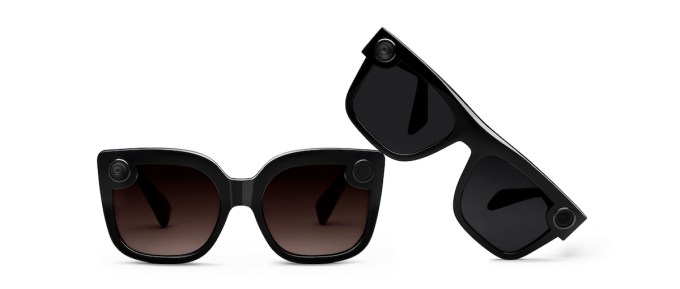
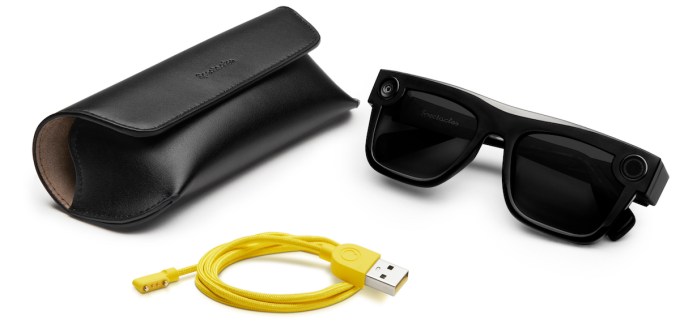
And today, Snapchat is launching two new black-rimmed hipster styles of Spectacles V2 — a Wayfarer-esque Nico model and a glamorous big-lensed Veronica model. Both come with a slimmer semi-soft black carrying case instead of the chunky old triangular yellow one, and are polarized for the first time. They look a lot more like normal sunglasses, compared to the jokey, bubbly V1s, so they could appeal to a more mature and fashionable audience. They go on sale today for $199 in the US and Europe and will be sold in Neiman Marcus and Nordstrom later this year, while the old styles remain $149.

The new Spectacles styles (from left): Veronica and Nico

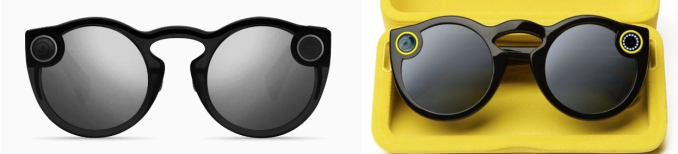
Spectacles V2 original style (left) and V1 (right)

Snap is also trying to get users to actually post what they capture, so it’s planning an automatically curated Highlight Story feature that will help you turn your best Specs content into great things to share. That could address the problem common amongst GoPro users of shooting a ton of cool footage but never editing it for display.

The problem is that V1 were pretty exceedingly unpopular, and those that did buy them. Snap only shipped 220,000 pairs and reportedly had hundreds of thousands more gathering dust in a warehouse. It took a $40 million write-off and its hardware “camera company” strategy was called into question. Business Insider reported that less than 50 percent of buyers kept using them after a month and a “sizeable” percentage stopped after just a week.

The new styles come with a slimmer semi-soft carry case

That means the bar was pretty low from which to score a 40 percent increase in usage, especially given the V2s take photos, work underwater, come in a slimmer charging case, and lack the V1s’ bright yellow ring around the camera lens that announces you’re wearing a mini computer on your face. Snap was smart to finally let you export in non-circular formats which are useful for sharing beyond Snapchat, and let you automatically save Snaps to your camera roll and not just its app’s Memories feature.

I’ve certainly been using my V2s much more than the V1s since they’re more discrete and versatile. And I haven’t encountered as much fear or anxiety from people worried about being filmed as privacy norms around technology continue to relax.

But even with the improved hardware, new styles, and upcoming features, Spectacles V2 don’t look like they’re moving the needle for Snapchat. After shrinking in user count last quarter, Snap’s share price has fallen to just a few cents above its all-time low. Given most of its users are cash-strapped teens who aren’t going to buy Spectacles even if they’re cool, the company needs to focus on how to make its app for everyone more useful and differentiated after the invasion of Instagram’s copy-cats of its Stories and ephemeral messaging.

Whether that means securing tentpole premium video content for Discover, redesigning Stories to ditch the interstitials for better lean-back viewing, or developing augmented reality games, Snap can’t stay the course. Despite its hardware ambitions, it’s fundamentally a software company. It has to figure out what makes that software special.


from RSSMix.com Mix ID 8176981 https://techcrunch.com/2018/09/05/spectacles-v2-nico-veronica/
http://www.gadgetscompared.com
from Tumblr http://ikonografico.tumblr.com/post/177769376836
via http://www.gadgetscompared.com
Monday, September 3, 2018

TikTok adds video reactions to its newly-merged app

Just about a month after the merger of the short-form video apps Musical.ly and TikTok, the app is introducing a new social feature, allowing users to post their reactions to the videos that they watch.

Instead of text comments, these reactions will take the form of videos that are essentially superimposed on top of existing clips. The idea of a reaction video should be familiar to anyone who’s spent some time on YouTube, but TikTok is incorporating the concept in way that looks like a pretty seamless.

To post a reaction, users just need to choose the React option in the Share menu for a given video. The app will then record your audio and video as the clip plays. You can also decide where on the screen you want your reaction video to appear.

If you don’t recognize the TikTok name, that’s probably because the app only launched in the United States at the beginning of August, but it’s been available in China for a couple of years.

TikTok Reactions

Back in 2017, Bytedance — the Chinese company behind TikTok as well as news aggregator Toutia — acquired Musical.ly for around $1 billion. It eventually merged the two apps to combine their audiences and features; Musical.ly users were moved over with their existing videos and settings.

The company says Reactions will be available in the updated app on Google Play and the Apple App Store over the next day or two.


from RSSMix.com Mix ID 8176981 https://techcrunch.com/2018/09/03/tiktok-reactions/
http://www.gadgetscompared.com
from Tumblr http://ikonografico.tumblr.com/post/177712519046
via http://www.gadgetscompared.com

Skype rolls back its redesign by ditching stories, squiggles and over-the-top color

Just over a year after Skype introduced a colorful, Snapchat-inspired makeover which included its own version of “stories,” the company says it’s now going to refocus on simplicity – and it’s ditching stories along the way. The redesign had been met with a lot of backlash. Skype had clearly wanted to appeal to a more youthful demographic with its update, but in doing so, it cluttered the user experience with features no one had asked for or needed.

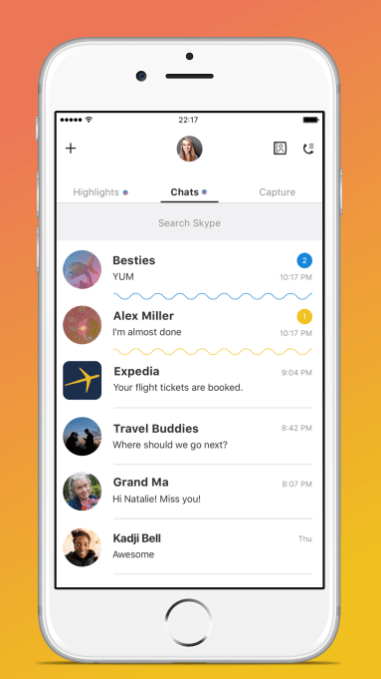
One of these was “Highlights,” a feature that was very much Skype’s own take on Snapchat’s or Instagram’s Stories. With Highlights, Skype users were able to swipe up to pull up their smartphone’s camera, then snap a photo or record a video that could be decorated with typed or handwritten text, as well as with Skype’s own set of stickers. This could then be shared with individual Skype users, groups, or posted to the Highlights section of the app.

Above: Skype on mobile

The company had argued at the time that the rise of stories across social media meant it was something that all social apps would adopt. And because it was the way people were used to interacting now, Skype needed to include the feature in its own app, too.

But stories, as it turns out, may not be as ubiquitous or as in-demand as a “news feed” interface – there are places it makes sense, and those where it does not. Skype is the latter.

In its announcement, Microsoft admitted that the changes it had introduced weren’t working.

“Calling became harder to execute and Highlights didn’t resonate with a majority of users,” wrote Peter Skillman, Director of Design for Skype and Outlook.

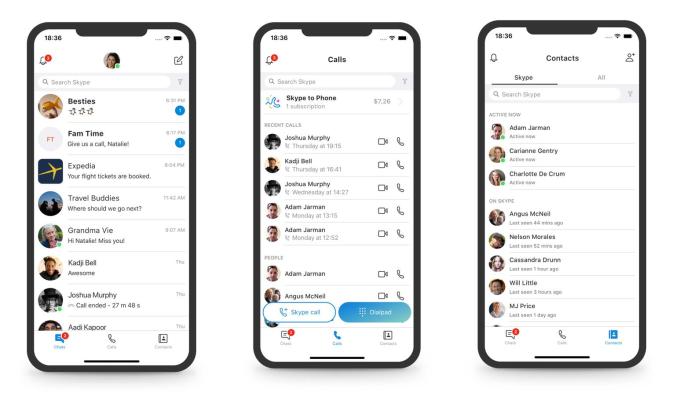
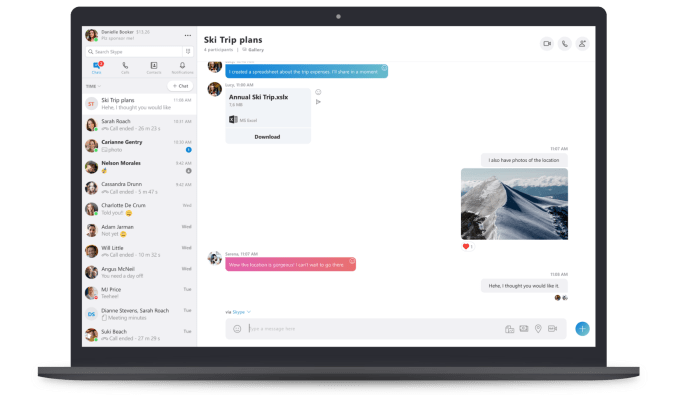
Instead, the app is introducing a simpler navigation model where there are now just three buttons at the bottom of the mobile app – Chats, Calls, and Contacts. Highlights and Capture are both gone. (If you actually used Highlights, you have until September 30 to download them to save them before the feature is removed).

There were already some hints Microsoft was planning to dial back its design changes. It recently announced it was keeping Skype Classic (Skype 7) around for an extended period of time, after its plans to shut the app down was met with overwhelming user outcry. It said then that it would gather more feedback to find out what it is that people wanted before forcing the upgrade to Skype 8.0.

With the new desktop version of Skype, the company now says it’s moving the Chats, Calls, Contacts, and Notifications to the top left of the window to make it easier for long-time Skype users to understand.

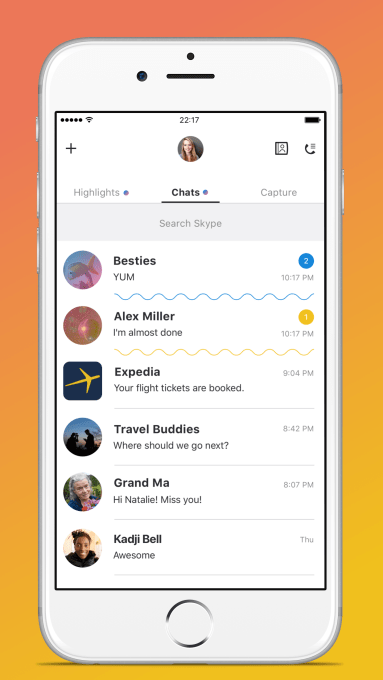
Skype also toned down its over-the-top use of color in the app and introduced a Skype “Classic” blue theme adjusted for contrast and readability. It yanked out some of its goofier decorative elements, as well, like the notifications with a squiggle shape cut out, which it admits “weren’t core to getting things done.” (Ya think?)

Below: Squiggles 

While it’s good that Skype is now listening to users – it says it’s testing new prototypes across global markets and it launched a UserVoice site – it’s concerning that it had not done enough listening beforehand. If it had, it wouldn’t have released a version of its app that bombed.

Skype should embrace its “classic” status, and not feel the need to play catch-up with teen chat apps like Snapchat, or social media trends like stories. People use Skype to get things done – calling faraway friends, placing work calls, and even recording podcasts. Being a simple and stable voice and video calling app is one that can retain loyal users over time, and attract those who need to communicate across platforms without all the fluff found elsewhere.

The latest design is available in Skype version (8.29) for Android, iOS, OS X, Linux, and Windows 7, 8 & 8.1 operating systems.


from RSSMix.com Mix ID 8176981 https://techcrunch.com/2018/09/03/skype-rolls-back-its-redesign-by-ditching-stories-squiggles-and-over-the-top-color/
http://www.gadgetscompared.com
from Tumblr http://ikonografico.tumblr.com/post/177697437226
via http://www.gadgetscompared.com