Tuesday, October 30, 2018

How to watch the live stream for Apple’s iPad and Mac keynote

Apple is holding a keynote today at the Brooklyn Academy of Music’s Howard Gilman Opera House, and the company is expected to unveil a brand new iPad Pro as well as updated Mac computers. The event starts at 10 AM in New York (7 AM in San Francisco, 2 PM in London, 3 PM in Paris), you’ll be able to watch the event as the company is streaming it live.

If you live in Europe and already put a note in your calendar, make sure you got the time right as daylight saving time has yet to happen in the U.S. New York is currently 4 hours behind London, 5 hours behind Paris, etc.

Apple is likely to unveil a new iPad Pro to replace the 10.5-inch and 12.9-inch iPad Pro. Rumor has it that it’ll look nothing like your current iPad. The device should get rounded corners, thinner bezels and a Face ID sensor. Apple could also switch to USB-C instead of Lightning and refresh the Apple Pencil.

On the Mac front, the MacBook Air could get a refresh. This could be Apple’s new entry-level laptop. But it should sport a retina display for the first time. There could also be a new Mac Mini of some sort after all those years without an update.

Finally, maybe Apple will tell us why the AirPower charging mat is still not available. Apple might also update the AirPods. But maybe it’ll happen later.

If you have a recent Apple TV, you can download the Apple Events app in the App Store. It lets you stream today’s event and rewatch old events. Users with pre-App Store Apple TVs can simply turn on their devices. Apple is pushing out the “Apple Events” channel so that you can watch the event.

And if you don’t have an Apple TV, the company also lets you live-stream the event from the Apple Events section on its website. This video feed now works in all major browsers — Safari, Google Chrome, Mozilla Firefox and Microsoft Edge.

So to recap, here’s how you can watch today’s Apple event:

  • On iOS: Safari.
  • On the Mac: Safari, Google Chrome or Mozilla Firefox.
  • On Windows: Google Chrome, Mozilla Firefox or Microsoft Edge.
  • An Apple TV with the Apple Events app in the App Store.

Of course, you also can read TechCrunch’s live blog if you’re stuck at work and really need our entertaining commentary track to help you get through your day. We have a big team in the room this year.

Apple Fall Event 2018


from RSSMix.com Mix ID 8176981 https://techcrunch.com/2018/10/30/apple-ipad-pro-mac-macbook-air-keynote-live-stream-livestream/
http://www.gadgetscompared.com
from Tumblr http://ikonografico.tumblr.com/post/179590267881
via http://www.gadgetscompared.com

Monday, October 29, 2018

iHeartRadio is coming to Mexico

iHeartMedia announced today that its streaming radio app iHeartRadio is coming to Mexico. In fact, a beta version of the app is already live, with plans for an official launch on November 3.

As part of this launch, the company is partnering with Mexican broadcaster Grupo ACIR, which owns the Amor, Mix and La Comadre radio brands. iHeartRadio México will include all 56 Grupo ACIR and 850 iHeartMedia broadcast radio stations.

The app will also offer digital-only stations from both companies, as well as English- and Spanish-language podcasts. (iHeartMedia is getting more serious about podcasts, as indicated by its recent acquisition of the parent company behind HowStuffWorks.)

The launch is timed to coincide with iHeartRadio Fiesta Latina in Miami, and the broadcasters are promoting the partnership with a contest for one Grupo ACIR listener to win a VIP trip to the event.

“This partnership will allow us to better connect with our audience by delivering an incredible free music listening experience and providing amazing technology to our users and partners,” said Grupo ACIR CEO Antonio Ibarra in the announcement.

At launch, the app won’t include some of iHeartRadio’s other features, like on-demand music streaming. Chief Product Officer Chris Williams said this follows the roadmap the company used when launching in markets like Australia, Canada and New Zealand — it starts out with live radio and podcasts, because negotiating for international streaming rights takes time.

“It’s faster for me to develop and release the app, get it out there and get adoption, establish what we are and who we are,” Williams said. “Then we can get the rights and add the functionality.”


from RSSMix.com Mix ID 8176981 https://techcrunch.com/2018/10/29/iheartradio-mexico/
http://www.gadgetscompared.com
from Tumblr http://ikonografico.tumblr.com/post/179573543786
via http://www.gadgetscompared.com

YC-backed Observant uses the iPhone’s infrared depth sensors to analyze user emotions

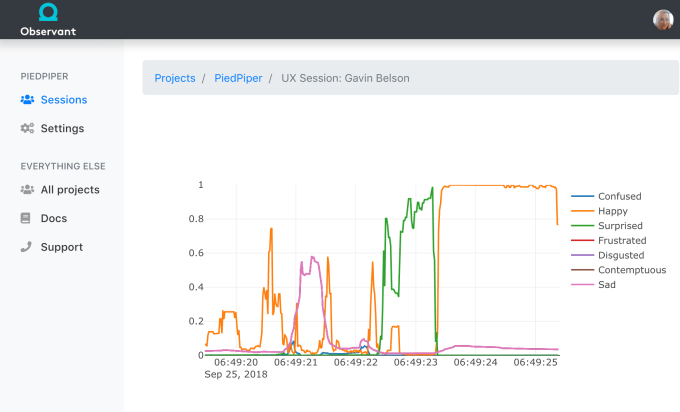
Observant has found a new way to use the fancy infrared depth sensors included on the iPhone X, XS and XR: analyzing people’s facial expression in order to understand how they’re responding to a product or a piece of content.

Observant was part of the winter batch of startups at accelerator Y Combinator, but was still in stealth mode on Demo Day. It was created by the same company behind bug-reporting product Buglife, and CEO Dave Schukin said his team created it because they wanted to find better ways to capture user reactions.

We’ve written about other startups that try to do something similar using webcams and eye tracking, but Schukin (who co-founded the company with CTO Daniel DeCovnick) argued that those approaches are less accurate than Observant’s — in particular, he argued that they don’t capture subtler “microexpressions,” and they don’t do as well in low-light settings.

In contrast, he said the infrared depth sensors can map your face in high levels of detail regardless of lighting, and Observant has also created deep learning technology to translate the facial data into emotions in real time.

Observant has created an SDK that can be installed in any iOS app, and it can provide either a full, real-time stream of emotional analysis, or individual snapshots of user responses tied to specific in-app events. The product is currently invite-only, but Schukin said it’s already live in some retail and e-commerce apps, and it’s also being used in focus group testing.

Observant

Of course, the idea of your iPhone capturing all your facial expressions might sound a little creepy, so he emphasized that as Observant brings on new customers, it’s working with them to ensure that when the data is collected, “users are crystal clear how it’s being used.” Plus, all the analysis actually happens on the users’ device, so no facial footage or biometric data gets uploaded.

Eventually, Schukin suggested that the technology could be applied more broadly, whether that’s by helping companies provide better recommendations, introduce more “emotional intelligence” to their chatbots or even detect sleepy driving.

As for whether Observant can achieve those goals when it’s only working on three phones, Schukin said, “When we started working on this almost a year go, the iPhone X was the only iPhone [with these depth sensors]. Our thinking at the time was, we know how Apple works, we know how this technology propagates over time, so we’re going to place a bet that eventually these depth sensors will be on every iPhone and every iPad, and they’ll be emulated and replicated on Android.”

So while it’s too early to say whether Observant’s bet will pay off, Schukin pointed to the fact that these sensors have expanded from one to three iPhone models as a sign that things are moving in the right direction.


from RSSMix.com Mix ID 8176981 https://techcrunch.com/2018/10/29/observant-launch/
http://www.gadgetscompared.com
from Tumblr http://ikonografico.tumblr.com/post/179573543566
via http://www.gadgetscompared.com

At long last, pet portraits with background blur are possible on the iPhone XR

The new iPhones have some great new photography features, but the XR lacks a couple, for instance portrait mode for non-people subjects, owing to its sadly having only the one camera. So last year! Fortunately third-party camera app Halide is here to help you get that professional-looking bokeh in your doggo shots.

There’s more to this than simply the lack of a second camera. As you know, because you read my article, The future of photography is code — and the present too, really. What’s great about this is that features that might otherwise rely on specific hardware, a chip or sensor, can often be added in software. Not always, but sometimes.

In the case of the iPhone XR, the lack of a second camera means depth data is very limited, meaning the slack has to be taken up with code. The problem was that Apple’s machine learning systems on there are only trained to recognize and create high-quality depth maps of people. Not dogs, cats, plants or toy robots.

People would be frustrated if the artificial background blur inexplicably got way worse when it was pointed at something that wasn’t a person, so the effect just doesn’t trigger unless someone’s in the shot.

The Halide team, not bound by Apple’s qualms, added the capability back in by essentially taking the raw depth data produced by the XR’s “focus pixels” and applying their own processing and blur effect to make sure it doesn’t do weird things. It works on anything that can realistically be separated from the background — pets, toy robots, etc. — because it isn’t a system specific to human faces.

As they write in a blog post explaining some of this at length, the effect isn’t perfect, and because of how depth data is sent from the camera to the OS, you can’t preview the function. But it’s better than nothing at all, and maybe people on Instagram will think you shelled out for the XS instead of the XR (though you probably made the right choice).

The update (1.11) is awaiting Apple approval and should be available soon. If you don’t already own Halide, it costs $6. Small price to pay for a velvety background blur in your chinchilla pics.


from RSSMix.com Mix ID 8176981 https://techcrunch.com/2018/10/29/at-long-last-pet-portraits-with-background-blur-are-possible-on-the-iphone-xr/
http://www.gadgetscompared.com
from Tumblr http://ikonografico.tumblr.com/post/179573543391
via http://www.gadgetscompared.com

The OnePlus 6T is launching on T-Mobile

This year marks an interesting turning point for OnePlus. In December, it will hit the five year mark. The Oppo-backed company has managed to grow significantly in that relatively short window. Back in June, it noted that it had sold one million units of its latest smartphone in the first 22 days.

Continued growth will require some strategic partnerships. In the States, that means partnering with a carrier — after all, most smartphone users still purchase devices through those channels here. Fittingly, along today’s launch of the 6T, OnePlus is announcing its first U.S. carrier partner, T-Mobile.

Why choose the third largest carrier? Here’s what CEO Pete Lau says of the deal, “T-Mobile is the perfect wireless partner for us in the US. The OnePlus 6T clocks some serious speed, and we wanted our customers to unleash it on the fastest network in the nation.”

T-Mobile’s foul mouthed CEO John Legere also notes that somewhere in the neighborhood of 200k OnePlus owners are using their unlocked handsets with the carrier. In addition to whatever sort of deals were worked out between the two companies, T-Mobile’s size offers a good opportunity to help OnePlus grow at a manageable rate. That kind of modest expansion has long been a key to the company’s success.

While other smartphone manufacturers are falling over themselves to one up the competition, OnePlus has focused on offering a solid handset at a decent price. But even $549 looks intimidating to users accustom to purchasing phones at carrier subsidized rates.

The 6T will be available from T-Mobile on November 1 — though folks in New York City can pick one up starting tonight at the T-Mobile store in Times Square.


from RSSMix.com Mix ID 8176981 https://techcrunch.com/2018/10/29/the-oneplus-6t-is-launching-on-t-mobile/
http://www.gadgetscompared.com
from Tumblr http://ikonografico.tumblr.com/post/179562527131
via http://www.gadgetscompared.com

Robby Stein to talk about Instagram beyond Systrom at Disrupt Berlin

Last month, Instagram co-founders CEO Kevin Systrom and CTO Mike Krieger announced that they would be leaving Instagram and Facebook. All eyes are now on Instagram to figure out what’s going to happen to the photo and video app. That’s why I’m excited to announce that Instagram Product Director Robby Stein is joining us at TechCrunch Disrupt Berlin.

Instagram is Facebook’s next big bet. Facebook’s growth has slowed down, which puts even more pressure on Instagram. Compared to Facebook, Instagram is still a relatively young platform. More and more people are joining Instagram and stories are boosting engagement.

Facebook currently has 2.23 billion monthly users while Instagram has 1 billion users. Many people have an active account on both platforms. But does Instagram have what it takes to reach Facebook’s scale?

When it comes to product, Instagram has relentlessly released new features over the past few years. Stories have become a creative playground, stars can share longer videos on IGTV and you can now start group video chats from the app.

It’s impressive to see that such a big platform keeps releasing radical changes that will affect over a billion users. Instagram has been moving incredibly fast. And it’s been key when it comes to fostering growth.

Stein will tell us more about Instagram’s product design strategy and what’s coming up. It’s always interesting to hear the perspective of an insider to analyze product decisions and discuss them.

Before joining Instagram, he was the co-founder and CEO of Stamped, which was acquired by Yahoo back in 2012. Stein started his career at Google. In a short period of time, he managed to work for Google, Facebook and Yahoo, and he also founded his own startup. Quite an impressive resume.

And if you want to hear what it feels like to work for Instagram at a pivotal moment, you should come to Disrupt Berlin. The conference will take place on November 29-30 and you can buy your ticket right now.

In addition to fireside chats and panels, like this one, new startups will participate in the Startup Battlefield Europe to win the highly coveted Battlefield cup.

Robby Stein

Product Director, Instagram

Robby Stein is Product Director at Instagram, where he leads the consumer product team for sharing, which includes Stories, Feed, Live and Direct Messaging. Previously he was the Co-Founder and CEO of Stamped, which was acquired by Yahoo in 2012. At Yahoo, Robby led mobile video products focused around recommended content. He started his career at Google, where he worked to bring new features to market for Gmail and Ad Exchange. He has been recognized on the Forbes 30 under 30 and graduated summa cum laude from Northwestern University.


from RSSMix.com Mix ID 8176981 https://techcrunch.com/2018/10/29/robby-stein-to-talk-about-instagram-beyond-systrom-at-disrupt-berlin/
http://www.gadgetscompared.com
from Tumblr http://ikonografico.tumblr.com/post/179553082511
via http://www.gadgetscompared.com

Thursday, October 25, 2018

Snapchat loses 2M more users, shares sink to new low despite business growth

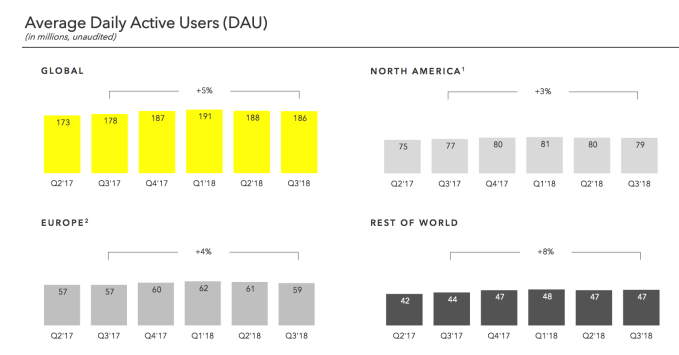
Snapchat continued to shrink in Q3 2018 but its business is steadily improving. Snapchat’s daily active user count dropped again, this time by 1 percent to 186 million, down from 188M and a negative 1.5 percent growth rate in Q2. User count is still up 5 percent year-over-year, though. Snapchat earned $298 million in revenue with an EPS loss of $0.12, beating Wall Street’s expectations of $283 million in revenue and EPS loss of $0.14, plus a loss of a half a million users.
Snap entered earnings with a $6.99 share price, close to its $6.46 all-time low and way down from its $24 IPO opening price. Snap lost $325 million this quarter compared to $353 million in Q2, so it’s making some progress with its cost cutting. That briefly emboldened Wall Street, which pushed the share price up 8.3 percent to around $7.57 right after earnings were announced.

But then Snap’s share price came crashing down to -9.3 percent to $6.31 in after-hours trading. The stock had been so heavily shorted by investors that it only needed modest growth in its business for shares to perk up, but the fear that Snap might shrink into nothing has investors weary. Projections that Snap will lose users again next quarter further scared off investors.

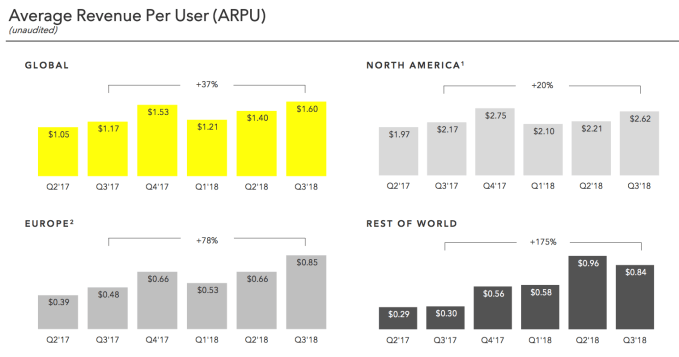
Worringly, Snapchat’s average revenue per user dropped 12.5 percent in the developing world this quarter. But strong gains in the US and Europe markets grew global ARPU by 14 percent. Snap projects $355 million to $380 million in holiday Q4 revenue, in line with analyst estimates.
In his prepared remarks, CEO Evan Spiegel admitted that “While we have incredible reach among our core demographic of 13- to 34-year-olds in the US and Europe, there are billions of people worldwide who do not yet use Snapchat.” He explained that the 2 million user loss was mostly on Android where Snapchat doesn’t run as well as on iOS. Noticibly absent was an update on monthly active users in the US and Canada. Snap said that was 100 million monthly users last quarter, probably in an effort to distract from the daily user shrinkage. Not updating that stat again this time may mean it shrank too.

Spiegel had said in a memo that his stretch goal was break-even this year and full-year profitability in 2019. But CFO Tim Stone said that “Looking forward to 2019, our internal stretch output goal will be an acceleration of revenue growth and full year free cash flow and profitability. Bear in mind that an internal stretch goal is not a forecast, and it’s not guidance.”

During the call, Spiegel responded to questions about the Android overhaul’s schedule saying, “Quality takes time. We’re going wait until we get it right”. But analysts piled on with inquiries about how Snap would turn things around in 2019. Spiegel said that expanding beyond the 13 to 34-year-old age group in the US and Europe, plus scoring more users in the developing world via the improved Android app. He admitted Snaps created per day had dropped from 3.5 billion to 3 billion per day, but tried to reassure investors by saying over 60% of our users are still creating snaps every day.

Now down to $1.4 billion in cash and securities, Snap will need to start reaching more of those international users or improving monetization of those it still has to keep afloat without outside capital.

An Uphill Battle

Q3 saw Snapchat’s launch its first in-house augmented reality Snappable games, while plans for an third-party gaming platform leak.  The Snappable Tic-Tac-Toe game saw 80 million unique users, suggesting gaming could be the right direction for Snap to move towards.

It launched Lens Explorer to draw more attention to developer and creator-built augmented reality experiences, plus its Storyteller program to connect social media stars to brands to earn sponsorship money. It also shut down its Venmo-like Snapcash feature. But the biggest news came from its Q2 earnings report where it announced it’d lost 3 million users. That scored it a short-lived stock price pop, but competition and user shrinkage has pushed Snap’s shares to new lows.

Snapchat is depending on the Project Mushroom engineering overhaul of its Android app to speed up performance, and thereby accelerate user growth and retention. Snap neglected the developing world’s Android market for years as it focused on iPhone-toting US teens. Given Snapchat is all about quick videos, slow load times made it nearly unusable, especially in markets with slower network connections and older phones.

Looking at the competitive landscape, WhatsApp’s Snapchat Stories clone Status has grown to 450 million daily users while Instagram Stories has reached 400 million dailies — much of that coming in the developing world, thereby blocking Snap’s growth abroad as I predicted when Insta Stories launched.. Snap Map hasn’t become ubiquitous, Snap’s Original Shows still aren’t premium enough to drag in tons of new users, Discover is a clickbait-overloaded mess, and Instagram has already copied the best parts of its ephemeral messaging. Snap could be vulnerable in the developing world if WhatsApp similarly copies its disappearing chats.

At this rate, Snap will run out of money before it’s projected to become profitable in 2020 or 2021. That means the company will likely need to sell new shares in exchange for outside investment or get acquired to survive.


from RSSMix.com Mix ID 8176981 https://techcrunch.com/2018/10/25/snapchat-q3-2018-earnings/
http://www.gadgetscompared.com
from Tumblr http://ikonografico.tumblr.com/post/179432893051
via http://www.gadgetscompared.com