Thursday, November 8, 2018

Chrome adds new security features to stop mobile subscription scams

Google today announced that Chrome will soon get a new feature that aims to stop mobile subscription scams. Those are the kind of sites that ask you for your phone number and that then, unbeknownst to you, sign you up for a mobile subscription that’s billed through your carrier. Starting with the launch of Chrome 71 in December, Google will pop up a prominent warning when a site doesn’t make it clear that users are signing up for a mobile subscription.

To make sure that developers who are legitimately using this flow to offer users a subscription don’t get caught up in this new system, Google also published a set of best practices for mobile billing today. Generally, developers are expected to make their billing information visible and obvious to users, display the actual cost and have a simple and straightforward fee structure.

If that information is not available, Google will throw up a prominent full-page warning, but users can always opt to proceed. Before throwing up the warning page, Google will notify webmasters in the Search Console when it detects a potential scam (there’s always a chance for false positives, after all).

This new feature will be available on both mobile and desktop, as well as in Android’s WebView.


from RSSMix.com Mix ID 8176981 https://techcrunch.com/2018/11/08/chrome-adds-new-security-features-to-stop-mobile-subscription-scams/
http://www.gadgetscompared.com
from Tumblr http://ikonografico.tumblr.com/post/179903597756
via http://www.gadgetscompared.com

Wednesday, November 7, 2018

Netflix’s hackathon produces a way to navigate its iOS app with ARKit and Face ID

Netflix’s internal hackathons have consistently produced fun and often silly hacks, from that “Netflixtendo” hack a few years ago that let you run Netflix on the original NES to the more recent “audiobook mode” that turned Netflix series into old-school radio shows by way of Audio Descriptions. This year’s hackathon doesn’t disappoint either, with new hacks that are both as goofy and interesting as in years past, including an AR and Face ID-powered hack that lets you navigate Netflix with just your eyes, another designed for “Sharknado” fans and more.

“Jump to Shark” lets viewers skip right to the good parts of the so-bad-it’s-good “Sharknado,” so they can watch the bloody action sequences with sharks, instead of having to sit through the movie’s actual plot. It’s pretty great, as the video shows.

The AR hack, Eye Nav, is fairly impressive, too.

The hack uses Apple’s ARKit and the technology that enables Face ID for tracking eye position and facial expressions. It tracks your eye position to move a pointer around the screen, then measures the time spent on the same area to trigger a “tap.”

If you want to dismiss a screen, you can just stick your tongue out.

While the resulting hack is definitely fun, there are also implications for accessibility use cases in the future.

The hack was produced in 24 hours, so it may not be stable enough for real-world use, but it’s definitely an interesting idea.

A third hack doesn’t involve Netflix, but rather the productivity software Slack, used by Netflix employees.

“LunchBot” connects co-workers who are too busy to go to lunch, by inviting them to eat lunch together — virtually, while in a Slack chat. The app also checks everyone’s calendars to make sure they’re free.

Other hacks this year included those for product improvements, enhancements to its internal tools and some that were just for fun. A few of these were showcased in its Hackday 2018 video, such as a map for locating studio production resources, an “easy login” system and a version of Animoji using Netflix characters.

But the larger goal of Netflix’s hackathon, as you can probably tell, isn’t necessarily about creating features that will later be productized (although, c’mon…Jump to Shark!), but they sometimes serve as inspiration for features further down the road, the company says.


from RSSMix.com Mix ID 8176981 https://techcrunch.com/2018/11/07/netflixs-hackathon-produces-a-way-to-navigate-its-ios-app-with-arkit-and-face-id/
http://www.gadgetscompared.com
from Tumblr http://ikonografico.tumblr.com/post/179873973061
via http://www.gadgetscompared.com

Tinder doubles down on its casual nature, as Match invests in relationship-focused Hinge

Tinder has never really shaken its reputation among consumers as a “hook up” app, instead of one designed for more serious dating. Now, it seems Tinder is planning to embrace its status as the default app for younger users who aren’t ready to settle down. According to Match Group CEO Mandy Ginsberg, speaking to investors on its Q3 earnings call this morning, Tinder is preparing to launch its first-ever brand marketing campaign that will promote the “single lifestyle” with billboard campaigns and other digital initiatives.

The move is something of an admission that Tinder isn’t working for helping people find long-term relationships.

“Tinder was such a phenomenon when it launched and spread so quickly that the market defined th brand, versus the business defining the brand,” said Ginsberg, referring to its “hook up app” reputation.

“Tinder’s brand particularly resonated with 18 to 25 year-olds because it provides a fun and easy way to meet people. Tinder sometimes gets a bad rap for being casual,” she then admitted. “But keep in mind that people in the late teens and early 20’s are not looking to settle down. It is a time to explore and discover yourself, meeting lots of people and being social.”

Tinder’s new marketing campaign will focus on the “single journey,” the exec said.

The dating app maker has already started publishing content that’s relevant to this “single lifestyle” on its Swipe Life website with stories relating to dating styles, travel, food, and more. For example, some of its recent articles have included things like: “7 Exit Strategies for Terrible Dates,” “Tinder Diaries: Which of these 5 Guys Will Get the Date?,” and “Study Abroad Hookup Confessions.”

Definitely not material for the relationship-minded.
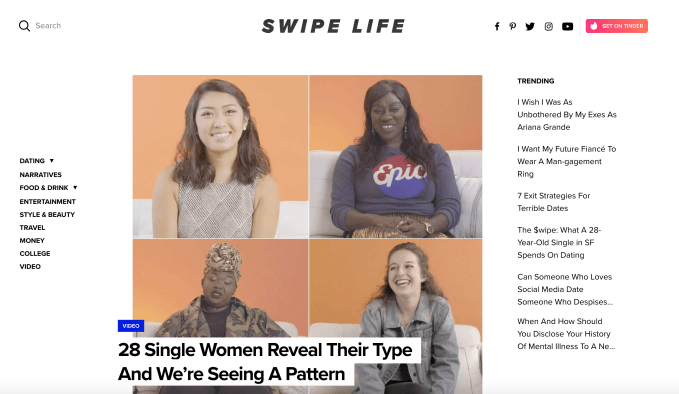
Now, the company will promote Tinder’s “single lifestyle” even further with billboards across major cities throughout the U.S., as well as on digital channels.

The campaign’s goal, explained Ginsberg, is about “further reinforcing how Tinder can enable users to make the most of this fun and adventurous time in their life.”

It’s not difficult to read between the lines here: Tinder’s business model succeeds among people who want to stay single. It succeeds when they’re retained in the app, continually swiping on to the next person they want to meet.

To be fair, Tinder has never really invested in many features that push people to go on dates or exit its app. Instead, it has added addictive features like an in-app news feed – like a social network would have – and tools that enhance in-app chats, like sharing GIFs.

If Tinder was Match’s only dating app, this narrow definition of an app for those embracing their “single lifestyle” would be a problem.
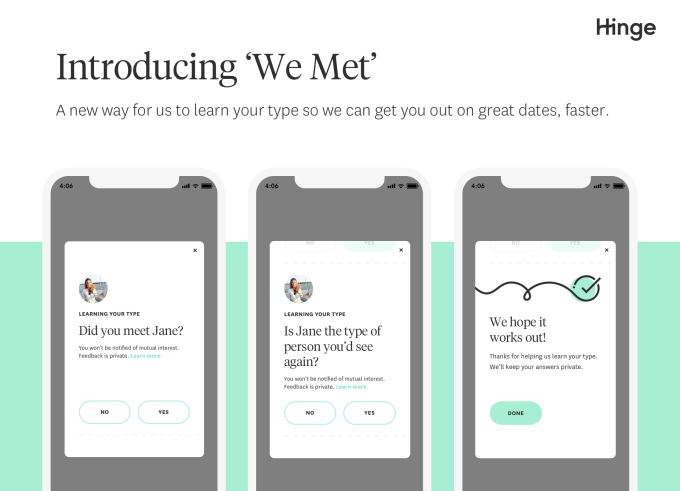
But Match’s strategy has been to diversify its lineup of dating apps. Now it’s a majority owner of dating app Hinge, whose focus has been on helping people get into relationships. In other words, when people are fed up with the ephemeral nature of Tinder, they can just switch apps – while remaining a Match customer, of course!

The company also says it will invest more in Hinge going forward – a move that’s not unrelated to the decisions Match is making around Tinder. 

In fact, in another admission that Tinder wasn’t serving those in search of relationships, Ginsberg said Hinge will help the company to address the “previously underserved” audience of 20-somethings looking for a serious relationship.

She speaks of how Hinge’s user interface is clean and simple, and encourages people to be more thoughtful in their initial conversations. It’s a stark contrast to Tinder, which certainly does not.

Hinge downloads have increased five times since Match invested, the company also noted. It’s gaining traction in major cities throughout the U.S, including New York, as well as in international markets, like London.

The plan is to make Hinge the anti-Tinder, then pull in users as they exit Tinder in search of something real. The company said it’s going to increase the marketing spend on Hinge to drive awareness of the app across the U.S.

“We see a real opportunity to invest meaningful dollars in both products and marketing at hinge to drive long-term growth,” said Ginsberg.

“We think it addresses a great gap in the market,” she continued. “If you think about when Tinder came into the market six years ago, it brought a whole new audience of young users, particularly college-age users. As they start to age…having a product that’s oriented to serious [dating] – but sort of mid-to-late 20’s – is really compelling for us,” she added.

Tinder has evolved over the years from casual dating to include those who are more serious. But with Match’s decision to focus on those not looking for lasting relationships, it risks losing some users going forward. The challenge for the company is to pick them up in another dating app it owns, and not lose them to Bumble…or to an exit from dating apps altogether.


from RSSMix.com Mix ID 8176981 https://techcrunch.com/2018/11/07/tinder-doubles-down-on-its-casual-nature-as-match-invests-in-relationship-focused-hinge/
http://www.gadgetscompared.com
from Tumblr http://ikonografico.tumblr.com/post/179866941246
via http://www.gadgetscompared.com

Tuesday, November 6, 2018

Photomath raises $6 million for its math solving app

Photomath just raised a $6 million funding round from Goodwater Capital with Learn Capital also participating. Photomath has created a hugely successful mobile app for iOS and Android with 100 million downloads so far.

Photomath first launched at TechCrunch Disrupt London back in 2014. The company was working on text recognition technology. Photomath was just a demo app to promote that technology.

But the startup accidentally created a consumer success. The app instantly attracted millions of downloads from many desperate students willing to learn math with their phones.

Years later, the app is still one of the most downloaded apps in the App Store and Play Store. And the reason why it’s been so successful is that it’s a simple concept.

After downloading the app, you just have to point your phone at a math problem. It can be in a book, or it can recognize your own handwriting. The app then gives you a step-by-step explanation to solve this problem.

Combining these two things together is what makes Photomath useful. WolframAlpha can solve equations, and Evernote can recognize your handwriting. But nobody thought about combining these things together.

Typing an equation can be hard, so it makes a ton of sense to bridge the gap between the physical world and smartphones. Before everybody started talking about augmented reality, Photomath was already taking advantage of the system-on-a-chip in your phone.

Photomath is also capable of generating graphs and supports advanced problems, such as limits, integrations, complex numbers, etc. The app solves around 1.2 billion math problems per month.


from RSSMix.com Mix ID 8176981 https://techcrunch.com/2018/11/06/photomath-raises-6-million-for-its-math-solving-app/
http://www.gadgetscompared.com
from Tumblr http://ikonografico.tumblr.com/post/179835335996
via http://www.gadgetscompared.com

Lydia launches mobile phone insurance

French startup Lydia is launching an insurance product for your mobile phone. For €4.29 per month ($4.89), you can insure your phone from the Lydia app.

Lydia is one of the most popular peer-to-peer payment apps in Europe with 1.5 million users. Think about it as a sort of Venmo or Square Cash for Europe. More recently, the company started offering more options to manage your money with a premium subscription and additional features.

While Lydia doesn’t want to replace your bank and insurance company, the company is offering an insurance product for the first time. Lydia is partnering with its investor CNP Assurances — having an insurance company as an investor has a few advantages.

So here’s what you get. You’re instantly covered against cracked screens, liquid damage and accidental damage. There’s no excess but you’re limited to one claim per year. Phones now cost a small fortune, but you’re limited to €500 ($570) per claim.

Optionally, you can subscribe to a better insurance product for €9.99 per month ($11.39). In addition to phone insurance, your laptop, tablet, Nintendo Switch, Kindle, camera and other electronics are covered. You can make two claims per year and you can get back up to €500 for your phone and €1,800 for other devices. More importantly, you’re also covered against theft.

Many phone carriers sell mobile phone insurance. But they usually cost more than that. In most cases, you also need to subscribe for at least one year. In Lydia’s case, you can cancel your subscription whenever you want in the app.

If that product sounds familiar, it’s because Revolut offers a similar feature with some drawbacks. You can subscribe to mobile phone insurance from Revolut’s mobile app.

Pricing isn’t as straightforward with Revolut as Premium subscribers get a discount. For an iPhone X, the insurance product costs as much as €9.58 per month ($10.92) without a Revolut Premium account, or as little as €6.67 per month ($7.60) if you pay upfront and you have a Revolut Premium account.

It’s a 12-month contract with a €125 excess and no theft protection. You also need to start insuring your phone quickly after buying (within six months) otherwise you aren’t covered. Revolut works with Allianz and Simplesurance for this insurance product.

Lydia may have borrowed the idea from Revolut, but I’m not sure why you’d choose Revolut’s insurance product over Lydia’s product.

It’s interesting to see that fintech companies are creating alternative revenue streams with insurance products. Subscribing to an insurance product is quick and painless as they already manage your money and have your card on file.


from RSSMix.com Mix ID 8176981 https://techcrunch.com/2018/11/06/lydia-launches-mobile-phone-insurance/
http://www.gadgetscompared.com
from Tumblr http://ikonografico.tumblr.com/post/179831982156
via http://www.gadgetscompared.com

Monday, November 5, 2018

Instagram prototypes bully-proof moderated School Stories

Instagram is considering offering collaborative School Stories that only a certain school’s students can see or contribute to. And to make sure these Stories wouldn’t become bullying cesspools, Instagram’s code shows a warning that “School stories are manually reviewed to make sure the community is safe.” School Stories could create a fun space for kids to share with their peers beyond the prying eyes of their parents or strangers, though they could also exacerbate teen culture issues around envy and exclusionary social scenes.

The code was first discovered by TechCrunch’s top tipster Jane Manchun Wong. Instagram declined to comment on the record regarding the code, though previous discoveries from its code that it also “no-comment’ed” such as video calling and Nametags went on to officially launch. But typically, Instagram confirms if it’s internally or externally testing features we spot, so if it ever decides to actually launch School Stories, it might not be for months or longer.

Instagram could still scrap the feature rather than having to risk the harassment issues and invest in moderation. Bullying isn’t always obvious namecalling. It can mean excluding certain kids from gatherings, using inside jokes to belittle people, or just purposefully making life look more glamorous than it is. Instagram would have to develop an extraordinarily nuanced rubrick for deciding what’s allowed, and do deep training of moderators to make sure they don’t miss anything. The question will be whether the teen engagement is worth the gamble.

In other news from Wong’s findings, Instagram is also prototyping a URL scheme for Stories so users could share deep links directly to their Stories outside of Instagram. That could be very powerful for influencers, public figures, and brands trying to build their audience with behind-the-scenes and day-to-day Stories content instead of just feed posts that already have URLs.

Instagram declined to comment on Stories URL as well, so again it could be a while before this rolls out if ever. But marketers might especially love the idea of being able to funnel ad clicks or fans of their other social profiles to their Instagram Stories. You could imagine Stories links floating around Twitter, YouTube, and more. Snapchat has neveroffered more than a deep link to user profiles, so this could be a way for Instagram to show it does more than just copy.

Instagram already allows users to contribute to public collaborative Stories around locations and hashtags, while Facebook offers them for Events and Groups. And Facebook Stories recently launched holiday Stories where friends can see collections of each other’s posts for Halloween or other big moments.

School Stories could build on the idea of Instagram sub-networks, which it first started testing last month with universities. Instagram used signals from what you post about, your location, and your network to invite users to join their university’s network. This lets them show off a line in their profile with their school, class year, major, sports team, and/or greek affiliation, and show up in a directory for the school so people could follow them or DM their pending inbox.

Facebook was originally school network-based when it launched in 2004. Users could leave their content visible by default to everyone at their school. While Facebook and Instagram are a lot more careful with privacy these days, School Stories could bring back that feeling of in-group community where users can post things that might be irrelevant or confusing to outsiders.


from RSSMix.com Mix ID 8176981 https://techcrunch.com/2018/11/05/instagram-school-stories/
http://www.gadgetscompared.com
from Tumblr http://ikonografico.tumblr.com/post/179800596661
via http://www.gadgetscompared.com

Saturday, November 3, 2018

Facebook reorganizes Oculus for AR/VR’s long-haul

Facebook is again looking to whip Oculus into shape for its 10-year journey towards making virtual reality mainstream. According to two sources, Facebook reorganized its AR and VR team this week from a divisional structure focused around products to a functional structure focused around technology areas of expertise. While no one was laid off, the change could eliminate redundancies by uniting specialists so they can iterate towards long-term progress rather than being separated into groups dedicated to particular gadgets.

Facebook confirmed the reorg to TechCrunch, with a spokesperson providing this statement: “We made some changes to the AR/VR organization earlier this week. These were internal changes and won’t impact consumers or our partners in the developer community.” Oculus CTO John Carmack and Oculus co-founder/newly-promoted Head of PC VR Nate Mitchell will remain in their leadership positions within VP of AR/VR Andrew ‘Boz’ Bosworth’s hardware wing of the company.

The shift obviously communicates that Facebook believes Oculus could be running more effectively. Organizing the company around areas of expertise rather than broader divisions is probably more appropriate for a moonshot effort that can’t afford redundancies, on the other hand, keeping expertise siloed could isolate new approaches and advancements from reaching other teams. As the company builds out its first full lineup of headsets, there seems to be significant overlap in the tech problems and products bring tackled by those working on mobile and PC products.

TechCrunch reported earlier this week that the company is planning to release a new Rift headset as early as 2019, possibly called the Rift S, which will featured upgraded displays and an inside-out tracking system. The company’s “Rift 2” project, codenamed Caspar, was left behind in the reorganization, a source tells us. We can’t confirm whether any other products or concepts have been shelved.

While an immersive virtual world that users can hang out and communicate in certainly seems to fit Facebook’s broader mission, the company has spent the better part of the past few years deciding how a costly, ambitious venture like Oculus fits into its corporate structure.

First, things went smoothly. The company and its empowered co-founders were building out a developer network and prepping for the launch of their Rift headset after creating a successful partnership with Samsung for the Gear VR. Then, the company’s good fortune turned as the Rift headset was racked by expensive delays and Oculus failed to ship the company’s Touch motion controllers at launch losing some initial ground to HTC. 

By the end of 2016, it was announced that co-founder Brendan Iribe was out as CEO and that the company would be reorganizing around divisions focused on things like PC VR, mobile and content with Xiaomi exec Hugo Barra coming aboard as VP of VR to lead the new effort working directly beneath CEO Mark Zuckerberg. An additional layer of oversight has been built in since then, with Bosworth was put in charge of the company’s consumer hardware ambitions with Oculus as a central pillar. His title is now VP of AR/VR.

The absorption of Oculus deeper into Facebook’s corporate structure was a trend that soon replicated itself as the company looked to rein in the independent teams under a more cohesive vision. The culmination of this was a major executive reshuffle earlier this year that changed the landscape for how divisions within the company were managed.

Now, they’re changing things up even more.

Oculus Go

The new structure sounds like it could coordinate efforts around more general lines like hardware and software allowing insights to flow more intuitively across Facebook’s planned devices.

Given the slow adoption of VR and engineering challenges of AR headsets, which at TechCrunch’s LA conference last month Facebook’s head of AR Ficus Kirkpatrick confirmed it was building, this structure could help Oculus iterate its way to long-term success rather than just getting the next product out the door.

If Facebook is going to beat companies solely focused on AR like Magic Leap, and potential incumbent invaders like Apple if it so chooses, it needs to maximize efficiency. And if it’s going to get both developers and users excited about these next-generation computing platforms, it will have to produce products that make cutting-edge technologies feel unified and accessible. That’s a lot easier when everyone’s not stepping on each other’s virtual shoes.


from RSSMix.com Mix ID 8176981 https://techcrunch.com/2018/11/03/oculus-organization/
http://www.gadgetscompared.com
from Tumblr http://ikonografico.tumblr.com/post/179733153966
via http://www.gadgetscompared.com