Friday, November 9, 2018

Rakuten has SoftBank in its sights

This week, I’ve tried to do something new at TechCrunch with this experimental column — getting obsessed about a topic broadly in tech and writing a continuous stream of thoughts and analysis about it.

With my research consultant and contributor Arman Tabatabai, we’ve covered two topics: Form Ds, the filing that startups usually submit to the SEC after a venture round closes (although increasingly do not), and SoftBank, which faces all kinds of strategic pressure due to its debt binging. If you missed the other episodes, here are links to the editions from Monday, Tuesday, Wednesday, and Thursday.

We are experimenting with new content forms at TechCrunch. This is a rough draft of something new – provide your feedback directly to the authors: Danny at danny@techcrunch.com or Arman at Arman.Tabatabai@techcrunch.com if you like or hate something here.

Today, one final round of thoughts on SoftBank and Rakuten (heavily written by Arman) and a lengthy list of articles for your weekend reading.

The Rakuten factor complicates SoftBank’s strategy

BEHROUZ MEHRI/AFP/Getty Images

Understanding SoftBank’s competitive strategy requires a bit of a deep dive into Japanese ecommence giant Rakuten.

Rakuten has been struggling to compete with Amazon and others like SoftBank’s Yahoo! Japan. So at the end of 2017, Rakuten announced it would be entering the telco space, hoping that operating its own network could generate user growth through better incentives around mobile shopping, streaming and payments.

Today, Japan’s telco space is a relatively cozy oligopoly dominated by NTT DoCoMo, au-KDDI and SoftBank. A major reason why Rakuten feels it can succeed where others have failed to break in is because it has the government on its side.

Rakuten’s plan to offer prices at least 30% lower than incumbent rates has led to favorable treatment from prime minister Shinzo Abe’s government, which has been looking for ways to stimulate market competition to force the country’s high phone prices lower.

Though a new entrant hasn’t been approved to enter the telco market since eAccess in 2007, Rakuten has already gotten the thumbs up to start operations in 2019. The government also instituted regulations that would make the new kid in town more competitive, such as banning telcos from limiting device portability.

Rakuten’s partnerships with key utilities and infrastructure players will also allow it to build out its network quickly, including one with Japan’s second largest mobile service provider, KDDI.

Just last week, Rakuten and KDDI announced an agreement where Rakuten will help KDDI utilize its payment and logistics infrastructure as KDDI turns its head towards e-commerce and payments, while KDDI will give Rakuten access to its network and nationwide roaming services, allowing Rakuten to provide nationwide service as its builds out its own infrastructure.

The agreement with KDDI is especially scary for SoftBank, the country’s third biggest telco and one of Rakuten’s e-commerce competitors, and whose customers seem most vulnerable to churn. The partnership also makes it seem even more likely that SoftBank’s competitors are looking to push it out of the market or turn its upcoming mobile segments IPO into a dud.

While Rakuten’s head-first dive into the market won’t ease investors into an IPO, it’s important we note that Rakuten is targeting a much smaller market share than the incumbents, targeting 10 million subscribers by 2028, a number lower than the company’s original 15 million subs goal and significantly lower than the 76 million, 52 million and 40 million subscribers NTT, KDDI and SoftBank hold currently. And even with its agreements, Rakuten faces a serious and expensive uphill battle in building out its network infrastructure quickly enough to compete.

Ultimately, Rakuten’s telco initiative is a splash, but one that seems like it will merely make its competitors wet and not drown them. For SoftBank, it is an annoying distraction on its telco IPO roadshow, but a distraction that is easily explained to potential investors.

SoftBank growth over the past two decades

Rajeev Misra. Photo by Drew Angerer/Getty Images

Changing gears from Rakuten, emails from readers this week asked us to look deeper into SoftBank’s performance over the last two decades. As we did so, it became clear that SoftBank has had a long history of price competitions and new entrants across its businesses, and it has proven its ability to operate and consistently grow earnings.

Since 2000, SoftBank has grown earnings at a ~30% CAGR and experienced revenue growth in all but one year. When eAccess did enter the telco market and picked up four million subscribers, SoftBank bought it and integrated it into its own system.

As we discussed earlier this week, despite having always held on to a clunky amount of debt, SoftBank has managed to deliver consistent growth by making sure its revenue and operating growth outpaced the upticks in its debt and interest expense.

A great example of this came after SoftBank’s acquisition of Vodafone in 2006, when it saw a huge spike in its interest expense, but also in its operating income.

Over the following five years, SoftBank managed to reduce its interest expense at an annual rate of 12% while growing its operating income at 16%. And regardless of its debt balances, SoftBank has always seemingly been able to secure funding one way or another, as shown by its ability to raise $90+ billion for the Vision Fund in less than a year from when plans for the fund were first reported.

The Vision Fund itself started as a way for SoftBank to continue to invest while its balance sheet was tight due to nearly back-to-back massive acquisitions of Sprint and Arm. Just look at how Rajeev Misra, who oversees the Vision Fund, discussed its creation in an interview with The Economic Times:

We had just bought ARM in June for $32 billion and Masa felt we are on the cusp of a technology revolution over the next 5-10 years with machine learning, AI, robotics and the impact of that in disrupting every industry – from healthcare to financial services to manufacturing.

We felt the world was going through a new industrial revolution. We were constrained financially given that we just did a $32-billion acquisition.

SoftBank, historically over the last 20 years, has invested from its own balance sheet. So, we had two options.

Either monetise some of the gains we made in Alibaba which we decided has a lot more upside… Alibaba has more than doubled in the last 12 months. So we decided to keep it which turned out to be good decision. The second option was to go out and raise money and co-invest with others. We prepared a presentation, went out, and by god’s grace we raised the fund.

Even before the Vision Fund, SoftBank has always had a strategy to make big bets in industries of the future. And while many have failed, the several that have paid off, like its $20 million investment in Alibaba, had massive cash outs that have driven consistent earnings growth for decades. SoftBank seems to be banking its future on the same strategy and frankly, it’s unclear how much they even care about how competitive their telco is, as shown by this exchange in the same interview with Misra:

Question: What about sectors like telecom?

Misra: Let the dust settle.

What’s next

Our obsession with SoftBank this week is probably going to subside, and we are in the market for our next deep dive topic in tech and finance. Have ideas? Drop us a line at danny@techcrunch.com and arman.tabatabai@techcrunch.com

Thoughts on Articles (i.e. Weekend Reading)

Photo by Darren Johnson / EyeEm via Getty Images

The CIA’s communications suffered a catastrophic compromise. It started in Iran. — This is a great follow-up from Yahoo News’ Zach Dorfman and Jenna McLaughlin on one of the most important espionage stories this past decade. The CIA, using an internet-based communications system to connect with spies and sources in the field, failed to keep the security of the system intact, leading to the dismantling of its Iranian, Chinese, and potentially other espionage rings. This article advances the story as we know it from the New York Times’ original piece, and Foreign Policy’s excellent follow up also written by Zach Dorfman. Definitely worth a read from a security/technical audience. (3,200 words)

The $6 Trillion Barrier Holding Electric Cars Back – Don’t read — the answer is infrastructure. (1,000 words, but should be one)

The Rodney Brooks Rules for Predicting a Technology’s Commercial Success – a good reminder that some technologies are much closer to reality than others, and that the key difference between them is our collective experience handling the technology. Rodney Brooks is the right person to cover this subject, although one can’t help but feel that every example is Musk-inspired. (2,800 words)

Uber’s economics team is its secret weapon by Alison Griswold & Soon there may be more economists at tech companies than in policy schools by Roberta Holland, both in Quartz — Griswold does a great job giving an overview of how Uber is using economists not just to improve its product for end users, but also to shape the discussion of public policy around the company. Clearly, Uber is not alone; as Holland notes in her piece, academic economists are very popular in Silicon Valley right now, with salaries that can match the top machine learning experts. (2,750 words and 1,200 words, respectively)

The future’s so bright, I gotta wear blinders – a short piece by Nicholas Carr fighting back against the notion that computing is still “at the beginning.” Many of our devices and pieces of software are already decades old — if they haven’t had an effect on human behavior or productivity, when are they going to? A useful antidote to some ideas we hear from the Valley every single day. (900 words)

The future of photography is code – Yes, yes, I am very late to this – blame Pocket disease. TechCrunch’s own Devin Coldewey writes a candid essay on the transition from improving photography through hardware like lenses to improving photos through computation. The future is looking very bright for beautiful photos, indeed. (2,400 words)

Freedom on the Net 2018 | Freedom House – and if you are looking for some depressing news, Freedom House’s report (which I am also a bit late to) is dreary. China is now increasingly the source of authoritarian internet control technology, and countries across the world are backtracking on internet freedom (including the U.S.) Sobering, but with so much riding on the openness of the internet, we all need to pay attention and build the kind of future for this technology that we want. (32 page PDF with exec summary)

Reading docket

What we are reading (or at least, trying to read)

Articles

Books


from RSSMix.com Mix ID 8176981 https://techcrunch.com/2018/11/09/rakuten-has-softbank-in-its-sights/
http://www.gadgetscompared.com
from Tumblr http://ikonografico.tumblr.com/post/179934532336
via http://www.gadgetscompared.com


Sneaker marketplace GOAT announces an AR-centric Black Friday giveaway

Black Friday giveaways have become a tradition for online sneaker marketplace GOAT. Today it’s announcing the details of this year’s campaign, which will be its first to incorporate augmented reality.

Director of Communications Liz Goodno described this as “the largest digital sneaker event of the year.” The company says it will be offering more than 1,000 prizes, including sneakers like the Air Jordan 1 Retro High OG Shattered Backboard, KAWSx Air Jordan 4 Retro Black, Pharrell x BBC x NMD Human Race Trail Heart/Mind, plus curated sneaker packs and up to $10,000 in GOAT credit.

You can enter the drawing anytime between now and 11:59pm Pacific on Thursday, November 22, with the winners notified at noon on Black Friday.

All participants will receive 100 tickets, but you can earn bonus tickets by visiting locations on an interactive GOAT map, which will highlight spots around the world that are tied to all-time great athletes and to sneaker history. Those locations really are global, and they include “Sneaker Street” in Hong Kong, San Francisco’s Moscone Center (where the iPhone debuted) and the location of Muhammad Ali’s historic victory over George Foreman in the Democratic Republic of Congo.

Also on the list are the New York and Los Angeles locations of Flight Club, the famous sneaker retailer that GOAT merged with earlier this year. And you can earn even more tickets by sharing augmented reality graphics that superimpose a “Greatest of All Time” message, or a newspaper highlighting sneaker history, on real-world imagery.

GOAT

IT Manager Clint Arndt, CEO Eddy Lu

GOAT showed off the AR capabilities at an event with Apple last week at Flight Club New York. The AR elements were built using Apple’s ARKit, and it sounds like the startup plans to do more with the technology in the future.

“We’ve always wanted to incorporate augmented reality technology,” Goodno said, but the challenge, until ARKit, was integrating the technology into the GOAT app. “As a sneaker marketplace there are so many use cases for AR.” (Nike has also been using AR to connect with sneakerheads through its SNKRS app.)

At the event, co-founder and CEO Eddy Lu also talked about the company’s plans beyond AR, saying that “next year, international is a huge thing for us” — which means it’ll be doing more to localize its apps. In addition, it’s getting ready to open its next Flight Club store, this time in Miami.


from RSSMix.com Mix ID 8176981 https://techcrunch.com/2018/11/09/goat-ar-black-friday/
http://www.gadgetscompared.com
from Tumblr http://ikonografico.tumblr.com/post/179934532041
via http://www.gadgetscompared.com

Thursday, November 8, 2018

Chrome adds new security features to stop mobile subscription scams

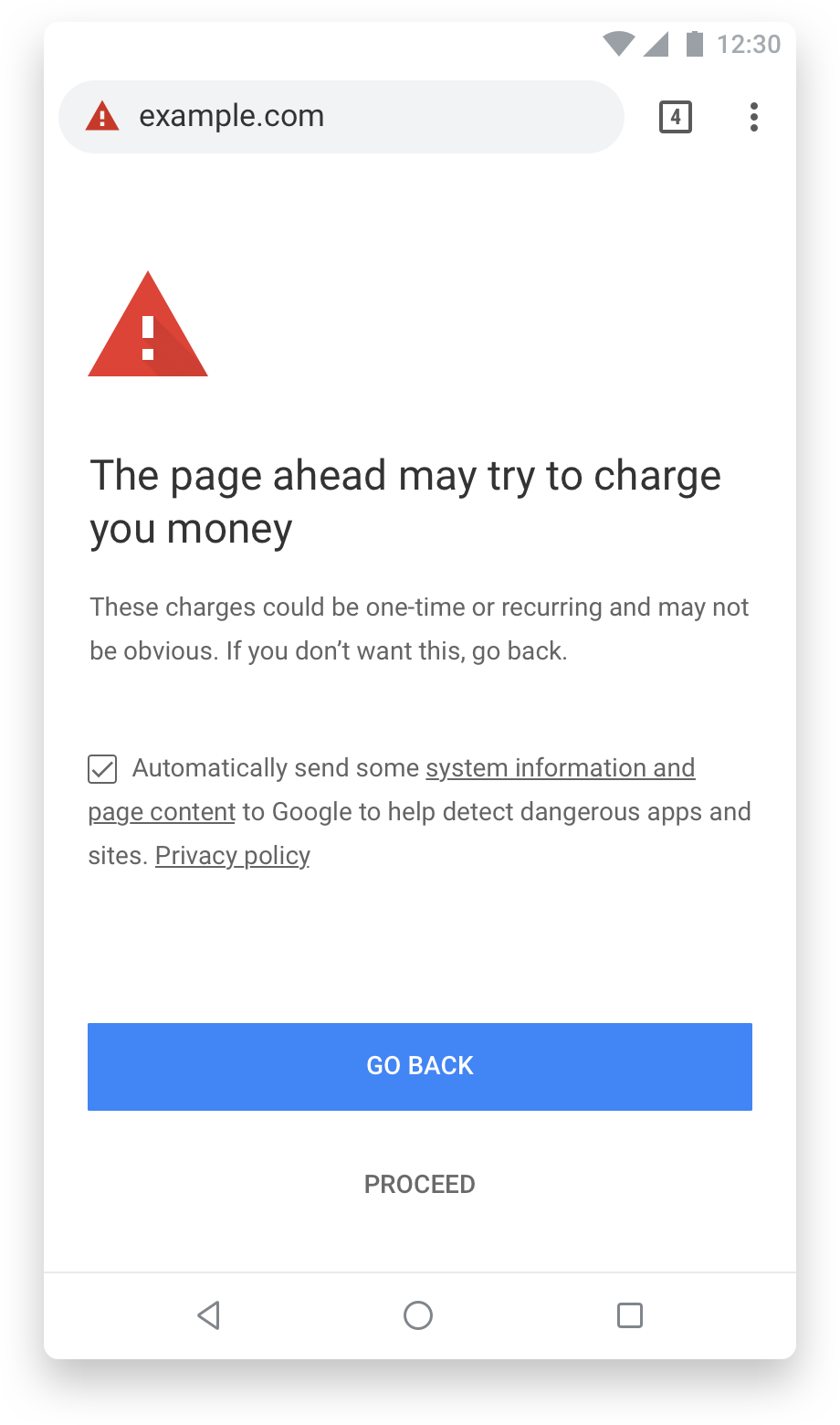
Google today announced that Chrome will soon get a new feature that aims to stop mobile subscription scams. Those are the kind of sites that ask you for your phone number and that then, unbeknownst to you, sign you up for a mobile subscription that’s billed through your carrier. Starting with the launch of Chrome 71 in December, Google will pop up a prominent warning when a site doesn’t make it clear that users are signing up for a mobile subscription.

To make sure that developers who are legitimately using this flow to offer users a subscription don’t get caught up in this new system, Google also published a set of best practices for mobile billing today. Generally, developers are expected to make their billing information visible and obvious to users, display the actual cost and have a simple and straightforward fee structure.

If that information is not available, Google will throw up a prominent full-page warning, but users can always opt to proceed. Before throwing up the warning page, Google will notify webmasters in the Search Console when it detects a potential scam (there’s always a chance for false positives, after all).

This new feature will be available on both mobile and desktop, as well as in Android’s WebView.


from RSSMix.com Mix ID 8176981 https://techcrunch.com/2018/11/08/chrome-adds-new-security-features-to-stop-mobile-subscription-scams/
http://www.gadgetscompared.com
from Tumblr http://ikonografico.tumblr.com/post/179903597756
via http://www.gadgetscompared.com
Wednesday, November 7, 2018

Netflix’s hackathon produces a way to navigate its iOS app with ARKit and Face ID

Netflix’s internal hackathons have consistently produced fun and often silly hacks, from that “Netflixtendo” hack a few years ago that let you run Netflix on the original NES to the more recent “audiobook mode” that turned Netflix series into old-school radio shows by way of Audio Descriptions. This year’s hackathon doesn’t disappoint either, with new hacks that are both as goofy and interesting as in years past, including an AR and Face ID-powered hack that lets you navigate Netflix with just your eyes, another designed for “Sharknado” fans and more.

“Jump to Shark” lets viewers skip right to the good parts of the so-bad-it’s-good “Sharknado,” so they can watch the bloody action sequences with sharks, instead of having to sit through the movie’s actual plot. It’s pretty great, as the video shows.

The AR hack, Eye Nav, is fairly impressive, too.

The hack uses Apple’s ARKit and the technology that enables Face ID for tracking eye position and facial expressions. It tracks your eye position to move a pointer around the screen, then measures the time spent on the same area to trigger a “tap.”

If you want to dismiss a screen, you can just stick your tongue out.

While the resulting hack is definitely fun, there are also implications for accessibility use cases in the future.

The hack was produced in 24 hours, so it may not be stable enough for real-world use, but it’s definitely an interesting idea.

A third hack doesn’t involve Netflix, but rather the productivity software Slack, used by Netflix employees.

“LunchBot” connects co-workers who are too busy to go to lunch, by inviting them to eat lunch together — virtually, while in a Slack chat. The app also checks everyone’s calendars to make sure they’re free.

Other hacks this year included those for product improvements, enhancements to its internal tools and some that were just for fun. A few of these were showcased in its Hackday 2018 video, such as a map for locating studio production resources, an “easy login” system and a version of Animoji using Netflix characters.

But the larger goal of Netflix’s hackathon, as you can probably tell, isn’t necessarily about creating features that will later be productized (although, c’mon…Jump to Shark!), but they sometimes serve as inspiration for features further down the road, the company says.


from RSSMix.com Mix ID 8176981 https://techcrunch.com/2018/11/07/netflixs-hackathon-produces-a-way-to-navigate-its-ios-app-with-arkit-and-face-id/
http://www.gadgetscompared.com
from Tumblr http://ikonografico.tumblr.com/post/179873973061
via http://www.gadgetscompared.com

Tinder doubles down on its casual nature, as Match invests in relationship-focused Hinge

Tinder has never really shaken its reputation among consumers as a “hook up” app, instead of one designed for more serious dating. Now, it seems Tinder is planning to embrace its status as the default app for younger users who aren’t ready to settle down. According to Match Group CEO Mandy Ginsberg, speaking to investors on its Q3 earnings call this morning, Tinder is preparing to launch its first-ever brand marketing campaign that will promote the “single lifestyle” with billboard campaigns and other digital initiatives.

The move is something of an admission that Tinder isn’t working for helping people find long-term relationships.

“Tinder was such a phenomenon when it launched and spread so quickly that the market defined th brand, versus the business defining the brand,” said Ginsberg, referring to its “hook up app” reputation.

“Tinder’s brand particularly resonated with 18 to 25 year-olds because it provides a fun and easy way to meet people. Tinder sometimes gets a bad rap for being casual,” she then admitted. “But keep in mind that people in the late teens and early 20’s are not looking to settle down. It is a time to explore and discover yourself, meeting lots of people and being social.”

Tinder’s new marketing campaign will focus on the “single journey,” the exec said.

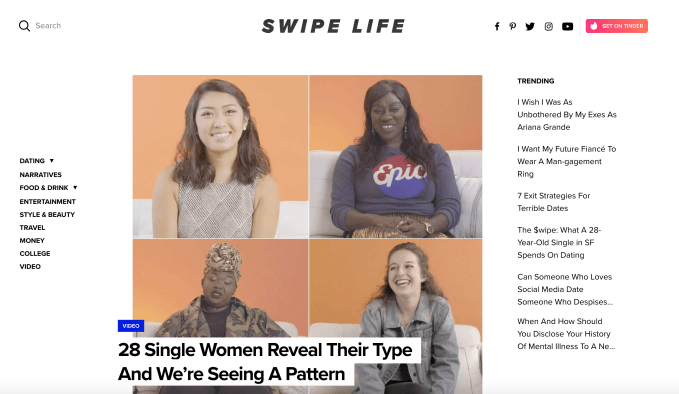
The dating app maker has already started publishing content that’s relevant to this “single lifestyle” on its Swipe Life website with stories relating to dating styles, travel, food, and more. For example, some of its recent articles have included things like: “7 Exit Strategies for Terrible Dates,” “Tinder Diaries: Which of these 5 Guys Will Get the Date?,” and “Study Abroad Hookup Confessions.”

Definitely not material for the relationship-minded.

Now, the company will promote Tinder’s “single lifestyle” even further with billboards across major cities throughout the U.S., as well as on digital channels.

The campaign’s goal, explained Ginsberg, is about “further reinforcing how Tinder can enable users to make the most of this fun and adventurous time in their life.”

It’s not difficult to read between the lines here: Tinder’s business model succeeds among people who want to stay single. It succeeds when they’re retained in the app, continually swiping on to the next person they want to meet.

To be fair, Tinder has never really invested in many features that push people to go on dates or exit its app. Instead, it has added addictive features like an in-app news feed – like a social network would have – and tools that enhance in-app chats, like sharing GIFs.

If Tinder was Match’s only dating app, this narrow definition of an app for those embracing their “single lifestyle” would be a problem.

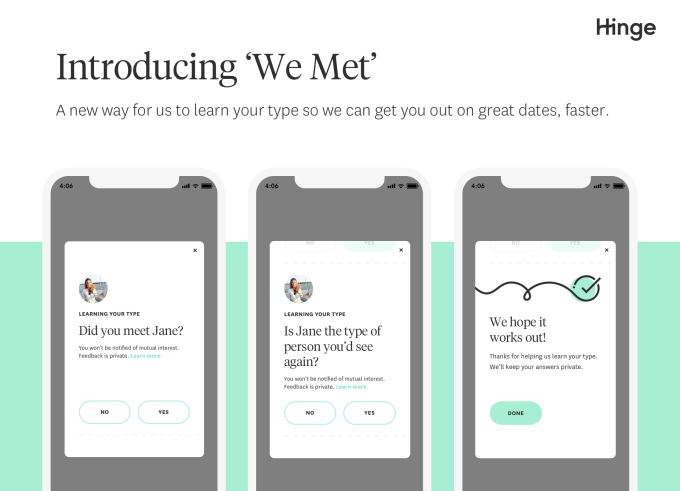
But Match’s strategy has been to diversify its lineup of dating apps. Now it’s a majority owner of dating app Hinge, whose focus has been on helping people get into relationships. In other words, when people are fed up with the ephemeral nature of Tinder, they can just switch apps – while remaining a Match customer, of course!

The company also says it will invest more in Hinge going forward – a move that’s not unrelated to the decisions Match is making around Tinder. 

In fact, in another admission that Tinder wasn’t serving those in search of relationships, Ginsberg said Hinge will help the company to address the “previously underserved” audience of 20-somethings looking for a serious relationship.

She speaks of how Hinge’s user interface is clean and simple, and encourages people to be more thoughtful in their initial conversations. It’s a stark contrast to Tinder, which certainly does not.

Hinge downloads have increased five times since Match invested, the company also noted. It’s gaining traction in major cities throughout the U.S, including New York, as well as in international markets, like London.

The plan is to make Hinge the anti-Tinder, then pull in users as they exit Tinder in search of something real. The company said it’s going to increase the marketing spend on Hinge to drive awareness of the app across the U.S.

“We see a real opportunity to invest meaningful dollars in both products and marketing at hinge to drive long-term growth,” said Ginsberg.

“We think it addresses a great gap in the market,” she continued. “If you think about when Tinder came into the market six years ago, it brought a whole new audience of young users, particularly college-age users. As they start to age…having a product that’s oriented to serious [dating] – but sort of mid-to-late 20’s – is really compelling for us,” she added.

Tinder has evolved over the years from casual dating to include those who are more serious. But with Match’s decision to focus on those not looking for lasting relationships, it risks losing some users going forward. The challenge for the company is to pick them up in another dating app it owns, and not lose them to Bumble…or to an exit from dating apps altogether.


from RSSMix.com Mix ID 8176981 https://techcrunch.com/2018/11/07/tinder-doubles-down-on-its-casual-nature-as-match-invests-in-relationship-focused-hinge/
http://www.gadgetscompared.com
from Tumblr http://ikonografico.tumblr.com/post/179866941246
via http://www.gadgetscompared.com
Tuesday, November 6, 2018

Photomath raises $6 million for its math solving app

Photomath just raised a $6 million funding round from Goodwater Capital with Learn Capital also participating. Photomath has created a hugely successful mobile app for iOS and Android with 100 million downloads so far.

Photomath first launched at TechCrunch Disrupt London back in 2014. The company was working on text recognition technology. Photomath was just a demo app to promote that technology.

But the startup accidentally created a consumer success. The app instantly attracted millions of downloads from many desperate students willing to learn math with their phones.

Years later, the app is still one of the most downloaded apps in the App Store and Play Store. And the reason why it’s been so successful is that it’s a simple concept.

After downloading the app, you just have to point your phone at a math problem. It can be in a book, or it can recognize your own handwriting. The app then gives you a step-by-step explanation to solve this problem.

Combining these two things together is what makes Photomath useful. WolframAlpha can solve equations, and Evernote can recognize your handwriting. But nobody thought about combining these things together.

Typing an equation can be hard, so it makes a ton of sense to bridge the gap between the physical world and smartphones. Before everybody started talking about augmented reality, Photomath was already taking advantage of the system-on-a-chip in your phone.

Photomath is also capable of generating graphs and supports advanced problems, such as limits, integrations, complex numbers, etc. The app solves around 1.2 billion math problems per month.


from RSSMix.com Mix ID 8176981 https://techcrunch.com/2018/11/06/photomath-raises-6-million-for-its-math-solving-app/
http://www.gadgetscompared.com
from Tumblr http://ikonografico.tumblr.com/post/179835335996
via http://www.gadgetscompared.com
Lydia launches mobile phone insurance

French startup Lydia is launching an insurance product for your mobile phone. For €4.29 per month ($4.89), you can insure your phone from the Lydia app.

Lydia is one of the most popular peer-to-peer payment apps in Europe with 1.5 million users. Think about it as a sort of Venmo or Square Cash for Europe. More recently, the company started offering more options to manage your money with a premium subscription and additional features.

While Lydia doesn’t want to replace your bank and insurance company, the company is offering an insurance product for the first time. Lydia is partnering with its investor CNP Assurances — having an insurance company as an investor has a few advantages.

So here’s what you get. You’re instantly covered against cracked screens, liquid damage and accidental damage. There’s no excess but you’re limited to one claim per year. Phones now cost a small fortune, but you’re limited to €500 ($570) per claim.

Optionally, you can subscribe to a better insurance product for €9.99 per month ($11.39). In addition to phone insurance, your laptop, tablet, Nintendo Switch, Kindle, camera and other electronics are covered. You can make two claims per year and you can get back up to €500 for your phone and €1,800 for other devices. More importantly, you’re also covered against theft.

Many phone carriers sell mobile phone insurance. But they usually cost more than that. In most cases, you also need to subscribe for at least one year. In Lydia’s case, you can cancel your subscription whenever you want in the app.

If that product sounds familiar, it’s because Revolut offers a similar feature with some drawbacks. You can subscribe to mobile phone insurance from Revolut’s mobile app.

Pricing isn’t as straightforward with Revolut as Premium subscribers get a discount. For an iPhone X, the insurance product costs as much as €9.58 per month ($10.92) without a Revolut Premium account, or as little as €6.67 per month ($7.60) if you pay upfront and you have a Revolut Premium account.

It’s a 12-month contract with a €125 excess and no theft protection. You also need to start insuring your phone quickly after buying (within six months) otherwise you aren’t covered. Revolut works with Allianz and Simplesurance for this insurance product.

Lydia may have borrowed the idea from Revolut, but I’m not sure why you’d choose Revolut’s insurance product over Lydia’s product.

It’s interesting to see that fintech companies are creating alternative revenue streams with insurance products. Subscribing to an insurance product is quick and painless as they already manage your money and have your card on file.


from RSSMix.com Mix ID 8176981 https://techcrunch.com/2018/11/06/lydia-launches-mobile-phone-insurance/
http://www.gadgetscompared.com
from Tumblr http://ikonografico.tumblr.com/post/179831982156
via http://www.gadgetscompared.com