Tuesday, July 2, 2019

Uber Eats invades restaurants with Dine-In option

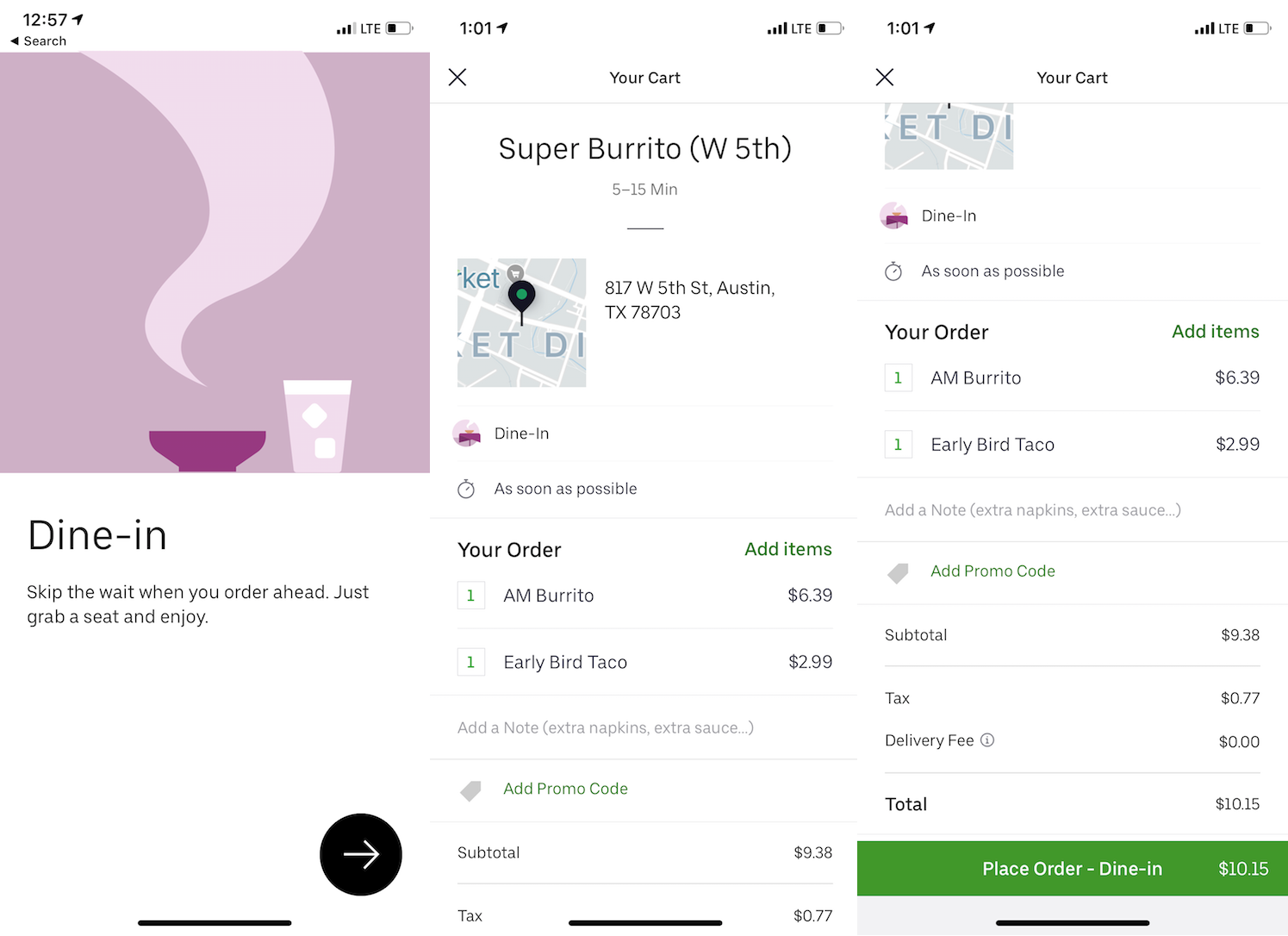
Tired of cleaning up after take-out or getting hangry waiting at your table in restaurants? Well Uber Eats is barging into the dine-in business. A new option in some cities lets you order your food ahead of time, go to the restaurant, and then sit down inside to eat, a tipster from competing dine-in app Allset tells us. We tested it, and Uber Eats Dine-In even waives the standard Uber delivery and service fees.

Adding Dine-In lets Uber Eats insert itself into more food transactions, expand to restaurants that care about presentation and don’t do delivery, and avoid paying drivers while earning low-overhead revenue. Uber’s Dine-In option is now available in some cities including Austin, Dallas, Phoenix and San Diego where it could save diners time and fees while helping restaurants fill empty tables and waiters earn tips. But it also could coerce more restaurants to play ball with UberEats if their competitors do, eating into their margins.

UberEats Dine In Option

Uber confirmed the existence of the Dine-In option, telling me “We’re always thinking about new ways to enhance the Eats experience.” They also verified there are no delivery or service fees, and restaurants get 100% of tips left in-app buy users. However, we found some items were silently marked up from restaurants’ listed prices in both Uber Eats Delivery and Dine-In options, which could help it make some money directly from these purchases. We also discovered this buried Uber Help Center FAQ with more details.

Uber has been rapidly experimenting with Uber Eats, trying discounted specials, Uber Eats Pool where you pay less for slower delivery, and $9.99 unlimited delivery subscriptions. It’s steadily becoming an omnivore.

How Uber Dine-In Works

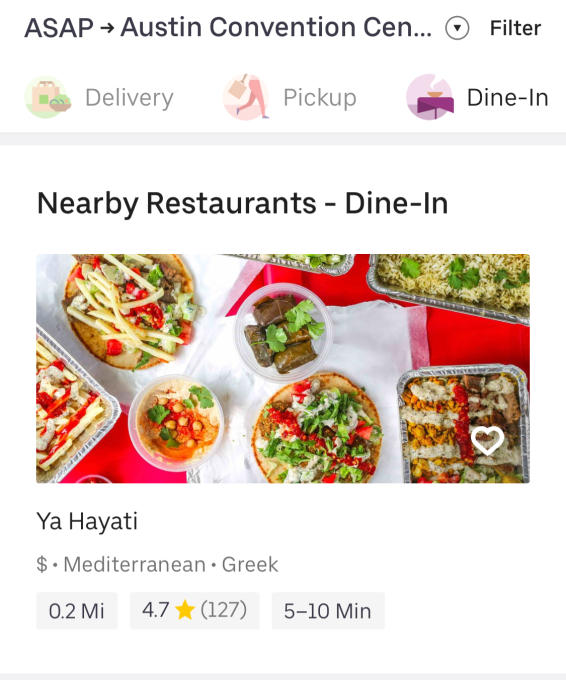
Dine-in appears next to the Delivery and Pick-Up options across the top of the Uber Eats app in select cities. You can choose to go eat “ASAP” or in some cases schedule when you want to arrive and sit down. You’ll be shown how long the food will take to prep, distance to the restaurant, your price, and the restaurant’s rating. You’ll then be notified as the order is prepared and approaches readiness. Then you just deliver yourself to the restaurant and add a tip in-app or on the table.

Uber Eats should obviously make it easy for you to hail an Uber with the restaurant as the pre-set destination. An Uber spokesperson called that a good idea but not something it’s doing yet. Back in 2016, Uber tried a merchant-sponsored rides option where you’d get a rebate on your travel if you spent money at a given store. You could imagine restaurants that want to show off their ambiance giving customers some money back if they come across town to eat there.

Uber Dine In

The new feature could spell trouble for other dine-in apps like Allset that’s been in the business for four years. Users might also opt for Uber Eats Dine-In over restaurant reservation apps like OpenTable and Resy. Why waste time waiting to order and for your food to be cooked when you could just show up as it comes out of the oven?

“I think that more delivery players will be tapping into dine-in space. It’s all about convenience and time saving. But it’s going to be very difficult for them, given their focus on delivery” AllsetCEO Stas Matviyenko said of Uber becoming a competitor. He believes dedicated apps for different modes of dining will succeed. But Uber Eats’ ubiquity and its one-stop-shop model for all your dining needs could make it stickier than a dine-in only app you use less frequently.

UberEatsheader

With Dine-In, Uber could aid restaurants that are empty at the start or end of their open hours. Last year we reported that Uber Eats was giving restaurants prominence in a Featured section of the app to drive up demand if they offered discounts to customers. Similarly, Uber could let restaurants entice more Dine-In customers especially when foot-traffic was slow by providing discounts on food or subsidized Uber transportation. Better to knock a dollar or two off an entree if it means filling the restaurant at 5:30 or 9:30pm.

And now that Uber Eats does delivery, take-out, and dine-in, it’d make perfect sense to offer traditional restaurant reservations through the app as well. That would pit it directly against OpenTable, Resy, and Yelp. Instead of trying to own a single use case that might only appeal to certain demographics in certain situations, Uber Eats’ strategy is crystallizing: be the app you open whenever you’re hungry.


from RSSMix.com Mix ID 8176981 https://techcrunch.com/2019/07/02/uber-dine-in/
http://www.gadgetscompared.com
from Tumblr https://ikonografico.tumblr.com/post/186012387496
via http://www.gadgetscompared.com

Samsung will announce the next Galaxy Note on August 7

It’s official. Samsung just sent out invites for the next Unpacked event. The big show kicks off at 4PM ET August 7, right here in New York. The timing lines up with rumors that have been floating around for few weeks — not to mention last year’s big event.

And in case there was any mystery around what precisely the company is going to unveil, Samsung has happily spoiled the surprise with the inclusion of a prominent S Pen on the invite. The August event will almost certainly see the debut of the Galaxy Note 10.

The art appears to hint at an updated camera, as well. Based on recent leaks, the invite looks to be a closeup of the nearly all-screen front of the new phablet, with the single hole punch front facing camera up top. 

The new handset is said to include a vertical three array camera with depth sensing and a 5G option. Samsung is also reportedly dropping the headphone jack this time out, after years pointing to it as a standout feature from the rest of the industry.

Last year’s event also saw a number of additional devices, including the (still unreleased) Galaxy Home smart speaker. And very least maybe we’ll finally be getting a date on that product, along with more information about the long delayed Galaxy Fold.


from RSSMix.com Mix ID 8176981 https://techcrunch.com/2019/07/01/samsung-will-announce-the-next-galaxy-note-on-august-7/
http://www.gadgetscompared.com
from Tumblr https://ikonografico.tumblr.com/post/185997896541
via http://www.gadgetscompared.com

Monday, July 1, 2019

Atlan raises $2.5M to stop enterprises from being so bad at managing data

Even as much of the world is digitizing its governance, in small towns and villages of India, data about its citizens is still being largely logged on long and thick notebooks. Have they received the subsidized cooking gas cylinders? How frequent are the power cuts in the village? If these data points exist at all, they are probably stored in big paperbacks stacked in a corner of some agency’s office.

Five years ago, two young entrepreneurs — Prukalpa Sankar and Varun Banka — set out to modernize this system. They founded SocialCops, a startup that builds tools that make it easier for government officials — and anyone else — to quickly conduct surveys and maintain digital records that could be accessed from anywhere.

The Indian government was so impressed with SocialCops’ offering that it partnered with the startup on National Data Platform, a project to connect and bring more transparency within many of the state-run initiatives; and Ujjwala Yojana, a project to deliver subsidized cooking gas cylinders to poor women across the nation.

“This is a crucial step towards good governance through which we will be able to monitor everything centrally,” India’s Prime Minister Narendra Modi said of National Data Platform. “It will enable us to effectively monitor every village of the country.”

Two years ago, the duo wondered if the internal tools that they built for their own teams to manage their projects could help data teams around the world? The early results are in: Atlan, a startup they founded using learnings from SocialCops, has secured more than 200 customers from over 50 nations and has raised $2.5 million in pre-Series A funding led by Waterbridge Ventures, an early stage venture fund.

The startup, which employs about 80 people, has also received backing from Ratan Tata, Chairman Emeritus of conglomerate Tata Sons, Rajan Anandan, the former head of Google Southeast Asia, and 500 Startups. On Tuesday, Singapore-headquartered Atlan moved out of stealth mode.

The premise of Atlan’s products is simple. It’s built on the assumption that the way most people in enterprises deal with data is inefficient and broken, Sankar and Banka told TechCrunch in an interview. Typically, there is no central system to keep track of all these data points that often live in their own silos. This often results in people spending days to figure out what their compliance policy is, for instance.

“Atlan wants to democratize data inside organizations,” said Sankar.

Atlan Discovery 2

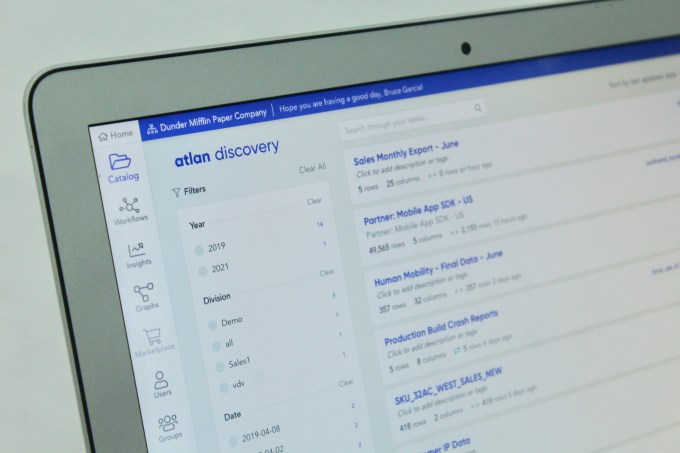
Teams within a typical company currently use a number of different tools to gather and manage data. Atlan has built products — dubbed Discovery, Grid, and Workflows — that work with several popular services to fetch data points from internal and external sources to one interface. This interface, which serves as a collaborative layer, can be viewed by anyone with prerequisite permission to access and edit data on a web browser. The interface also allows users to quickly sort the data points by the year of their creation and look for patterns.

Atlan’s Grid allows an organization to see all the data they have licensed or purchased from external sources. So, for instance, an organization may have teams that subscribe to data from consulting and analytics firm. Currently, they are required to visit the websites or apps of all these third-party firms to view the data. Grid brings them to the same aforementioned interface.

The startup has also built a product called Collect that allows an organization to quickly deploy apps to conduct surveys and collect granular data. These apps can collect data even when there is no internet connection and again, all of these data points then can be viewed on one interface.

Atlan intends to use the capital it has raised on product development and sign more customers. It has already won some big names including Unilever, Milkbasket, Barbeque Nation, WPP and GroupM, Mahindra Group and InMobi in India, Chuan Lim Construction in Singapore, ServeHaiti in Haiti, Swansea University in the UK, the Ministry of Environment in Costa Rica, and Varun Beverages in Zambia.

In a prepared statement, Manish Kheterpal, Managing Partner at WaterBridge Ventures, said, “companies are struggling to overcome the friction that arises when diverse individuals need to collaborate, leading to project failure. The IPOs of companies like Slack and Zoom are proof that we live in the era of consumerization of the enterprise. With its sharp focus on data democratization, Atlan is well-positioned to reimagine the future of how data teams work.”

As for SocialCops, Sankar said many companies and government agencies are using the startup’s products and it will continue to live on and pursue its signature “social good” mission.


from RSSMix.com Mix ID 8176981 https://techcrunch.com/2019/07/01/atlan-socialcops/
http://www.gadgetscompared.com
from Tumblr https://ikonografico.tumblr.com/post/185990207041
via http://www.gadgetscompared.com

Samsung CEO calls Galaxy Fold mishap ‘embarrassing’

In a meeting with a group of journalists in South Korea, Samsung Electronics CEO DJ Koh candidly addressed the company’s latest hardware mishap. “It was embarrassing,” he told reporters, as quoted by The Independent. “I pushed it through before it was ready.”

That last bit no one can debate, really. After years of preamble, Samsung still managed to jump the gun with the Galaxy Fold. The company was eager to be the first major manufacture to market with the category’s most radical redesign in a decade. Ultimately, however, the company ended up pumping the breaks after multiple reviewers reported problems with their units.

Samsung was quick to place the blame at the hands of reviewers, but eventually shifted tacts after realizing that problems were more widespread. More than two months after the handset was initially expected to hit retail, we’re still very much in a holding pattern with Samsung’s first foldable. Though the company has promised a more concrete date for some time.

Samsung has been quick to deny any rumors that the phone has been altogether canceled, and Koh reiterated that the Fold is still being put through its paces. “I do admit I missed something on the foldable phone, but we are in the process of recovery,” the executive told the press. “At the moment, more than 2,000 devices are being tested right now in all aspects. We defined all the issues. Some issues we didn’t even think about, but thanks to our reviewers, mass volume testing is ongoing.”

Koh didn’t offer specifics with regards to a release date, though the company is reportedly gearing up to launch the next version of the Note at an event in August.


from RSSMix.com Mix ID 8176981 https://techcrunch.com/2019/07/01/samsung-ceo-calls-galaxy-fold-mishap-embarrassing/
http://www.gadgetscompared.com
from Tumblr https://ikonografico.tumblr.com/post/185985408926
via http://www.gadgetscompared.com

Calm raises $27M to McConaughey you to sleep

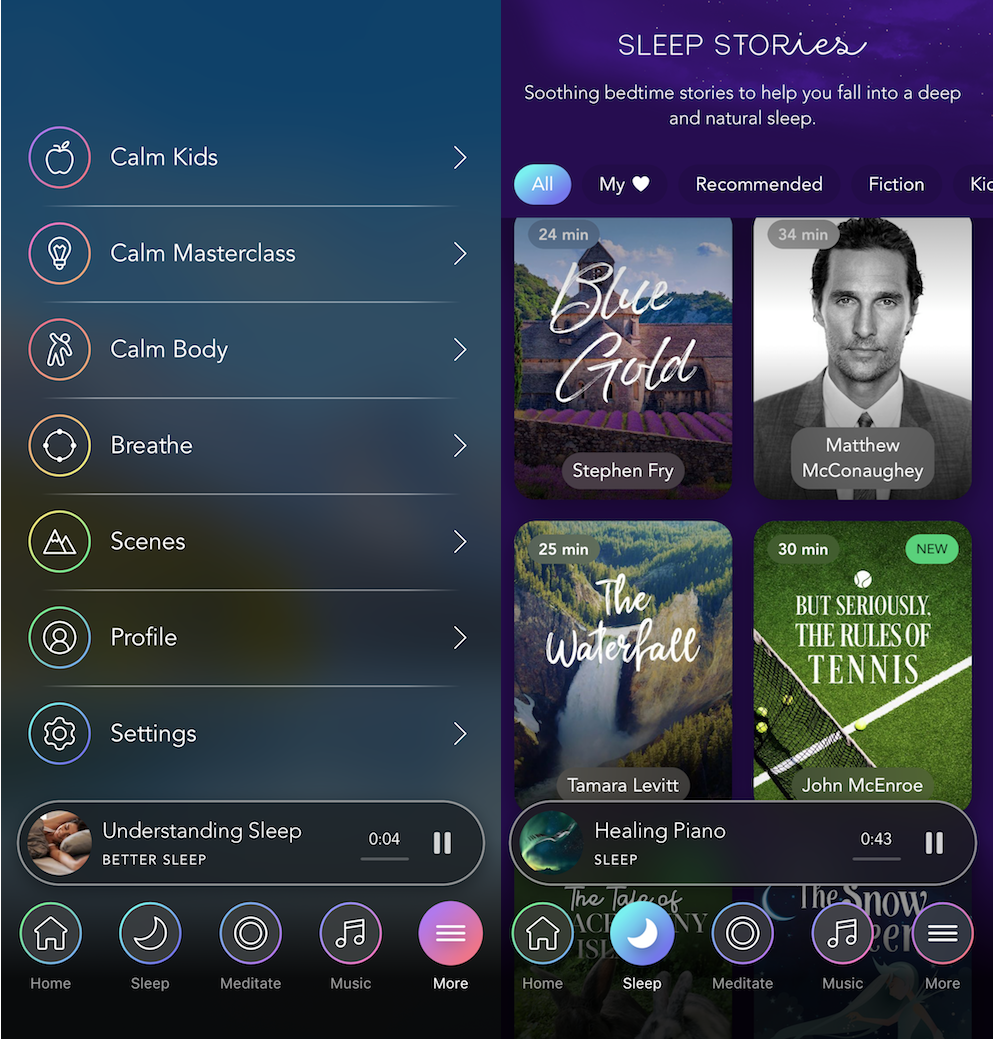
Meditation app unicorn Calm wants you to doze off to the dulcet tones of actor Matthew McConaughey’s southern drawl or writer Stephen Fry’s english accent. Calm’s Sleep Stories feature that launched last year is a hit, with over 150 million listens from its 2 million paid subscribers and 50 million downloads. While lots of people want to meditate, they need to sleep. The 7-year-old app has finally found its must-have feature that makes it a habit rather than an aspiration.

Keen to capitalize on solving the insomnia problems plaguing people around the world, Lightspeed tells TechCrunch it has just invested $27 million into a Series B extension round in Calm alongside some celebrity angels at a $1 billion valuation. The cash will help the $70 per year subscription app further expand from guided meditations into more self-help masterclasses, stretching routines, relaxing music, breathing exercises, stories for children, and celebrity readings that lull you to sleep.

Calm App

The funding adds to Calm’s $88 million Series B led by TPG that was announced in February that was also at a $1 billion valuation, bringing the full B round to $115 million and Calm’s total funding to about $141 million. Lightspeed partner Nicole Quinn confirms the fund started talks with Calm around the same time as TPG, but took longer to finish due diligence, which is why the valuation didn’t grow despite Calm’s progress since February.

“Nicole and Lightspeed are valueable partners as we continue to double down on entertainment through our content” Calm’s head of communications Alexia Marchetti tells me. The startup plans to announce more celebrity content tie-ins later this summer.

Broadening its appeal is critical for Calm amidst a crowded meditation app market including Headspace, Simple Habit, and Insight Timer plus newer entrants like Peloton’s mindfulness sessions and Journey’s live group classes. It’s become easy to find guided meditations online for free, so Calm needs to become a holistic mental wellness hub.

While it risks diluting its message by doing so much, Calm’s plethora of services could make it a gateway to more of your personal health spend, including therapy, meditation retreats, and health merchandise from airy clothing to yoga mats. But subscription fees alone are powering a big business. Calm quadrupled revenue in 2018 to reach $150 million in ARR and hit profitability.

Calm is poised to keep up its rapid revenue growth. After the launch of Sleep Stories, “it was incredible to see the engagement spike up and also the retention” says Quinn. Users can choose from having McConaughey describe the wonders of the cosmos, John McEnroe walk them through the rules of tennis, fairy tales like The Little Mermaid, and more.

Quinn tells me “Sleep Stories is now a huge percentage of the business, and also the length of time people spend on the app has gone up dramatically.” She tells me that so many startups are “trying to invent a problem where there isn’t one.” But difficulty snoozing is so widespread and detrimental that users are eager to pay for an app instead of a sleeping pill. Having the Inception actor talk about the universe until I pass out sounds alright, alright, alright.

Alright Alright Alright


from RSSMix.com Mix ID 8176981 https://techcrunch.com/2019/07/01/calm-sleep-stories/
http://www.gadgetscompared.com
from Tumblr https://ikonografico.tumblr.com/post/185985408821
via http://www.gadgetscompared.com

Higher Ground Labs is betting tech can help sway the 2020 elections for Democrats

When Shomik Dutta and Betsy Hoover first met in 2007, he was coordinating fundraising and get-out-the-vote efforts for Barack Obama’s first presidential campaign and she was a deputy field director for the campaign.

Over the next two election cycles the two would become part of an organizing and fundraising team that transformed the business of politics through its use of technology — supposedly laying the groundwork for years of Democratic dominance in organizing, fundraising, polling and grassroots advocacy.

Then came Donald J. Trump and the 2016 election.

For both Dutta and Hoover, the 2016 outcome was a wake-up call against complacency. What had worked for the Democratic party in 2008 and 2012 wasn’t going to be effective in future election cycles, so they created the investment firm Higher Ground Labs to provide financing and a launching pad for new companies serving Democratic campaigns and progressive organizations.

“As the political world shifts from analog to digital, we need a lot more tools to capture that spend,” says Dutta. “Democrats are spending on average 70 cents of every dollar raised on television ads. We are addicted to old ways of campaigning. If we want to activate and engage an enduring majority of voters we have to go where they are (and that’s increasingly online) and we have to adapt to be able to have these conversations wherever they are.”

Social media and the rise of “direct to consumer” politics

While the Obama campaign effectively used the internet as a mobilization tool in its two campaigns, the lessons of social media and mobile technologies that offer a “direct-to-consumer” politics circumventing traditional norms have, in the ensuing years, been harnessed most effectively by conservative organizations, according to some scholars and activists.

“The internet is a tool and in that sense it’s neutral, but just like other communication tools from the past, people with more power, with more resources, with more organization, have been able to take advantage of it,” Jen Schradie, an assistant professor at the Observatoire sociologique du changement at Sciences Po in Paris, told Vox in an interview earlier this month.

Schradie is a scholar whose recent book, “The Revolution That Wasn’t,” contends that the internet’s early application as a progressive organizing tool has been overtaken by more conservative elements. “The idea of neutrality seems more true of the internet because the costs of distributing information are dramatically lower than with something like television or radio or other communication tools,” she said. “However, to make full use of the internet, you still need substantial resources and time and motivation. The people who can afford to do this, who can fund the right digital strategy, create a major imbalance in their favor.”

Schradie contends that a web of privately funded think tanks, media organizations, talk radio and — increasingly — mobile applications have woven a conservative stitch into the fabric of social media. The medium’s own tendency to promote polarizing and fringe viewpoints also served to amplify the views of pundits who were previously believed to be political outliers.

Essentially, these sites have enabled commentators and personalities to create a patchwork of “grassroots” organizations and media operations dedicated to reaching an audience receptive to their particular political message that’s funded by billionaire donors and apolitical corporate ad dollars.

Then there’s the technology companies, like Cambridge Analytica, which improperly used access to Facebook data for targeting purposes — also financed by these same billionaires.

“The last six years have witnessed millions and millions of dollars of private Koch money and Mercer money that have gone to pretty sophisticated data and media efforts to advance the Republican agenda,” says Dutta. “I want to even the scale.”

Dutta is referring to Charles and David Koch and Robert Mercer, the scions and founder (respectively) of two family dynasties worth billions. The Koch brothers support a web of political advocacy groups, while Mercer and his daughter were large backers of Breitbart News and Cambridge Analytica, two organizations that arguably provided much of the policy underpinnings and online political machinery for the Trump presidential campaign.

But there’s also the simple fact that Donald Trump’s digital strategy director, Brad Parscale, was able to effectively and inexpensively leverage the social media tools and data troves amassed by the Republican National Committee that were already available to the candidate who won the Republican primary. In fact, in the wake of Romney’s loss, Republicans spent years building up profiles of 200 million Americans for targeted messaging in the 2016 election.

“Who controls Facebook controls the 2016 election,” Parscale said during a speaking engagement at the Romanian Academy of Sciences, according to a report in Forbes.

Parscale, now the campaign manager for the president’s 2020 reelection campaign recalled, “These guys from Facebook walked into my office and said: ‘we have a beta … it’s a new onboarding tool … you can onboard audiences straight into Facebook and we will match them to their Facebook accounts,’ ” according to Forbes .

During the 2016 campaign, Hillary Clinton’s team made 66,000 visual ads, according to Parscale, while the Trump campaign made 5.9 million ads by leveraging social media networks and the language of memes. And in the run-up to the 2020 election, Parscale intends to go back to the same well. The Trump campaign has already spent more than $5 million on Facebook ads in the current election cycle, according to The New York Times — outspending every single Democratic candidate in the field and roughly all of the Democrats combined.

Reaching higher ground

Dutta and Hoover are working to offset this movement with investments of their own. Back in 2017, the two launched Higher Ground Labs, an early-stage company accelerator and investment firm dedicated to financing technology companies that could support progressive causes.

The firm has $15 million committed from investors, including Reid Hoffman, the co-founder of LinkedIn and a partner at Greylock; Ron Conway, the founder of SV Angel and an early backer of Google, Facebook and Twitter; Chris Sacca, an early investor in Uber; and Elizabeth Cutler, the founder of SoulCycle. Already, Higher Ground has invested in more than 30 companies focused on services like advocacy outreach, polling and campaign organizing — among others. 
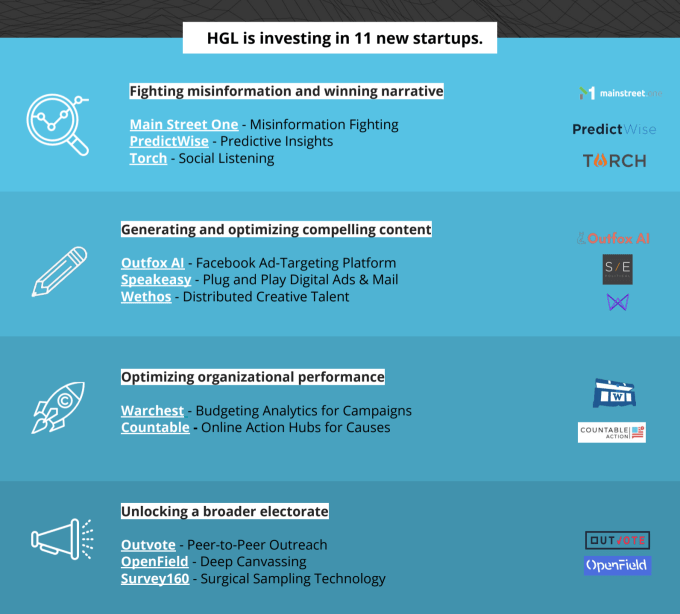
Screen Shot 2019 07 01 at 5.36.26 AM

The latest cohort of companies to receive backing Higher Ground Labs

“It is vitally important that Democrats learn to do their campaigns online,” says Dutta. “The way you recruit volunteers; the way you poll sentiment; the way you target and mobilize voters has to be done with online tools and has to improve in the progressive movement and that’s the job of Higher Ground Labs to fix.”

For-profit companies have a critical role to play in election organizing and mobilization, Dutta says. Thanks to government regulation, only private companies are allowed to trade data across organizations and causes (provided they do it at fair market value). That means advocacy groups, unions and others can tap the information these companies collect — for a fee.

The Democratic Party already has one highly valued private company that it uses for its technology services. Formed from the merger of NGP Software and Voter Activation Network, two companies that got their start in the late 1990s and early 2000s, NGP VAN is the largest software and technology services provider for Democratic campaigns. It’s also a highly valued company, which received roughly $100 million in financing last year from the private equity firm Insight Venture Partners, according to people familiar with the investment. Terms of the deal were not disclosed.

“Our vision has been to build a platform that would break down the painful data silos that exist in the campaigns and nonprofit space, and to offer truly best-in-class digital, fundraising and organizing features that could serve both the largest and the smallest nonprofits and campaigns, all with one unified CRM,” wrote Stu Trevelyan, the chief executive of NGP VAN + EveryAction, in an August blogpost announcing the investment. “We’re so excited that others, like our new partners at Insight, share that vision, and we can’t wait to continue innovating and growing together in the coming years.”

Can startups lead the way?

Even as private equity dollars boost the firepower of organizations like NGP VAN, venture capitalists are financing several companies from the Higher Ground Labs portfolio.

Civis Analytics, a startup founded by the former chief analytics officer of Barack Obama’s 2012 reelection campaign, raised $22 million from outside investors, and counts Higher Ground Labs among its backers. Qriously, another Higher Ground Labs portfolio company, was acquired by Brandwatch, as was GroundBase, a messaging platform acquired by the nonprofit progressive advocacy organization ACRONYM.

Other companies in the portfolio are also attracting serious attention from investors. Standouts like Civis Analytics and Hustle, which raised $30 million last May, show that investors are buying into the proposition that these companies can build lasting businesses serving Democratic and progressive political campaigns and corporate businesses that would also like to rally employees or personalize a marketing pitch to customers.

These are companies like Change Research, an earlier-stage company that just launched from Higher Ground Labs accelerator last year. That company, founded by Mike Greenfield, a serial Silicon Valley entrepreneur who was the first data scientist working on the problem of fraud detection at PayPal, and Pat Reilly, a communications professional who worked with state and local Democratic politicians, is slashing the cost of political polling.

“I wanted to do something for American democracy to try and improve the state of things,” Greenfield said in an interview last year.

For Greenfield, that meant increasing access to polling information. He cited the test case of a Kansas special election in a district that Donald Trump had won by 27 points. Using his own proprietary polling data, Greenfield predicted that the Democratic challenger, James Thompson, would pose a significant threat to his Republican opponent, Mike Estes.

Estes went on to a 7% victory at the ballot, but Thompson’s campaign did not have access to polling data that could have helped inform his messaging and — potentially — sway the election, said Greenfield.

“Public opinion is used to ween out who can be most successful based on how much money they’re able to raise for a poll,” says Reilly. It’s another way that electoral politics is skewed in favor of the people with disposable income to spend what is a not-insignificant amount of money on campaigns.

Polls alone can cost between $20,000 to $30,000 — and Change Research has been able to cut that by 80% to 90%, according to the company’s founders.

“It’s safe to say that most of the world was stunned by the outcome [of the presidential election] because most polls predicted the opposite,” says Greenfield. “Being a good American and as a parent of a 10-year-old and a 12-year-old, providing forward-thinking candidates and causes with the kind of insight they needed to win up and down the ballot could not only be a good business, but really help us save our democracy.”

Change Research isn’t just polling for politicians. Last year, the company conducted roughly 500 polls for political candidates and advocacy groups.

“The way that I’ve described Change Research to investors is that we want to simultaneously move the world in a better direction and having a positive impact while building a substantial business,” says Greenfield. “We’re only going to work with candidates and causes that we’re aligned with.”

Being exclusively focused on progressive causes isn’t the liability that many in the broader business community would think, says Dutta. Many Democratic organizations won’t work with companies that sell services to both sides of the aisle.

For Higher Ground Labs, a stipulation for receiving their money is a commitment not to work with any Republican candidate. Corporations are okay, but conservative causes and organizations are forbidden.

“We’re in a moment of existential crisis in America and this Republican party is deeply toxic to the health and future of our country,” says Dutta. “The only path out of this mess is to vote Republicans out of office and to do that we need to make it easier for good candidates to run for office and to engage a broader electorate into voting regularly.”


from RSSMix.com Mix ID 8176981 https://techcrunch.com/2019/07/01/higher-ground-labs/
http://www.gadgetscompared.com
from Tumblr https://ikonografico.tumblr.com/post/185985305146
via http://www.gadgetscompared.com
Analysts think global 5G smartphone shipments will overtake 4G in 2023

After years of buildup, 5G is finally here — albeit more as a trickle than a deluge. These things take time, of course. Carriers are adding coverage, city by city, promising dozens by years end. And as for hardware, early adopters have somewhere between one and three handsets to chose from, carrier dependent.

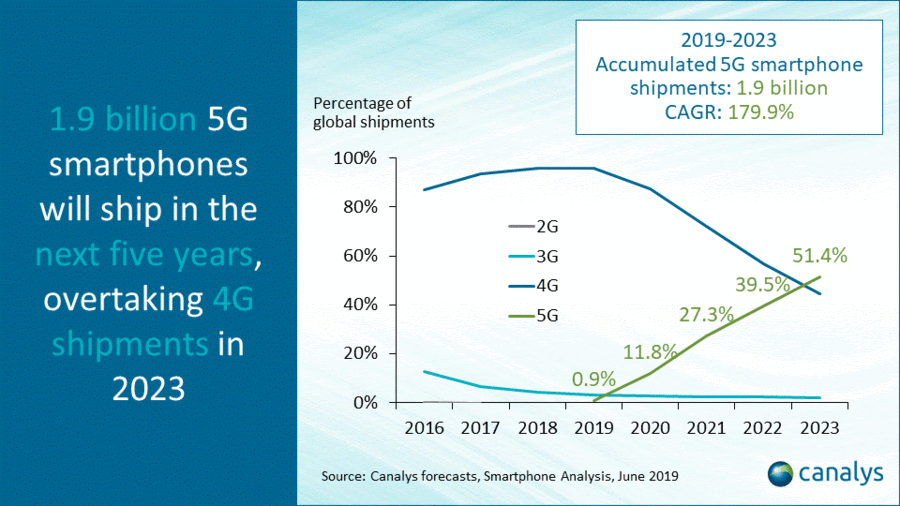
5G is pretty universally regarded as the next key mobile trend, but it’s not going to happen overnight. A new report from Canalys has 2023 as the true pivot point, when 5G handset shipments finally overtake 4G. That’s roughly five years, with 2019 included. Of course, that’s the global number, and these things will almost will almost certainly vary from market to market.

unnamed 2

The firm has 5G phones hitting 800 million shipments in 2023, which will comprise 51.4 percent of the global market for the year. That will bring the total shipments up to 1.9 billion since the first 5G capable devices were launched this year. North America will make up 18.8 percent of the market to Greater China’s 34 percent.

That’s big, continued growth for China, which surpassed the U.S. for the title of the largest smartphone market back in 2011. While the Chinese economy has slowed and taken its high end smartphone market with it, the country is well positioned to be an important player in the race to 5G.

“5G smartphones will see rapid adoption in China, thanks to a strong government technology roadmap and operators’ financial capabilities,” Canalys mobile VP Nicole Peng said in a statement. “China is also home to many major 5G equipment suppliers and smartphone vendors, which will be responsible for an aggressive marketing push over the next few years.”


from RSSMix.com Mix ID 8176981 https://techcrunch.com/2019/07/01/analysts-think-global-5g-smartphone-shipments-will-overtake-4g-in-2023/
http://www.gadgetscompared.com
from Tumblr https://ikonografico.tumblr.com/post/185980811271
via http://www.gadgetscompared.com