Monday, July 8, 2019

Google’s Pixel 4 renders surface and all anyone can do is stare at that top bezel

This time last month, Google took the surprise (and anticlimactic) move of tweeting out images of the Pixel 4 well ahead of its October launch. Of course, that glimpse just focused on the rear of the device. Not only was the company looking to nip leaks in the bud, they were almost certainly attempting to show off their camera array before Apple got the jump on them.

New 3D renders from OnLeaks may reveal why Google wasn’t in a rush to show off the front of the phone. The 6.25-inch phone appears to maintain the company’s staunch indifference to the war of notch attrition, forgoing the hole-punch camera from what appears to be a sizable top bezel (forehead).

Perhaps there’s something to be said for the company sitting this out while the competition battles things out with all sorts of solutions, from pop-up cameras to jamming them into displays. Besides, the Pixel XL got dinged for its giant notch, so you’re damned if you do, etc.

As always, take these early renders with a grain of salt, but the source has a pretty good track record with this stuff.

Questionable aesthetics aside, the latest batch of rumors do reveal a fair number of features coming to the phone three or so months out. The handset appears to ditch the rear fingerprint sensor, leading to speculation that the tech has been ditched for face unlock or Google is doing fingerprint readings through the screen, perhaps using Qualcomm tech.

The device its said to sport two selfie cameras and perhaps some matter of gesture detection up top (that last bit seems to be largely speculation), which could account for that additional bezel real estate. On the back is a triple camera array, maintaining the company’s standard camera innovations.


from RSSMix.com Mix ID 8176981 https://techcrunch.com/2019/07/08/googles-pixel-4-renders-surface-and-all-anyone-can-do-is-stare-at-that-top-bezel/
http://www.gadgetscompared.com
from Tumblr https://ikonografico.tumblr.com/post/186148440391
via http://www.gadgetscompared.com

Thursday, July 4, 2019

UnitedMasters releases iPhone app for DIY cross-service music distribution

Alphabet-backed UnitedMasters, the music label distribution startup and record label alternative that offers artists 100 percent ownership of everything they create, launched its iPhone app today.

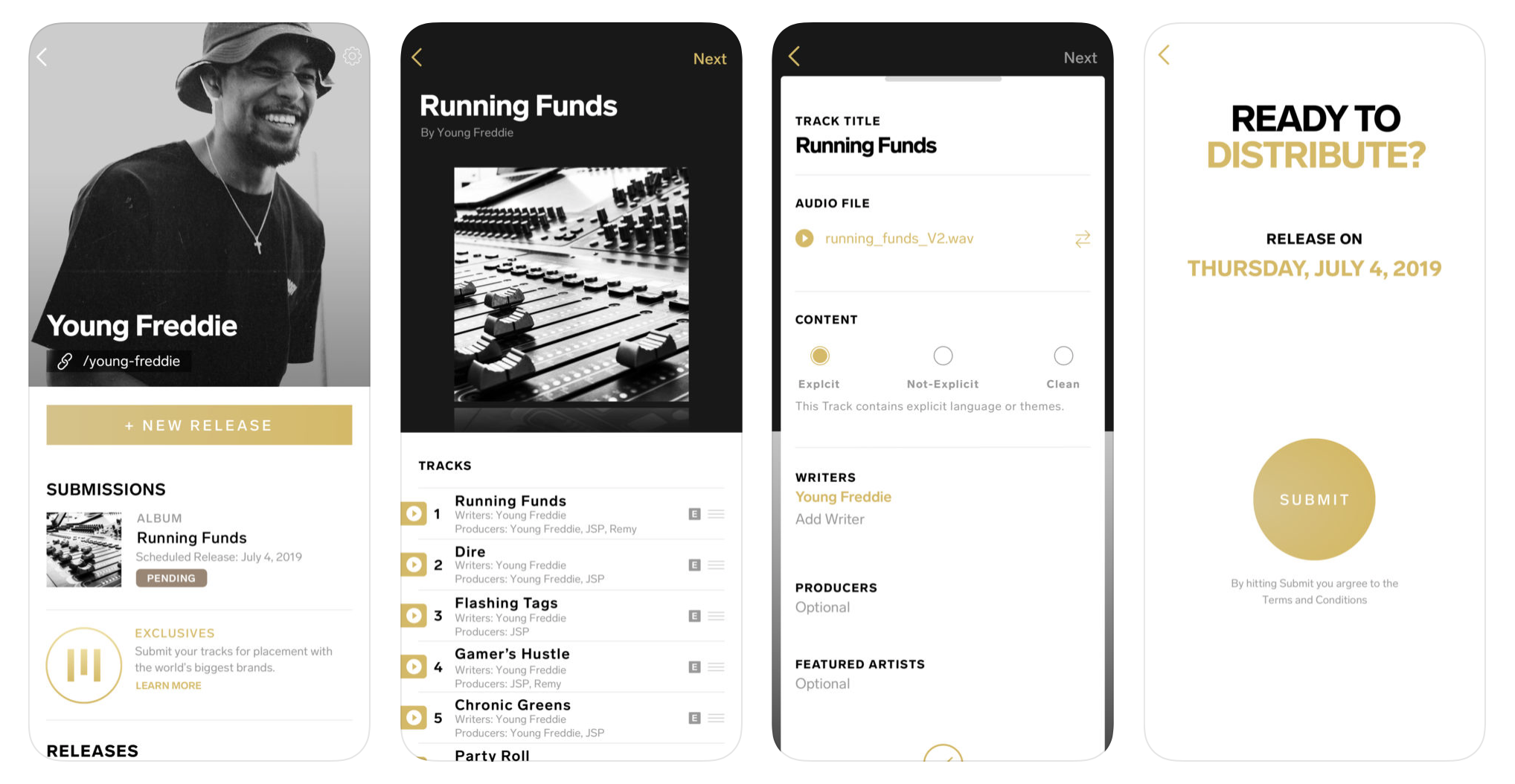
The iPhone app works like the service they used to offer only via the web, giving artists the chance to upload their own tracks (from iCloud, Dropbox or directly from text messages), then distribute them to a full range of streaming music platforms, including Spotify, Apple Music, Tidal and more. In exchange for this distribution, as well as analytics on how your music is performing, UnitedMasters takes a 10% share on revenue generated by tracks it distributes, but artists retain full ownership of the content they create.

UnitedMasters also works with brand partners, including Bose, the NBA and AT&T, to place tracks in marketing use across the brand’s properties and distributed content. Music creators are paid out via PayPal once they connect their accounts, and they can also tie-in their social accounts for connecting their overall online presence with their music.

UnitedMasters

Using the app, artists can create entire releases by uploading not only music tracks but also high-quality cover art, and by entering information like whether any producers participated in the music creation, and whether the tracks contain any explicit lyrics. You can also specific an exact desired release date, and UnitedMasters will do its best to distribute across services on that day, pending content approvals.

UnitedMasters was founded by former Interscope Records president Steve Stoute, and also has funding from Andreessen Horwitz and 20th Century Fox. It’s aiming to serve a new generation of artists who are disenfranchised by the traditional label model, but seeking distribution through the services where listeners actually spend their time, and using the iPhone as manage the entire process definitely fits with serving that customer base.


from RSSMix.com Mix ID 8176981 https://techcrunch.com/2019/07/04/unitedmasters-releases-iphone-app-for-diy-cross-service-music-distribution/
http://www.gadgetscompared.com
from Tumblr https://ikonografico.tumblr.com/post/186058296226
via http://www.gadgetscompared.com

HQ Trivia lays off ~20% as it preps subscriptions

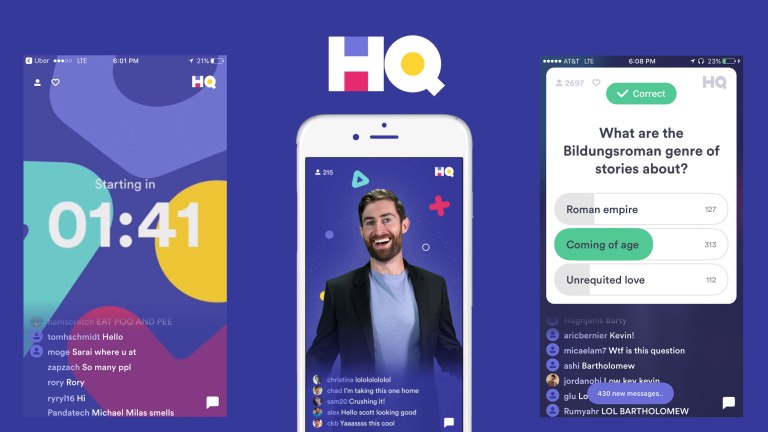
HQ Trivia is struggling after a mutiny failed to oust its CEO. Downloads per month are down 92% versus last June according to Sensor Tower. And now four sources confirm that HQ laid off staff members this week. One said about 20% of staff was let go, and another said six to seven employees were departing. That aligns with Digiday reporter Kerry Flynn’s tweet that 7 employees were let go bringing HQ to under 30 (shrinking from 35 to 28 staffers would be a 20% drop).

That will leave the company short-handed as it attempts to diversify revenue with the upcoming launch of monthly subscriptions. “HQ Words Everyday. Coming next month …  Bigger prizes … More ways to win. $9.99/mo. subscription” the company tweeted from the account for its second game, the Wheel Of Fortune-style HQ Words. The company has been trying to regain momentum with new hosts since the departure of Quiz Daddy aka Scott Rogowsky, HQ Trivia’s original host.

hq trivia app 1

The cuts hit HQ’s HR, marketing, and product engineering teams, according to LinkedIn profiles of employees let go. The cuts could further hamper morale at the startup following a tough first half of the year. HQ Trivia and co-founder Rus Yusupov did not respond to repeated requests for comment.

HQ Trivia employees petitioned to remove co-founder Rus Yusupov from the CEO position

Following the tragic death of co-founder and CEO Colin Kroll, Yusupov retook control. But staff found him difficult to work with as he’d allowed the product to stagnate and popularity to decline. Yusupov was slow to make changes to the app, and “no one wanted to work under Rus” a source told me.

That led 20 of 35 staffers to sign a letter to HQ Trivia’s board asking them to remove Yusupov, though it was never formally sent. Yusupov caught wind of the plot and fired two of the leaders of the petition. That further sunk morale, leading to the exit of HQ Trivia’s SVP of brand partnerships and its marketing manager. The board began a search for a new CEO, though it’s unclear how that’s panned out.

Since then, new games HQ teased in April haven’t materialized as its download rate continued to suffer. It’s dropped to the #731 US game on iOS according to AppAnnie. HQ Trivia saw just 827,000 downloads from January through June 2019, down 92% from the 10.2 million it saw in the same time frame in 2018 according to Sensor Tower. That’s the same percentage drop in downloads from June 2019 versus June 2018, indicating Rogowsky’s replacements that started in April couldn’t turn things around.

Interest in the live game show format seems to be waning as a whole. HQ Trivia fan site HQTrivia.fan shut down this week fearing the end was near for the official game, and the (Business) INSIDER-run clone of the game on Facebook Watch called Confetti stopped airing at the end of June.

Rather than solely monetizing a waning audience via in-app purchases and sponsorships, HQ Words announced it would debut a $9.99 monthly subscription sometime this month that would grant access to winning “bigger prizes”. This could be a smart way to squeeze more dollars out of a smaller but more diehard audience.

While HQ Trivia was an inspiring approach to mobile gaming, its twice-daily games didn’t fit the always-on nature of mobile. It’s failed build a proper onboarding experience that gives users a taste of it games right away rather than forcing them to wait for the next scheduled match as we suggested over a year ago. Gamers are fickle, craving instant gratification, and HQ hasn’t tried to meet them in middle.

Perhaps there’s a future for HQ on cable television, or as a small but steady business on mobile catering to loyalists. But all the unfortunate events and mismanagement may make it difficult to exceed the $100 million valuation it raised money at during its peak.


from RSSMix.com Mix ID 8176981 https://techcrunch.com/2019/07/04/hq-trivia-layoffs/
http://www.gadgetscompared.com
from Tumblr https://ikonografico.tumblr.com/post/186055462336
via http://www.gadgetscompared.com

Wednesday, July 3, 2019

App revenue tops $39 billion in first half of 2019, up 15% from first half of last year

App store spending is continuing to grow, although not as quickly as in years past. According to a new report from Sensor Tower, the iOS App Store and Google Play combined brought in $39.7 billion in worldwide app revenue in the first half of 2019 — that’s up 15.4% over the $34.4 billion seen during the first half of last year. However, at that time, the $34.4 billion was a 27.8% increase from 2017’s numbers, then a combined $26.9 billion across both stores.

Apple’s App Store continues to massively outpace Google Play on consumer spending, the report also found.

In the first half of 2019, global consumers spent $25.5 billion on the iOS App Store, up 13.2% year-over-year from the $22.6 billion spent in the first half of 2018. Last year, the growth in consumer spending was 26.8%, for comparison’s sake.

Still, Apple’s estimated $25.5 billion in the first half of 2019 is 80% higher than Google Play’s estimated gross revenue of $14.2 billion — the latter, a 19.6% increase from the first half of 2018.

The major factor in the slowing growth is iOS in China, which contributed to the slowdown in total growth. However, Sensor Tower expects to see China returning to positive growth over the next 12 months, we’re told.

To a smaller extent, the downturn could be attributed to changes with one of the top-earning apps across both app stores: Netflix.

Last year, Netflix dropped in-app subscription sign-ups for Android users. Then, at the end of December 2018, it did so for iOS users, too. That doesn’t immediately drop its revenue to zero, of course — it will continue to generate revenue from existing subscribers. But the number will decline, especially as Netflix expands globally without an in-app purchase option, and as lapsed subscribers return to renew online with Netflix directly.

In the first half of 2019, Netflix was the second highest-earning non-game app with consumer spending of $339 million, Sensor Tower estimates, down from $459 million in the first half of 2018. (We should point out the firm bases its estimates on a 70/30 split between Netflix and Apple’s App Store that drops to 85/15 after the first year. To account for the mix of old and new subscribers, Sensor Tower factors in a 25% cut. But Daring Fireball’s John Gruber claims Netflix had a special relationship with Apple where it had an 85/15 cut from year one.)

In any event, Netflix’s contribution to the app stores’ revenue is on the decline.

In the first half of last year, Netflix had been the No. 1 non-game app for revenue. This year, that spot went to Tinder, which pulled in an estimated $497 million across the iOS App Store and Google Play, combined. That’s up 32% over the first half of 2018.

1h 2019 app revenue worldwide

But Tinder’s dominance could be a trend that doesn’t last.

According to recent data from eMarketer, dating app audiences have been growing slower than expected, causing the analyst firm to revise its user estimates downward. It now expects that 25.1 million U.S. adults will use a dating app monthly this year, down from its previous forecast of 25.4 million. It also expects that only 21% of U.S. single adults will use a dating app at all in 2019, and that will only grow to 23% by 2023.

That means Tinder’s time at the top could be overrun by newcomers in later months, especially as new streaming services get off the ground (assuming they offer in-app subscriptions); if TikTok starts taking monetization seriously; or if any other large apps from China find global audiences outside of China’s third-party app stores.

For example, Tencent Video grossed $278 million globally in the first half of 2019, outside of the third-party Chinese Android app stores. That made it the third-largest non-game app by revenue. And Chinese video platform iQIYI and YouTube were the No. 4 and No. 5 top-grossing apps, respectively.

Meanwhile, iOS app installs actually declined in the first half of the year, following the first quarter that saw a decline in downloads, Q1 2019, attributed to the downturn in China.

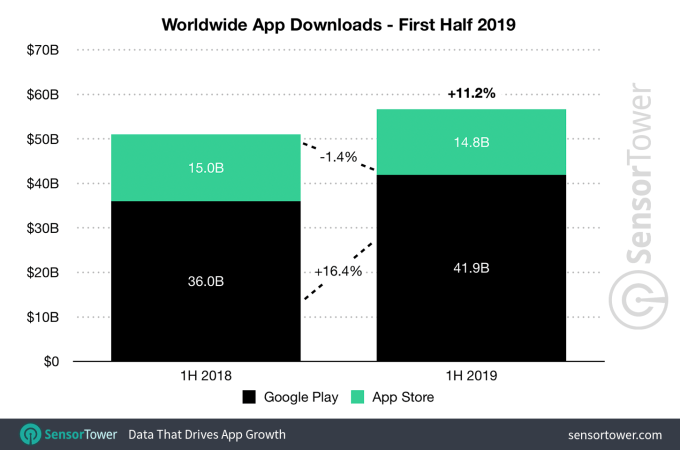
The App Store in the first half of 2019 accounted for 14.8 billion of the total 56.7 billion app installs.

Google Play installs in the first half of the year grew 16.4% to 41.9 billion, or about 2.8 times greater than the iOS volume.
1h 2019 app downloads worldwide

The most downloaded apps in the first half of 2019 were the same as before: WhatsApp, Messenger, and Facebook led the top charts. But TikTok inched ahead of Instagram for the No. 4 spot, and it saw its installs grow around 28% to nearly 344 million worldwide.

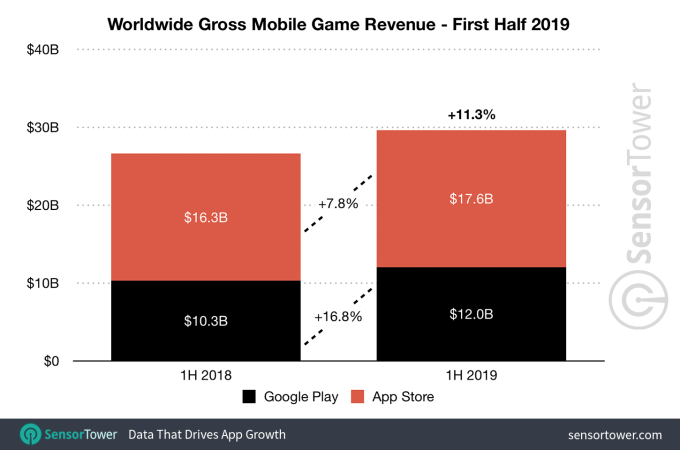
In terms of mobile gaming specifically, spending was up 11.3% year-over-year in the first half of 2019, reaching $29.6 billion across the iOS App Store and Google Play. Thanks to the fallout of the game licensing freeze in China, App Store revenue growth for games was at $17.6 billion, or 7.8% year-over-year growth. Google Play game spending grew by 16.8% to $12 billion.

The top-grossing games, in order, were Tencent’s Honor of Kings, Fate/Grand Order, Monster Strike, Candy Crush Saga, and PUBG Mobile.
1h 2019 game revenue worldwide

Meanwhile, the most downloaded games were Color Bump 3D, Garena Free Fire, and PUBG Mobile.

Image credits: Sensor Tower


from RSSMix.com Mix ID 8176981 https://techcrunch.com/2019/07/03/app-revenue-tops-39-billion-in-first-half-of-2019-up-15-from-first-half-of-last-year/
http://www.gadgetscompared.com
from Tumblr https://ikonografico.tumblr.com/post/186030811736
via http://www.gadgetscompared.com

Reliance Jio partners with Facebook to launch literacy program for first time internet users in India

Mukesh Ambani, India’s richest man, has enabled tens of millions of people — if not more — to come online for the first time with his disruptive telecom network. He has changed how many Indians, once thrifty about each megabyte they spent browsing the internet, consume mobile data today.

But many of these first time internet users are increasingly struggling with grasping the nuances of the internet — often ending up trusting everything they see online and, in extreme cases, causing major chaos in the nation. Ambani now wants to help these people understand the ins and outs of the digital world.

His telecom network Reliance Jio announced today a literacy program called ‘Digital Udaan’ for first time internet users in India. The two-and-a-half-year-old telecom network, which has amassed more than 300 million subscribers, said it has partnered with Facebook to create “the largest ever digital literacy program” that will offer audio-visual training in 10 regional languages.

As part of the Digital Udaan program, Reliance Jio will hold training sessions to help its users learn about internet safety, and how they should engage with popular services and its devices. The operator said it will hold these sessions each Saturday and also provide training videos and information brochures to users.

Reliance Jio said Facebook helped it build and curate modules that are relevant for people in cities and small towns in India. In the first phase of the program, Jio will conduct these training sessions in about 200 different locations across 13 states. It will then expand it to over 7,000 locations where “millions of JioPhone users and other first-time internet users” live.

“Facebook is an ally in this mission, and we are delighted to partner with Jio in attracting new Internet users and creating mechanisms for them to unleash the power of that access,” Ajit Mohan, VP and MD of Facebook India, said in a statement. Facebook and WhatsApp count India, where they reach about 350 million users, as their largest and fastest growing market. There are more than 500 million internet users in India.

Akash Ambani, Director of Reliance Jio, said he hopes to “help eradicate barriers of information asymmetry and provide accessibility in real time. It is a program for inclusive information, education and entertainment, where no Indian will be left out of this digital drive. Jio envisions to take this to every town and village of India, achieving 100% digital literacy in the country.”

Reliance Jio, through its free voice calls and low-data prices, has significantly helped accelerate the growth of India’s internet and smartphone ecosystem. The platform has brought the nation, now the world’s second largest internet and smartphone market, to a point that many thought would have taken more than five years to reach.

But this growth has also accompanied new sets of challenges. WhatsApp, which is the most popular app in India, continues to grapple with spread of false information in the nation, for instance. Other social media services are facing similar challenges as well. Last year, WhatsApp began to air TV commercials in India to help users become more cautious about the messages they share on its service. It also partnered with Reliance Jio to pay for teams of performers to travel across India and hold roadshows to help people better understand the rampant rise of fake news.


from RSSMix.com Mix ID 8176981 https://techcrunch.com/2019/07/03/reliance-jio-facebook-digital-literacy-udaan-india/
http://www.gadgetscompared.com
from Tumblr https://ikonografico.tumblr.com/post/186028559121
via http://www.gadgetscompared.com

Samsung’s Galaxy Fold problems are reportedly fixed — so now what?

In a recent interview, Samsung CEO DJ Koh noted that the company was hard at work on Galaxy Fold fixes (he also said people won’t be using smartphones in five years, so who knows?). And now, a report from Bloomberg confirms that the company has put the finishing touches on those fixes two months after the handset was originally set to debut.

So now what? We still don’t have a date. We’ve been seeing promises that a firmer timeline for release would arrive in “coming weeks” for what seems like months now. But those “people familiar with the matter” who told the site that the phone is finally read for prime time aren’t offering any additional info on timeframe.

Instead, it looks like the company’s plans are to — at very least — have its first foldable available in time for the holidays. At just under $2,000, that’s a pretty hefty ask for a stocking stuffer. Given that Samsung has now officially confirmed its Note 10 event for August 7, it might well just wait for that big show to confirm the release date — especially if we’re not expecting the see it hit retail until Q4.

Samsung’s been through worse, of course. The Note 7 debacle was a bigger black eye both in terms of timing and scope. But the initial spate of problems with the handset felt like as much of an indictment of the category as Samsung’s methods. Even Huawei used it as an opportunity to put its Mate X through more rigorous testing. Whatever the case, the revolution is going to take even longer to unfold than expected.


from RSSMix.com Mix ID 8176981 https://techcrunch.com/2019/07/03/samsungs-galaxy-fold-problems-are-reportedly-fixed-so-now-what/
http://www.gadgetscompared.com
from Tumblr https://ikonografico.tumblr.com/post/186028558956
via http://www.gadgetscompared.com

Tuesday, July 2, 2019

Uber Eats invades restaurants with Dine-In option

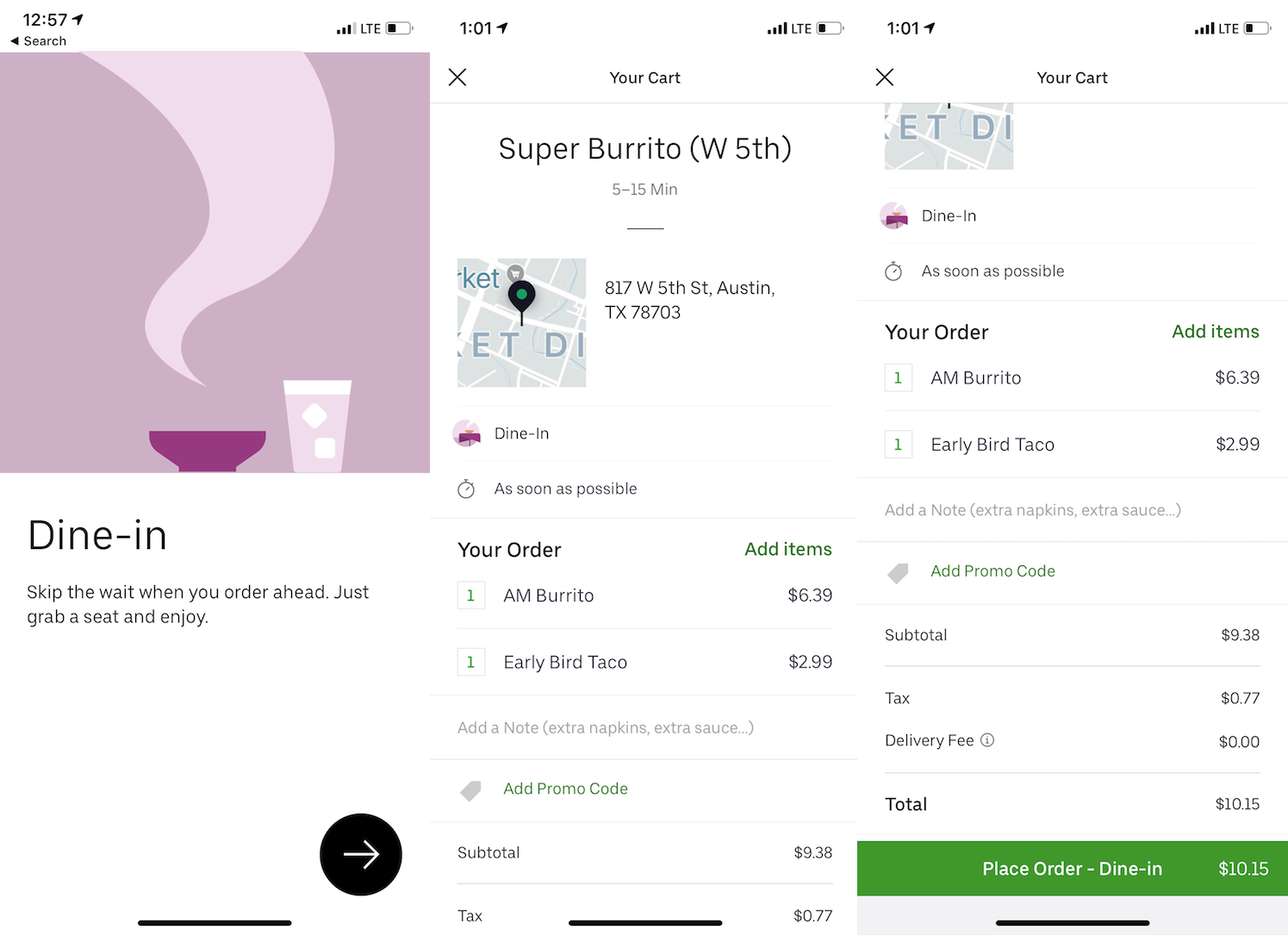
Tired of cleaning up after take-out or getting hangry waiting at your table in restaurants? Well Uber Eats is barging into the dine-in business. A new option in some cities lets you order your food ahead of time, go to the restaurant, and then sit down inside to eat, a tipster from competing dine-in app Allset tells us. We tested it, and Uber Eats Dine-In even waives the standard Uber delivery and service fees.

Adding Dine-In lets Uber Eats insert itself into more food transactions, expand to restaurants that care about presentation and don’t do delivery, and avoid paying drivers while earning low-overhead revenue. Uber’s Dine-In option is now available in some cities including Austin, Dallas, Phoenix and San Diego where it could save diners time and fees while helping restaurants fill empty tables and waiters earn tips. But it also could coerce more restaurants to play ball with UberEats if their competitors do, eating into their margins.

UberEats Dine In Option

Uber confirmed the existence of the Dine-In option, telling me “We’re always thinking about new ways to enhance the Eats experience.” They also verified there are no delivery or service fees, and restaurants get 100% of tips left in-app buy users. However, we found some items were silently marked up from restaurants’ listed prices in both Uber Eats Delivery and Dine-In options, which could help it make some money directly from these purchases. We also discovered this buried Uber Help Center FAQ with more details.

Uber has been rapidly experimenting with Uber Eats, trying discounted specials, Uber Eats Pool where you pay less for slower delivery, and $9.99 unlimited delivery subscriptions. It’s steadily becoming an omnivore.

How Uber Dine-In Works

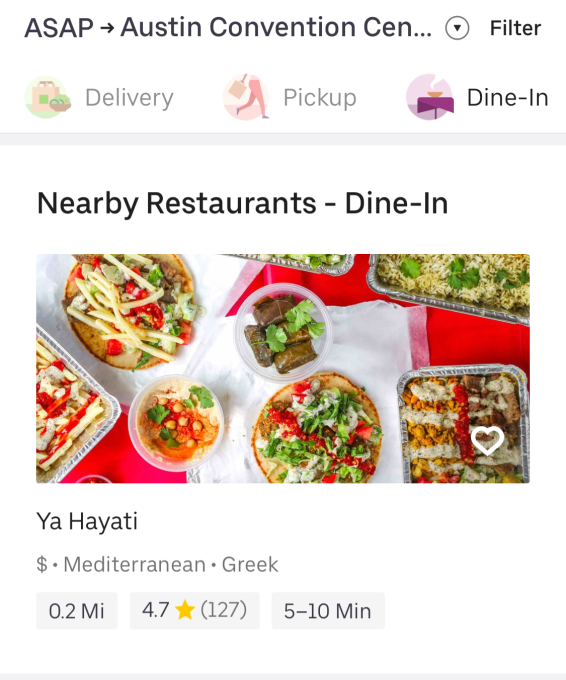
Dine-in appears next to the Delivery and Pick-Up options across the top of the Uber Eats app in select cities. You can choose to go eat “ASAP” or in some cases schedule when you want to arrive and sit down. You’ll be shown how long the food will take to prep, distance to the restaurant, your price, and the restaurant’s rating. You’ll then be notified as the order is prepared and approaches readiness. Then you just deliver yourself to the restaurant and add a tip in-app or on the table.

Uber Eats should obviously make it easy for you to hail an Uber with the restaurant as the pre-set destination. An Uber spokesperson called that a good idea but not something it’s doing yet. Back in 2016, Uber tried a merchant-sponsored rides option where you’d get a rebate on your travel if you spent money at a given store. You could imagine restaurants that want to show off their ambiance giving customers some money back if they come across town to eat there.

Uber Dine In

The new feature could spell trouble for other dine-in apps like Allset that’s been in the business for four years. Users might also opt for Uber Eats Dine-In over restaurant reservation apps like OpenTable and Resy. Why waste time waiting to order and for your food to be cooked when you could just show up as it comes out of the oven?

“I think that more delivery players will be tapping into dine-in space. It’s all about convenience and time saving. But it’s going to be very difficult for them, given their focus on delivery” AllsetCEO Stas Matviyenko said of Uber becoming a competitor. He believes dedicated apps for different modes of dining will succeed. But Uber Eats’ ubiquity and its one-stop-shop model for all your dining needs could make it stickier than a dine-in only app you use less frequently.

UberEatsheader

With Dine-In, Uber could aid restaurants that are empty at the start or end of their open hours. Last year we reported that Uber Eats was giving restaurants prominence in a Featured section of the app to drive up demand if they offered discounts to customers. Similarly, Uber could let restaurants entice more Dine-In customers especially when foot-traffic was slow by providing discounts on food or subsidized Uber transportation. Better to knock a dollar or two off an entree if it means filling the restaurant at 5:30 or 9:30pm.

And now that Uber Eats does delivery, take-out, and dine-in, it’d make perfect sense to offer traditional restaurant reservations through the app as well. That would pit it directly against OpenTable, Resy, and Yelp. Instead of trying to own a single use case that might only appeal to certain demographics in certain situations, Uber Eats’ strategy is crystallizing: be the app you open whenever you’re hungry.


from RSSMix.com Mix ID 8176981 https://techcrunch.com/2019/07/02/uber-dine-in/
http://www.gadgetscompared.com
from Tumblr https://ikonografico.tumblr.com/post/186012387496
via http://www.gadgetscompared.com