Tuesday, October 8, 2019

What the hell is up with this Essential device?

Essential CEO Andy Rubin has been pretty silent over the past year for, well, lots of reasons — both business and otherwise. The company has struggled to sell devices, reportedly shipping only 88,000 handsets in its first year. On a far more serious note, Rubin has been plagued by reports of inappropriate behavior during his time at Google. A bombshell report from The New York Times highlighted sexual misconduct accusations prior to his receiving a $90 million exit package from the company. 

The former Google executive last used Twitter to state that the story “contains numerous inaccuracies about my employment at Google.” Now, a year later, he’s back on the platform touting a new device. It could be the next Essential handset, or it could be something else entirely.

It’s not the shiny “GEM Colorshift material” on the back that’s caught viewers’ eyes, as much as the “new UI for radically different formfactor.” The closet thing I can thing to compare the long, skinny handset to is the new Galaxy Fold when closed. Of course, this has the decided advantage of a full length screen.

The UI appears to be a collection of different widgets, each sporting different apps: weather, maps, calendar and Uber on one, with a full length map on the other. It’s certainly different and even more of a departure from the original Essential handset, which had very little of the industry revolutionizing impact the company was initially hoping for.

A spokesperson for the company confirmed that the new device is in “early testing” in the real world, which is probably why Rubin opted to get out in front of leaks by showing the half-phone on his own terms, rather than grainy leaks. Here’s the official statement from Essential:

We’ve been working on a new device that’s now in early testing with our team outside the lab. We look forward to sharing more in the near future.

There are, of course, way more questions than answers right now, like whether the company is abandoning the first gen’s modular attachment system. Also, is the lack of cellular information at top a sign? Is this why the company acquired CloudMagic? Can one say this is truly “essential”?

At the very least, the existence of such a device does seem to contradict earlier rumors about Rubin canceling the device and attempting to sell the company. Maybe. If I had to venture a guess, I’d say Essential is courting a similar secondary handset market as Palm — though that, too, didn’t exactly set the smartphone world ablaze.

More soon, I suppose.


from RSSMix.com Mix ID 8176981 https://techcrunch.com/2019/10/08/what-the-hell-is-up-with-this-essential-device/
http://www.gadgetscompared.com
from Tumblr https://ikonografico.tumblr.com/post/188227434971
via http://www.gadgetscompared.com

Instagram launches Create mode with On This Day throwbacks

Instagram has finally turned Throwback Thursday into an official feature. It’s part of the new Instagram “Create” mode that launches today in Stories, bringing the app beyond the camera. Create makes Instagram a more omni-purpose social network with the flexibility to adapt to a broader range of content formats.

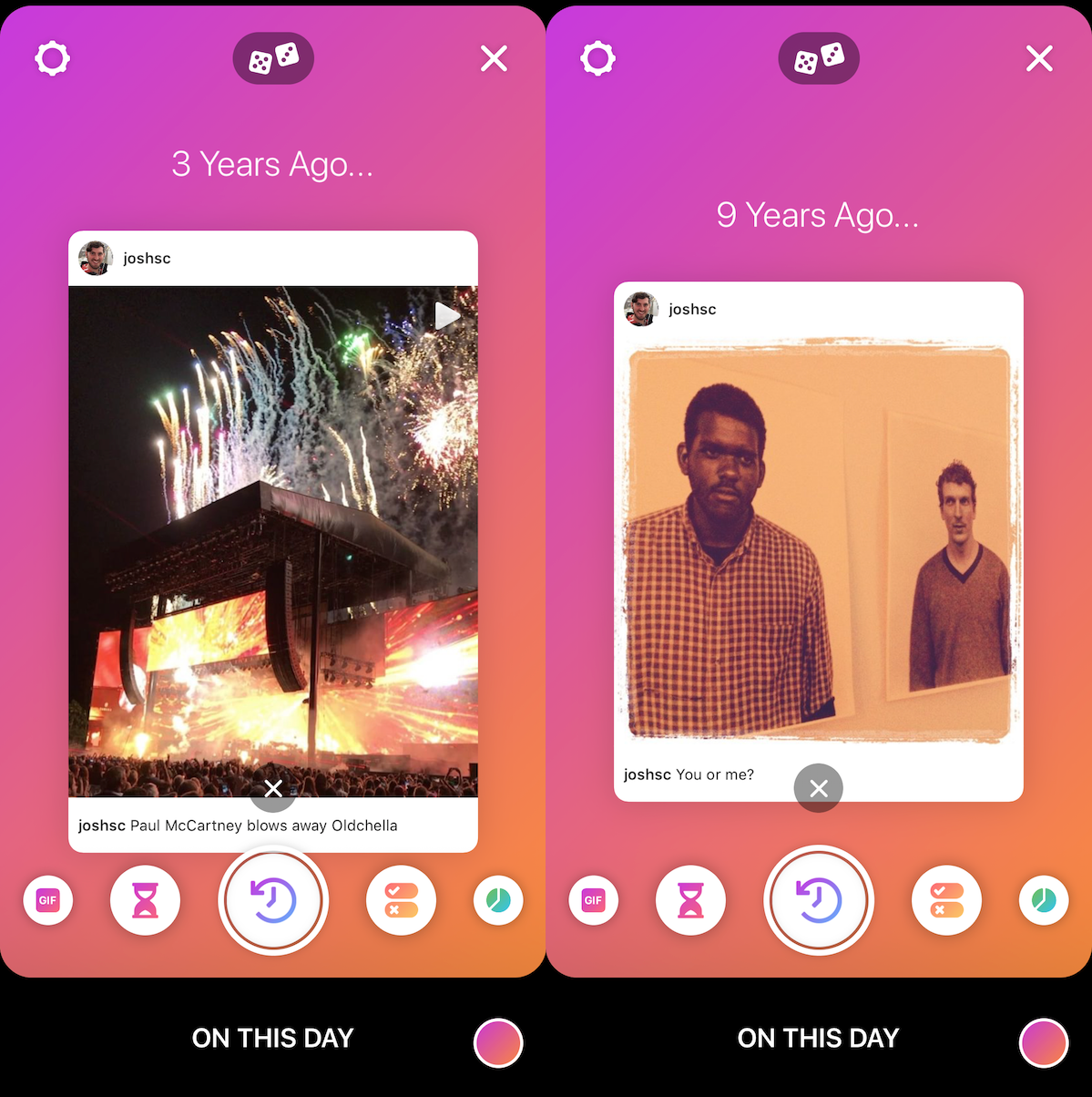
For now, the highlight of Create is the “On This Day” option that shows a random feed post you shared on the same calendar date in the past. Tap the dice button to view a different On This Day post, and once you find one you prefer, you can share it to Stories as an embedded post people can open.

The launch could make it easy for users to convert their old impermanent content into fresh ephemeral content. That could be especially helpful since not everyone does something Stories-worthy every day. And given how many #TBT throwbacks get shared already, there’s clearly demand for sharing nostalgia with new commentary.

Instagram Create On This Day

When asked about Create mode, an Instagram spokesperson told me “this new mode helps you combine interactive stickers, drawings and text without needing a photo or video to share … On This Day suggests memories and lets you share them via Direct and Stories.” It’d sure be nice if embedded On This Day video posts played inside of Stories, but for now you have to tap to open them on their own page.

Instagram actually launched a different way to share throwbacks called “Memories” early this year. But most users didn’t know about it since it was tucked in the Profile -> Three-Line ‘Hamburger’ Sidebar -> Archive option used to for Highlighting or Restoring expired Stories or post you’d hidden.

Instagram Archive Memories

Now ‘On This Day’ is much more accessible as part of the new Create Mode inside the Stories composer, which replaces Type mode with more options for sharing without your camera than just posting text. You can access it by swiping right at the bottom of the screen from the Stories camera, instead of left to other options like Boomerang. Create lets you use features otherwise added as Stickers atop photos and videos, but on their own with new suggestions of what to share:

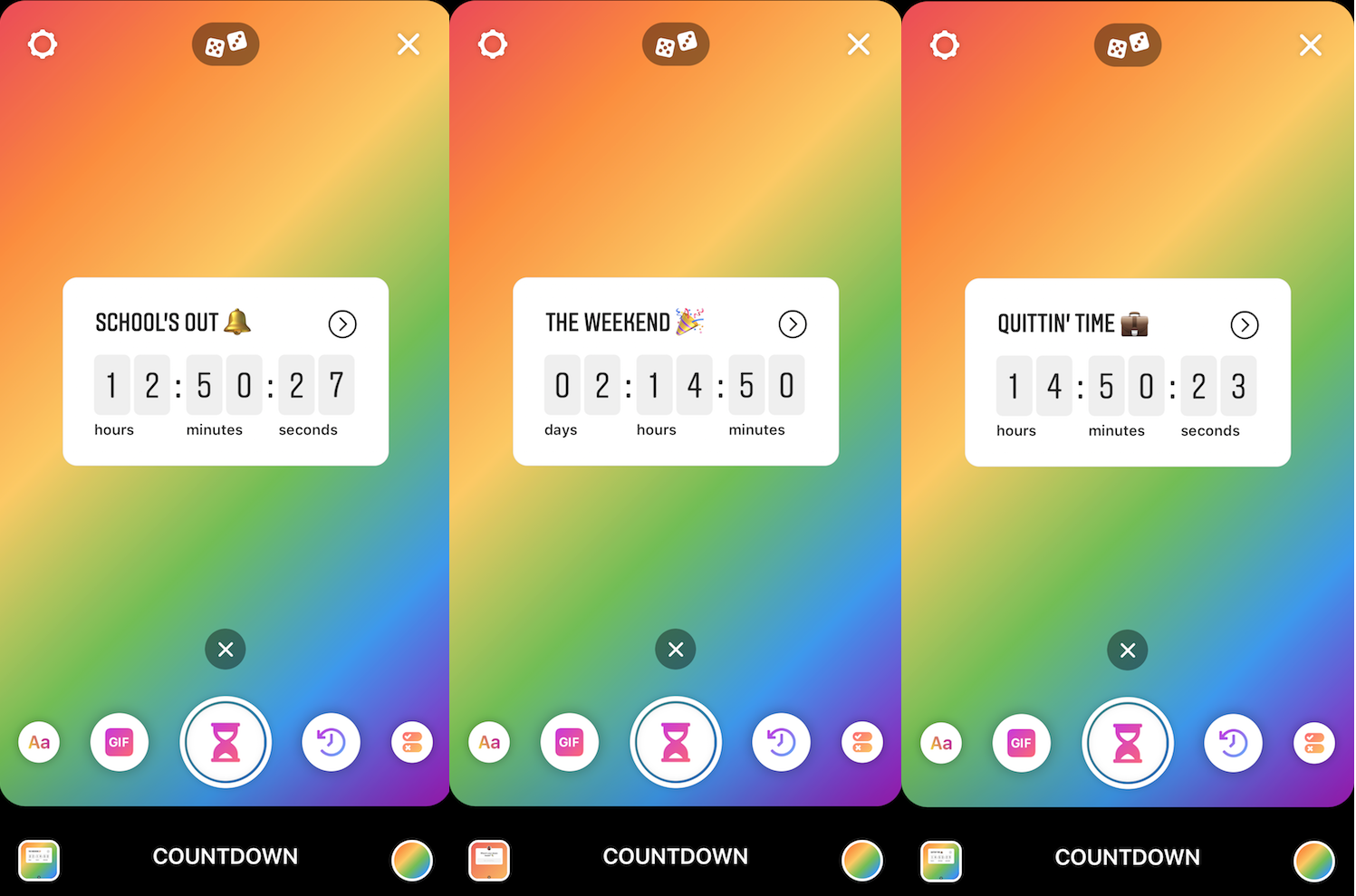
-Countdown timer with suggestions for “The Weekend”, “Quittin’ Time”, and “School’s Out”

Instagram Create Countdown

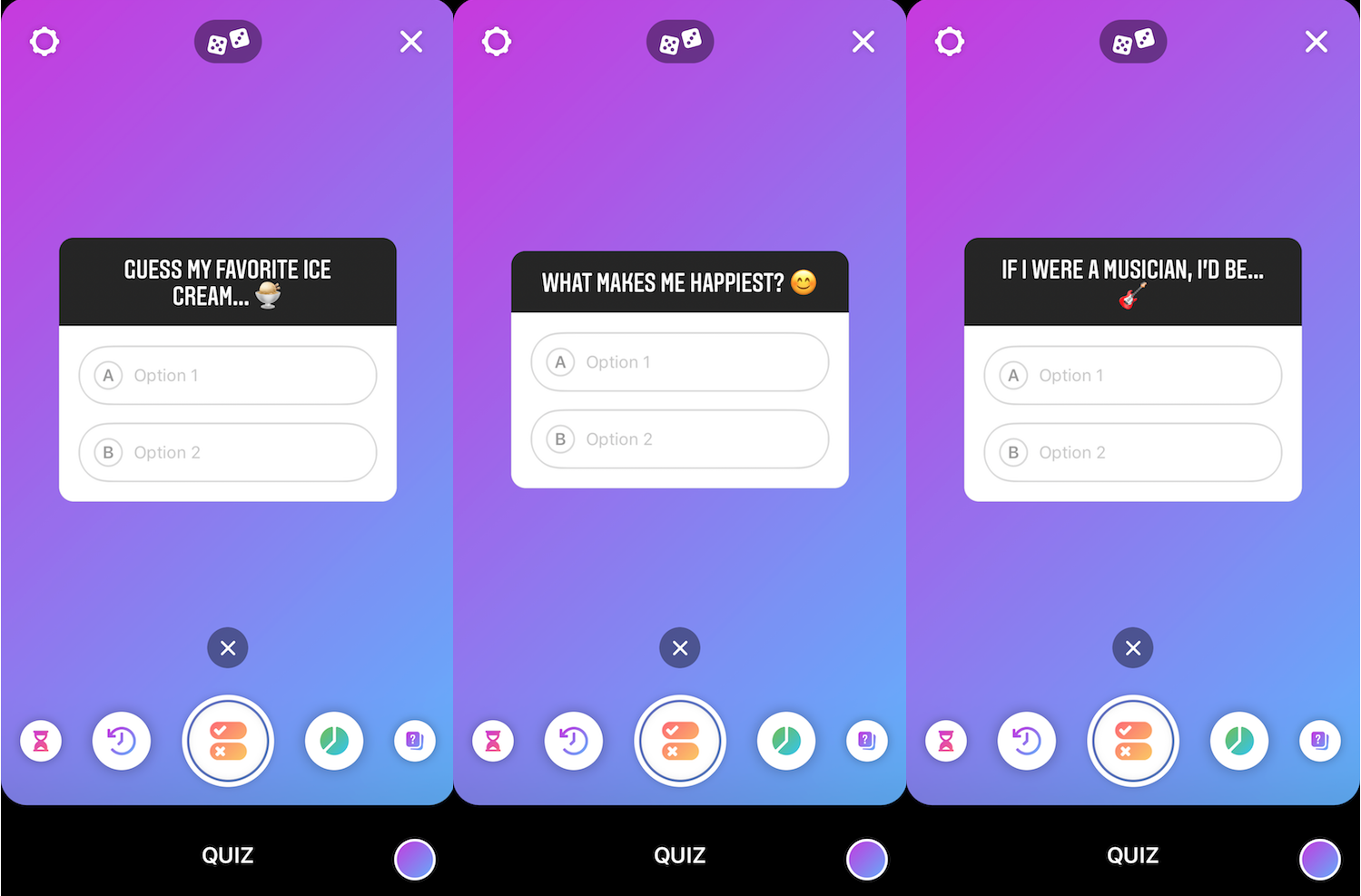
-Quiz with suggestions including “What’s my biggest fear?” and “Only one of these is true” (The Quiz sticker already had suggestions)

Instagram Create Quiz

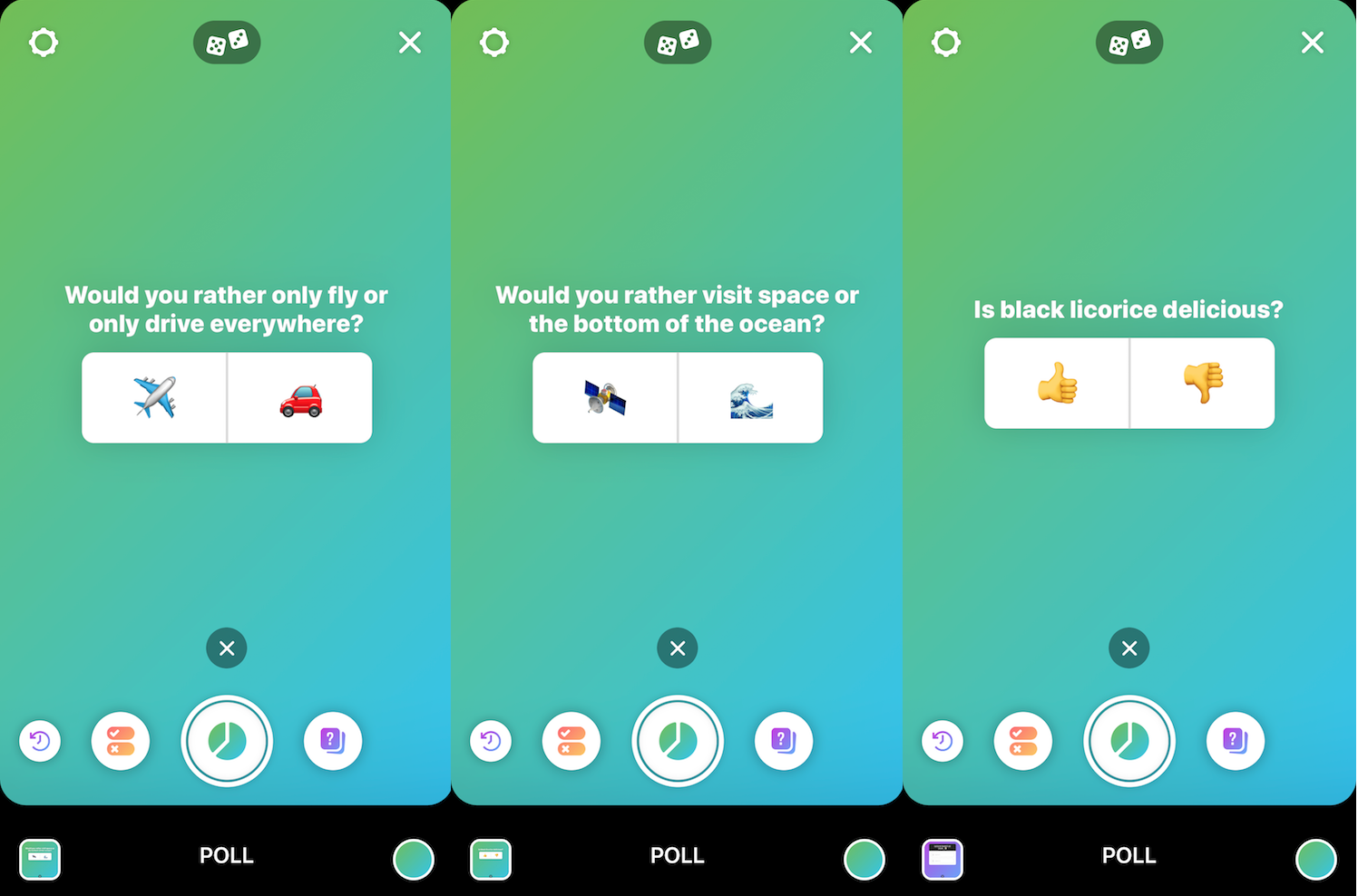
-Poll with suggestions including “Sweet or savory?” and “Better first date: dinner or movie?”

Instagram Create Poll

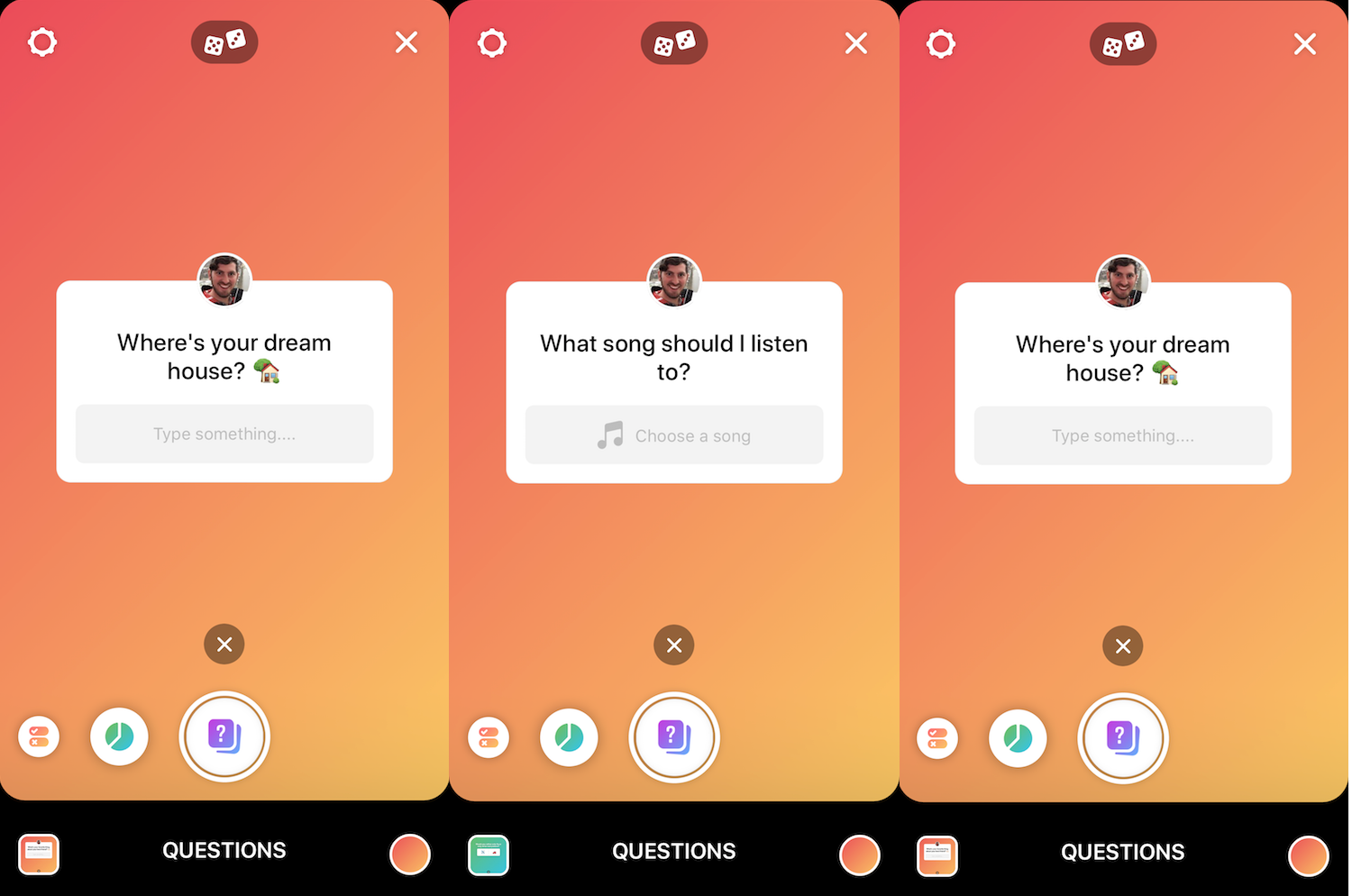
-Question with suggestions including “If you had 3 wishes…” and “Any hidden talents?”

Instagram Create Questions

Instagram is also offering a new version of its Giphy -powered GIFs feature inside Create. It lets you search for a GIF and see it tiled three times vertically as the background of your Create post, rather than laid on top.

Instagram Create GIFs

Through all these features, Create lets people generate new things to share even if they’re laying in bed or stuck somewhere. As Instagram grows internationally to more users with lower quality phones, and replaces Facebook for many people, the ability to share text and other stuff without having to use their camera could increase people’s posting. Between the Camera shutter modes and room for more sharing styles in Create, Instagram can encompass most any content.

As of today, Instagram is about more than photos and videos. It’s stepping up as a multi-faceted social app just as  Facebook’s battered brand becomes desperate to turn Instagram into its reputation and business lifeboat.


from RSSMix.com Mix ID 8176981 https://techcrunch.com/2019/10/08/instagram-create-mode/
http://www.gadgetscompared.com
from Tumblr https://ikonografico.tumblr.com/post/188225177976
via http://www.gadgetscompared.com

Microsoft adds per-app time limits to its parental controls

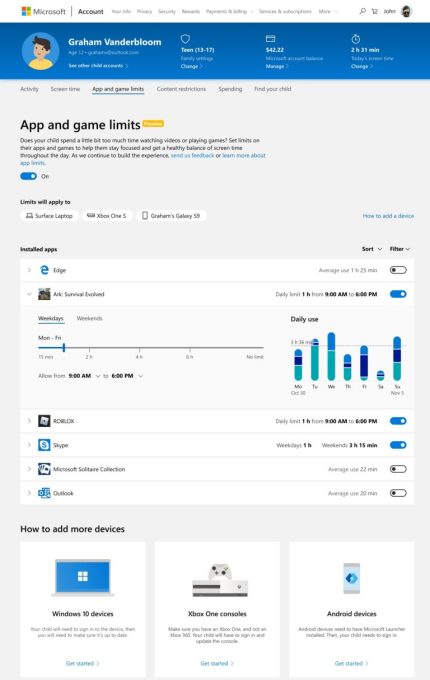
Microsoft is following Apple and Google’s lead with today’s launch of per-app and per-game time limits in its parental control software. Already, the company allows parents to limit screen time across Windows 10, Xbox One, and Android via the Microsoft Launcher. However, it hadn’t yet allowed parents to limit the amount of time a child would spend in a specific app or game, as its competitors do.

Instead, its existing controls allowed parents only to dole out a set amount of hours of screen time. Parents could choose to either leave the time up to the kids to manage, or limit it at the device level — like, only allowing one hour of Xbox time but permitting more screen time on the PC, for example.

However, the current trend in screen time management is not to approach all screen time as unproductive and unhealthy. Instead, it’s about configuring limits on the more addictive apps and games that eat up increasing amounts of children’s time, while permitting educational tools to have fewer limits.

For older kids and teens, social media apps like TikTok or Instagram could be the culprit, while younger kids may just be spending too much time “hanging out” in virtual worlds like Roblox and Fortnite. Problems on this front have gotten pretty bad. Mobile games are under fire for using gambling tactics like loot boxes to engage children. And Fortnite is now the subject of a lawsuit that claims that, in part, that the game’s addictive nature is due to its use slot machine-like mechanics and variable reward systems, which manipulate children’s brains.

Without being able to limit these apps directly, kids may end up using all of their allotted screen time on just the one app or game they’re obsessed with at the moment.

Apple had already allowed per-app time limits with the launch of its screen time controls in iOS 12. And Google more recently updated its own Family Link software, now preinstalled on new Android devices, to include a similar feature.

With today’s update, Microsoft is now on board, too.

microsoft per app time limits

The new app and game limits parents set will apply across Windows 10, Xbox and Android devices running Microsoft Launcher. In other words, kids can’t get more game time just by switching devices.

The controls also allow parents to offer more screen time on certain days — like weekends, for instance — than others.

To use this feature, parents will need to create a family group and make Microsoft accounts for all the kids.

Once enabled, kids will get a warning about their screen time 15 minutes before the limit is reached, and then again at 5 minutes. Since kids will often beg for a few more minutes, Microsoft made it easy for parents to grant or deny more time via email or via a Microsoft Launcher notification on their own Android phone.

The per-app time limits are launching today in preview within Microsoft’s existing family settings.

“Ultimately, our goal is for the app and game limits feature to provide flexible and customizable tools to meet each family’s unique needs,” the company explains in an announcement. “You as parents know what’s best for your children — no technology can ever replace that — but we’re hoping these tools can help you to strike the right balance,” it says.


from RSSMix.com Mix ID 8176981 https://techcrunch.com/2019/10/08/microsoft-adds-per-app-time-limits-to-its-parental-controls/
http://www.gadgetscompared.com
from Tumblr https://ikonografico.tumblr.com/post/188220710116
via http://www.gadgetscompared.com

Lawyers for former Tinder execs file to dismiss defamation lawsuit

Last week, former Tinder CEO Greg Blatt filed a defamation lawsuit against Sean Rad and Rosette Pambakian, who are part of a group of Tinder founders and former executives who accused Blatt (pictured above) of sexual harassment and assault as part of a broader suit.

Now Rad and Pambakian’s attorneys have filed their own motion to dismiss the suit, arguing that it “seeks to chill protected speech through costly litigation” — in other words, that it’s the kind of lawsuit prohibited under California’s anti-SLAPP law.

“This lawsuit is intended to muzzle Rosette and Sean from telling the truth about how [IAC chairman] Barry Diller and Greg Blatt stole from their employees and covered up sexual assault allegations,” said Rad and Pambakian’s attorney Orin Snyder in a statement. “Unfortunately, unlawful retaliatory lawsuits like this one designed to silence victims and violate their First Amendment rights are all too common in the #metoo era.”

In the filing, Rad and Pambakian’s attorneys also argued that Blatt filed the suit “solely to launch a public smear campaign against Pambakian and the person who reported the assault to Match, Sean Rad. At the same time, and now that Blatt’s public court filings have served his media objective, Blatt says that the complaint that he himself chose to file in court should actually be sent to private arbitration.”

In response, Blatt’s attorney Vineet Bhatia sent the following statement:

We fully expected this run-of-the-mill, procedural smoke screen to be made by Rad and Pambakian. These arguments are legally wrong and we expect to prevail in Court. The bottom line is, Rad and Pambakian conspired to defame Mr. Blatt and should be held responsible.

Both Blatt’s suit and the new filing seek to connect the case to the broader #metoo movement (which, as Snyder alluded to, has seen number of high-profile figures accused of sexual assault, and who then fought back through defamation lawsuits).

Blatt’s lawyers argued that “Rad and Pambakian have attempted to weaponize an important social movement, undermining the plight of true victims of sexual abuse by making false accusations in cynical pursuit of a $2 billion windfall.”

In contrast, Rad and Pambakian’s attorneys said the “ensuing crescendo of retaliation — reminiscent of many Hollywood #MeToo cases — included [Tinder’s parent company] Match circling the wagons around Blatt, publicly belittling Pambakian by chalking up the assault to ‘consensual cuddling,’ and firing her months later after she refused to sign an NDA.”

In a lawsuit filed in the summer of 2018, Rad (Tinder’s co-founder and former CEO), Pambakian (who was then the company’s vice president of marketing and communications), Rad’s fellow co-founders Justin Mateen and Jonathan Badeen and others sued Match and its controlling shareholder IAC, accusing them of manipulating financial data and removing Rad as CEO in order to create a “fake lowball valuation” and strip the founders and executives of their stock options.

The suit also accused Blatt — who served as an executive at IAC and as CEO of Match before replacing Rad as CEO of Tinder — of sexually harassing Pambakian at a company holiday party in 2016.

IAC and Match have called this suit meritless. And in Blatt’s defamation lawsuit, his attorneys said the encounter between Blatt and Pambakian at the holiday party was consensual and that Rad and Pambakian subsequently “conspired to make false allegations of sexual harassment and sexual assault against Blatt with the specific intent to damage Blatt’s good name, personal and professional reputation, and credibility.”

In a footnote, Rad and Pambakian’s attorney say that because they’re making a free speech argument, their motion to dismiss Blatt’s suit does not require the court to “delve into the facts.” However, they add:

Blatt’s false narrative — that this was consensual, and that Pambakian and Rad concocted the assault allegations to aid their valuation lawsuit — is patently false and offensive. The evidence shows that Blatt admitted being drunk at the holiday party, making inappropriate comments to Pambakian, and “snuggling and nuzzling” her in a hotel bed. It further shows that Blatt apologized to Pambakian the following week, and later offered to resign over his misconduct. These are not the actions of an innocent man, nor is it the first time Blatt has been accused of mistreating women in the workplace.

To back that up that up, the motion points to a Gawker article describing supposed harassment and verbal abuse by an unnamed “CEO of a major dating site” owned by a corporation “in a glass building on the far side of town” (subsequent coverage has suggested that the piece was about Blatt).

Pambakian withdrew from the initial suit due to an arbitration agreement, but is now suing Blatt and Match for wrongful termination and sexual assault.

You can read the full motion below.


from RSSMix.com Mix ID 8176981 https://techcrunch.com/2019/10/08/lawyers-for-former-file-to-dismiss-defamation-lawsuit/
http://www.gadgetscompared.com
from Tumblr https://ikonografico.tumblr.com/post/188216401046
via http://www.gadgetscompared.com

Robinhood revives checking with new debit card & 2% interest

This time it actually has insurance. Zero-fee stock trading app Robinhood is launching Cash Management, a new feature that earns users 2.05% APY interest on uninvested money in their account with the ability to spend it through a special Mastercard debit card. The waitlist opens today in the US with the first users to be admitted soon. “If you have $5000 in your account while you’re thinking about what to invest in, you’d have an extra $105 at the end of the year” thanks to Robinhood Cash Management’s interest, co-CEO Baiju Bhatt tells me.

The $7.6 billion-valuation startup first attempted something similar in December with Robinhood Checking, promising a stunningly tall 3% interest rate. But the product turned into a PR disaster when the Securities Investor Protection Corporation that was supposed to insure users’ funds declared Robinhood ineligible, with its CEO noting it had never agreed to cover checking account. That led Robinhood to shelve the feature, scrub its site of any mention of Checking, and apologize.
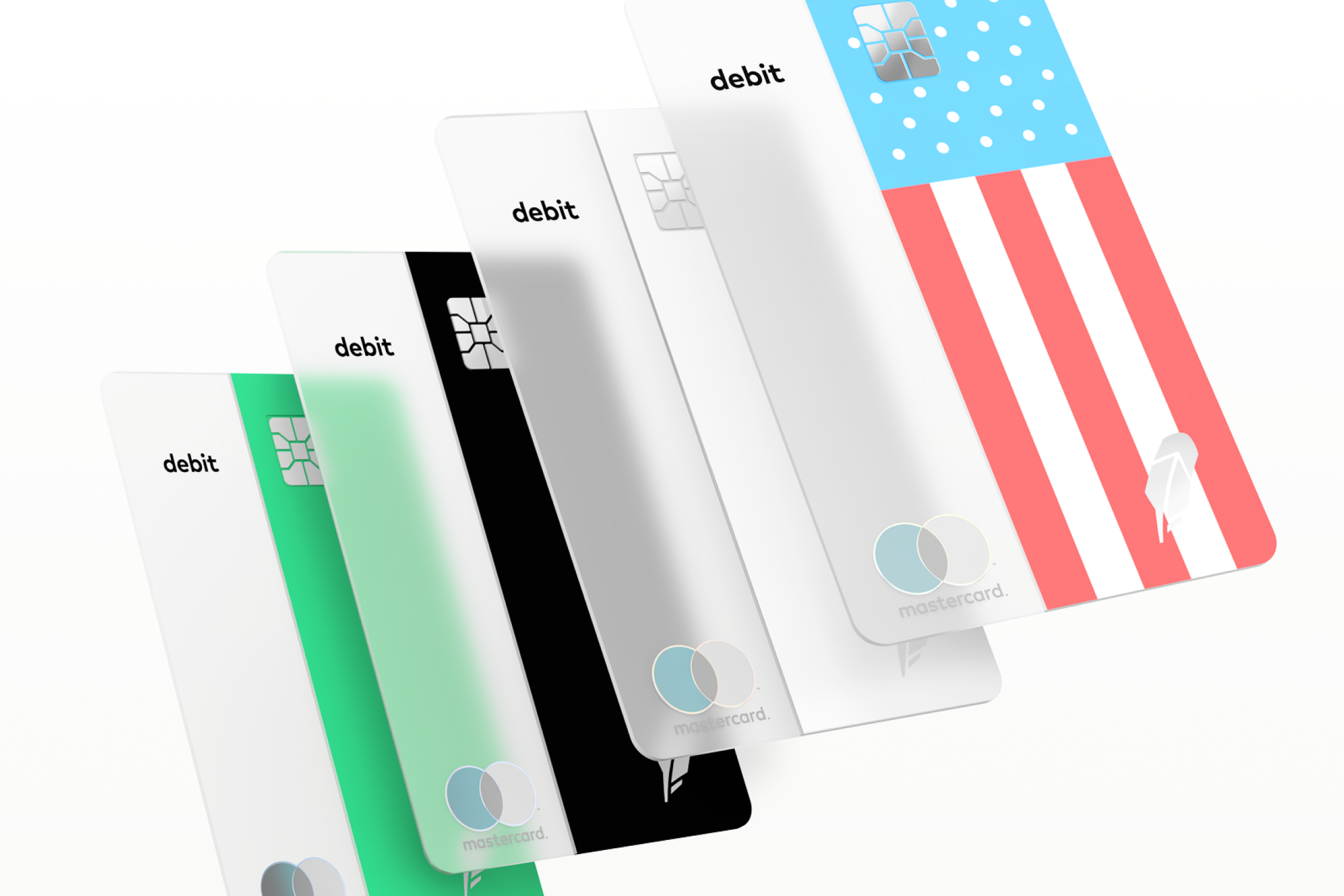
Robinhood Debit Card

Robinhood Cash Management’s debit cards, featuring the same design from the scrapped Checking launch

Now despite Bhatt claiming “Cash Management is a brand new program built from the ground up”, it will offer the exact same debit card design and network of 75,000 ATMs . It’s even using an identical promo image for its half-translucent green, black, white, and American flag debit card designs. But each user’s funds will be covered by the Federal Deposit Insurance Corporation up to $1.25 million. To get around the $250,000 FDIC limit per bank, Robinhood is partnering with five banks that it will spread a user’s cash across as necessary to bundle up to that sum. Robinhood earns money by taking a chunk of the interchange fees from transactions on its debit card run in partnership with Sutton Bank, and from a few paid by the five banks cash gets swept into.

To help it avoid further regulatory missteps, Robinhood yesterday added former SEC commissioner Dan Gallagher as its first independent board member. He joins the startup’s recently hired COO, CFO, Chief Compliance Officer, VP of risk & compliance, and VP of legal & regulatory to bring more supervision to Robinhood.
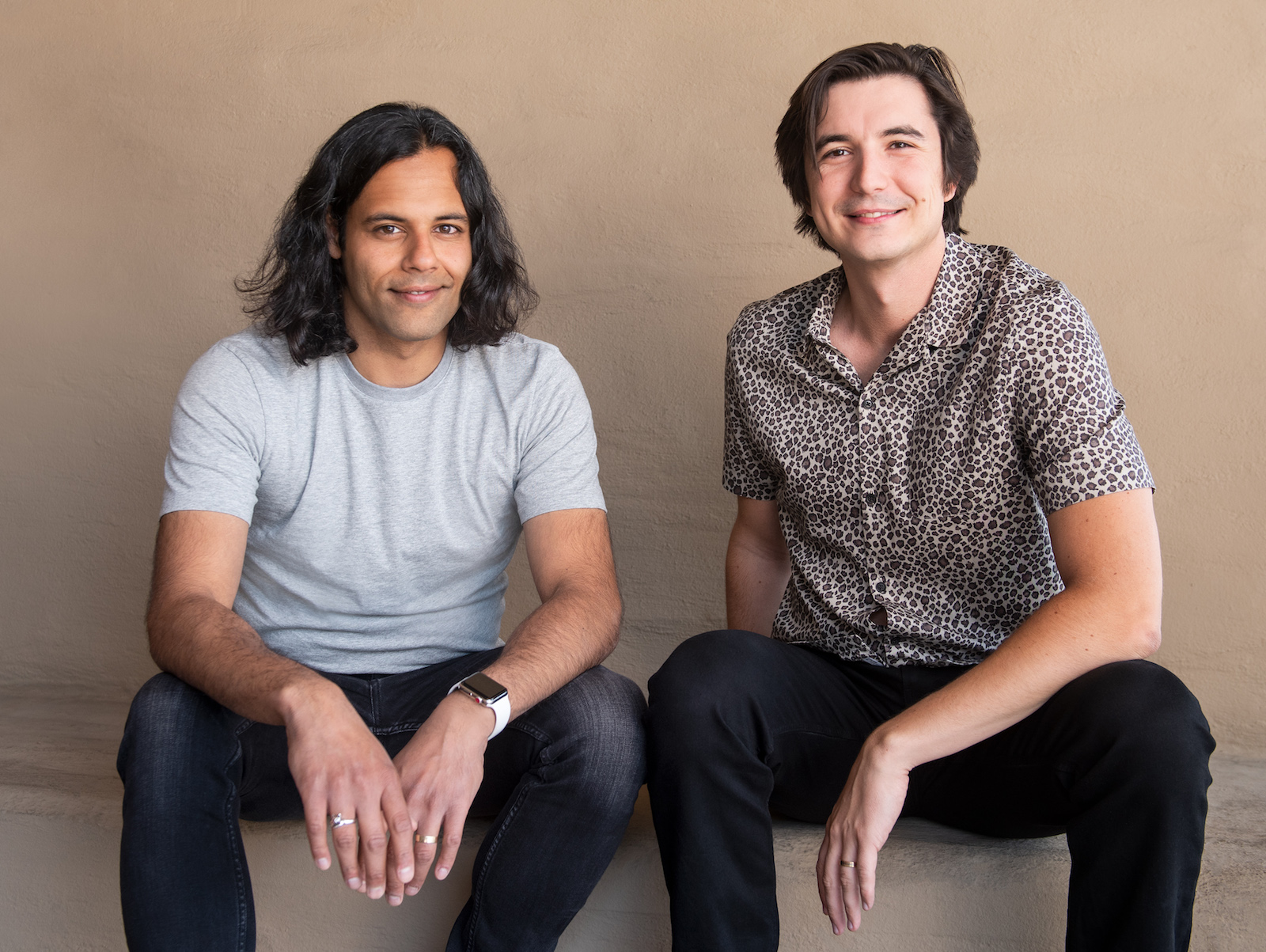
Baiju Bhatt Vlad Tenev Co Founders and Co CEOs 1

Baiju Bhatt Vlad Tenev Co- Founders and Co-CEOs (from left): Baiju Bhatt and Vlad Tenev

The opt-in feature prevents users from missing out on earning interest if they keep money in their Robinhood account, and makes funds from stock sales quickly accessible via the debit card for spending or withdrawal. That convenience could give Robinhood an edge as its loses one if its key differentiators. Last week, its top incumbent competitors Charles Schwab, E*Trade, and AmeriTrade all dropped their $4.95 to $6.95 fees on stock trades to match Robinhood’s free offering. That makes Cash Management and Robinhood Crypto even more critical to its continued grow. That’s necessary to justify the $7.6 billion valuation from its recent $323 million Series E raise led by DST Global that brings it to $860 million in total funding.

How Robinhood Cash Management Works

“We decided the best thing to do is giving people the peace of mind that their money is held at these banks, while trying to pay back the very best interest rates” Bhatt tells me. [Disclosure: I know Robinhood’s co-founders from college together]

With Cash Management, once users deposit cash into the Robinhood accounts and opt into the program, they’re eligible to earn interest. Any balance on their account including returns from sales of securities or cryptocurrencies is swept into the FDIC-insured partner banks via Promontory’s debit suite system. Those banks include Wells Fargo, HSBC, Goldman Sachs, Citibank, U.S Bank, and Bank Of Baroda. If one of those banks folds, the FDIC will make customers whole up for up to $250,000, equaling $1.25 million across all five working with Robinhood.

7689B378 C92A 43FF A3A6 C4653971274B

There the cash earns a variable annual percentage yield (APY) that may fluctuate based on market factors like the Fed funds rate. Currently Robinhood offers a 2.05% APY, but refused to compare it to competitors. However, it ranks relatively high amongst popular banking options like these according to Bankrate, especially given it has no minimum balance:

Robinhood Cash Management will also compete directly with Wealthfront Cash that launched in February and now offers 2.07% APY interest, but lacks a debit card or ATMs. Betterment Checking & Savings does provide a Visa debit card, but its current APY is 1.79%.
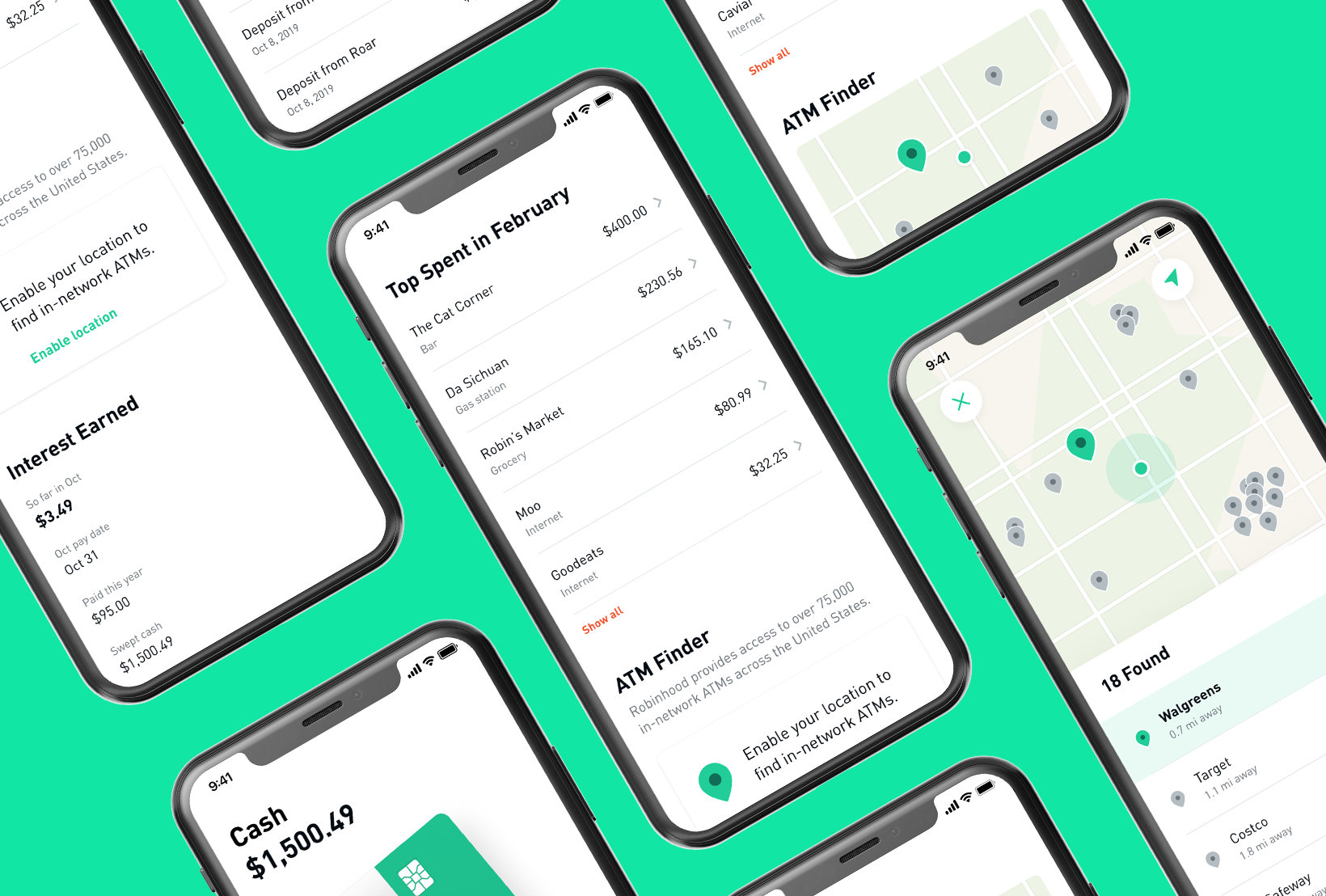
Cash Management Product 1

Cash Management users can select from the four debit cards styles that are accepted anywhere that takes Mastercard, plus 75,000 ATMs. It also works with Apple Pay, Google Pay, and Samsung Pay. There’s no foreign transaction fees, maintenance fee, or account minimum.

A variety of new Cash Management features are being added to the Robinhood app. You can get notifications and emails for all your transactions, and lock the card from your phone if you suspect fraud. You can also opt for location protection, which alerts you if your card is used too far away from your phone. An in-app ATM finder shows users where they can get cash out without a fee.

“Partially we want this to be a good business but we also want this to be a big part of customer’s lives” says Robinhood VP of product Josh Elman. Instead of nickel and diming Cash Management users, the startup monetizes by charging its partners. But the bigger strategy is to get more users on Robinhood in hopes some will subscribe to Robinhood Gold. There users pay a variable monthly fee depending on how much they want to borrow from the startup to trade on margin.

Robinhood co-CEO Baiju Bhatt speaks with TechCrunch’s Josh Constine at Disrupt SF 2018

“I think the main takeaway over the last year has been that since last December, our company has been very committed to building an organization on that has a really strong culture [of compliance]” Bhatt concludes. “We’ve grown the leadership team over the last year with experience from risk and finance backgrounds. We think that’s reflected pretty clearly in how Robinhood operates and the diligence that went into building this new program.”

No longer a scrappy startup, the budding fintech giant must now grapple with much greater regulatory scrutiny. With over 6 million users, the SEC won’t stand for it putting people’s finances in in jeopardy.


from RSSMix.com Mix ID 8176981 https://techcrunch.com/2019/10/08/robinhood-cash-management/
http://www.gadgetscompared.com
from Tumblr https://ikonografico.tumblr.com/post/188216400871
via http://www.gadgetscompared.com

CBS News is bringing a 60 Minutes-inspired news show to streaming service Quibi

Jeffrey Katzenberg’s streaming service Quibi, due to launch in April, has partnered with CBS News to modernize “60 Minutes”-style programming for the era of bite-sized video. Instead of an hour-long newsmagazine, CBS News will launch “60 in 6,” which will condense original news stories into 6-minute long episodes, designed for consumption on mobile devices.

The deal will see 60 Minutes producing one original story per week, as part of Quibi’s licensing agreement.

“This is a perfect opportunity to bring 60 Minutes’ style of storytelling, in-depth reporting, and investigative journalism to a new audience,” said 60 Minutes executive producer Bill Owens, in a statement. “We are excited to launch ’60 In 6,’ as our digital footprint is more important than ever,” he said.

CBS isn’t the first news partner coming to the upcoming streaming service. NBC will build out a full production team exclusively for its Quibi programming, which will include a 6-minute morning and evening news show for the service. The BBC and Quibi, meanwhile, are developing an international news show for millennials, that’s five minutes in length. And ESPN just agreed to do a sports highlights and news show.

“60 Minutes has been, is, and will continue to be the gold standard of storytelling news journalism,” added Jeffrey Katzenberg, Quibi founder and chairman of the board, in a statement. “Bringing their talent and resources to a new form of storytelling could not be more exciting for us at Quibi,” he said.

News programming is only one aspect to Quibi, which will also include a variety of entertainment offerings from big-name talent, like Sam Raimi, Guillermo del Toro, Antoine Fuqua, and producer Jason Blum, among others. Quibi will also feature a show about Snapchat’s founding, an action-thriller starring Liam Hemsworth, a murder mystery comedy from SNL’s Lorne Michaels, a beauty docuseries from Tyra Banks, a Steven Spielberg horror show, a comedy from Thomas Lennon, a car-stunt series with Idris Elba, a comedy series from Trevor Noah, a drama with Queen Latifah, a thriller with Sophie Turner, and more.

Quibi’s premise is taking premium content and chopping it up into “quick bites” (hence the name), and delivering it to mobile viewers in both horizontal and vertical formats. The idea, essentially, is to build a Netflix for the Snapchat generation. This is a risky endeavor, given that the targeted demographic — Gen’s Y and Z — is quite happy with their Netflix subscriptions for higher-production value entertainment, and with YouTube for more casual video viewing from the creator community.

Quibi also seems to ignore the fact that most subscription-based video is still watched on TVs, not mobile devices. Meanwhile, on users’ phones, Quibi will have to compete with a range of other apps and games — including the new titles from Apple Arcade — as well as other time fillers, like YouTube, Instagram, TikTok and Snapchat.

That said, having Katzenberg at the helm has brought a lot of industry support to Quibi. The company has raised $1 billion from Disney, WarnerMedia, 21st Century Fox and others, and was looking to raise more. It also said this summer it had booked $100 million in ad sales pre-launch.

Quibi will launch in April 2020, and “60 in 6” will be available at that time. The service will cost $5 per month, or $8 to go ad-free.


from RSSMix.com Mix ID 8176981 https://techcrunch.com/2019/10/08/cbs-news-is-bringing-a-60-minutes-inspired-news-show-to-streaming-service-quibi/
http://www.gadgetscompared.com
from Tumblr https://ikonografico.tumblr.com/post/188216400981
via http://www.gadgetscompared.com
Monday, October 7, 2019

Spotify gains Siri support on iOS 13, arrives on Apple TV

In a long-awaited move, Spotify announced this morning its iOS 13 app would now offer Siri support and its streaming music service would also become available on Apple TV. That means you can now request your favorite music or podcasts using Siri voice commands, by preferencing the command with “Hey Siri, play…,” followed by the audio you want, and concluding the command with “on Spotify.”

The Siri support had been spotted earlier while in beta testing, but the company hadn’t confirmed when it would be publicly available.

According to Spotify, the Siri support will also work over Apple AirPods, on CarPlay, and via AirPlay on Apple HomePod.

In addition, the Spotify iOS app update will include support for iPhone’s new data-saver mode, which aids when bandwidth is an issue.

Spotify is also today launching on Apple TV, joining other Spotify apps for TV platforms, including Roku, Android TV, Samsung Tizen, and Amazon Fire TV.

The app updates are still rolling out, so you may need to wait to take advantage of the Apple TV support and other new features.

The lack of Siri support for Spotify was not the streaming music service’s fault — it wasn’t until iOS 13 that such support even became an option. With the new mobile operating system launched in September, Apple finally opened up its SiriKit framework to third-party apps, allowing end-users to better control their apps using voice commands. That includes audio playback on music services like Spotify, as well as the ability to like and dislike tracks, skip or go to the next song, and get track information.

Pandora, Google Maps and Waze were among the first to adopt Siri integration when it became available in iOS 13 — a clear indication that some of Apple’s chief rivals have been ready and willing to launch Siri support as soon as it was possible.

Though the integration with Siri will be useful for end-users and beneficial to Spotify’s business, it may also weaken the streaming company’s antitrust claims against Apple.

Spotify has long stated that Apple engages in anti-competitive business practices when it comes to its app platform, which is designed to favor its own apps and services, like Apple Music, it says. Among its chief complaints was the inability of third-party apps to work with Siri, which gave Apple’s own apps a favored position. Spotify also strongly believes the 30% revenue share required by the App Store hampers its growth potential.

The streamer filed an antitrust complaint against Apple in the European Union in March. And now, U.S. lawmakers have reached out to Spotify to request information as a part of an antitrust probe here in the states, reports claim. 

Despite its new ability to integrate with Siri in iOS 13, Spotify could argue that it’s still not enough. Users will have to say “on Spotify” to take advantage of the new functionality, instead of being able to set their default music app to Spotify, which would be easier. It could also point out that the support is only available to iOS 13 devices, not the entire iOS market.

Along with the Apple-related news, Spotify today also announced support for Google Nest Home Max, Sonos Move, Sonos One SL, Samsung Galaxy Fold, and preinstallation on Michael Kors Acess, Diesel and Emporio Armani Wear OS smartwatches.


from RSSMix.com Mix ID 8176981 https://techcrunch.com/2019/10/07/spotify-gains-siri-support-on-ios-13-arrives-on-apple-tv/
http://www.gadgetscompared.com
from Tumblr https://ikonografico.tumblr.com/post/188196291751
via http://www.gadgetscompared.com