Thursday, October 10, 2019

Daily Crunch: Apple pulls Hong Kong app

The Daily Crunch is TechCrunch’s roundup of our biggest and most important stories. If you’d like to get this delivered to your inbox every day at around 9am Pacific, you can subscribe here.

1. Apple pulls HKmap from App Store, the day after Chinese state media criticized its ‘unwise and reckless decision’ to approve it

Less than a day after Apple was criticized by Chinese state media for allowing HKmap in the App Store, the crowdsourced map app said it had been delisted.

This is Apple’s second reversal on the issue, which it explained with a statement claiming it learned that the app “has been used in ways that endanger law enforcement and residents in Hong Kong.”

2. Grammarly raises $90M at over $1B+ valuation for its AI-based grammar and writing tools

Grammarly provides a toolkit used today by 20 million people to correct their written grammar, suggest better ways to write things and moderate their tone depending on who will be doing the reading.

3. Okta wants to make every user a security ally

Okta is giving end users information about suspicious activity involving their login, while letting them share information with the company’s security apparatus.

4. Waymo to customers: ‘Completely driverless Waymo cars are on the way’

Waymo’s existing programs all use a human safety driver behind the wheel. Now the Alphabet-owned company is getting ready for completely driverless rides.

5. Calm and Room made a $4,000 branded ‘meditation booth’

From the looks of it, the Calm Booth by Room is little more than a standard Room booth, with frosted glass, softer lighting and “a soothing misty forest interior.” But it’s a pretty smart partnership between two white-hot startups.

6. Creators of modern rechargeable batteries share Nobel prize

The prize this year honors M. Stanley Whittingham, John Goodenough and Akira Yoshino, all of whom contributed to the development of what is today the most common form of portable power.

7. Silicon Valley’s competing philosophies on tech ethics with The New Yorker’s Andrew Marantz

Marantz has in recent years trained his attention on the tech world and its contribution to social unrest in the United States and beyond. And he has just published a new book, “Antisocial: Online Extremists, Techno-Utopians, and the Hijacking of the American Conversation.” (Extra Crunch membership required.)



from RSSMix.com Mix ID 8176981 https://techcrunch.com/2019/10/10/daily-crunch-apple-pulls-hong-kong-app/
http://www.gadgetscompared.com
from Tumblr https://ikonografico.tumblr.com/post/188265413796
via http://www.gadgetscompared.com


Get ready to see more looping videos on Spotify, as Canvas launches into beta

Spotify is opening up its Canvas feature to more artists, the company announced this morning, which means you’ll see a lot more of those looping videos on the app starting soon. The feature has been in limited testing before today with select artists. When available, you don’t just see the album artwork behind the player controls — you see a moving, visual experience that plays in a short loop.

So far, Canvas has had mixed reviewers from Spotify users. Some find the looping imagery distracting while others simply prefer seeing the album art. Some people seem to like the feature. But others only like it with certain content and artists.

The challenge is in designing a video loop that works well. That means it shouldn’t be an attempt to try to lip sync to a part of a song. It shouldn’t include intense flashing graphics or text, nor should it distract people from being able to see the player controls and track information.

Screen Shot 2019 10 10 at 12.07.54 PM

Spotify also suggests trying to tell a full story in the loop rather than just drastically trimming a music video down to the time allotted (3- or 8-second clips). Other recommended Canvas experiences are those that help develop the artists’ persona across their profile and tracks, or those that are updated frequently. Billie Eilish, for example, uses the feature to share animated versions of fan art.

Since launching, Canvas has been seen by millions of users, Spotify says. But the company seems to acknowledge the impact varies, based on how the Canvas is designed. When it works, it can “significantly increase” track streams, shares, and artists page visits. But Spotify didn’t say what happens when the feature fails to engage fans.

However, based on social media discussions about the feature and how-to guides detailing how to turn the thing off, it would seem that some users choose to opt out of the experience entirely.

Today, Spotify says Canvas will no longer be limited to select artists, as it’s opening more broadly to artists in an expanded beta. With the beta, Spotify hopes artists will treat Canvas as a critical part of their release strategy, and will continue to use it across their catalog.

“It’s a way to get noticed and build a vision — and an excellent way to share more of who you are with your listeners, hopefully turning them into fans,” the company writes in an announcement. “The goal is for you to have richer ways to express yourself and to allow listeners to engage with you and your music even more deeply. We’re continuing to work on additional features, as well as more tools and metrics to help you better understand how your art is reaching your audience,” the company says.

It’s hard not to comment on the timing of this launch. At the end of September, Google announced that YouTube Music would not be preinstalled on new Android devices, taking the place of Google Play Music. With YouTube Music, streamers gain access to a visually immersive experience where they can watch the music videos, not just listen to the audio, if they prefer.

Spotify, however, has traditionally been a place to listen — not to watch. That’s not to say there aren’t music videos on Spotify, they’re just not well highlighted by the app nor a core part of the Spotify experience.

The company says it’s now sending artists their invites to join the beta. Those who haven’t received the invite can instead make a request to be added here.


from RSSMix.com Mix ID 8176981 https://techcrunch.com/2019/10/10/get-ready-to-see-more-looping-videos-on-spotify-as-canvas-launches-into-beta/
http://www.gadgetscompared.com
from Tumblr https://ikonografico.tumblr.com/post/188261027746
via http://www.gadgetscompared.com
Google takes AMP to the OpenJS Foundation

AMP, Google’s somewhat controversial project for speeding up the mobile web, has always been open-source, but it also always felt like a Google project first. Today, however, Google announced that the AMP framework will join the OpenJS Foundation, the Linux Foundation-based group that launched last year after the merger of the Node.js and JS foundations. The OpenJS Foundation is currently the home of projects like jQuery, class=“crunchbase-link” href=“https://crunchbase.com/organization/node” target=“_blank” data-type=“organization” data-entity=“node”>Node .js and webpack, and AMP will join the Foundation’s incubation program.

Large companies like Google tend to donate open-source projects to foundations once they become stable — and that’s definitely the case with the four-year-old AMP project, which developers have now used to create billions of pages on more than 30 million domains, according to Google. Late last year, Google introduced a Technical Steering Committee to help oversee the development of AMP and it was this committee that also agreed to bring the project to the OpenJS Foundation.

“Now in our fourth year, AMP is excited for the next step on our journey,” said Malte Ubl, Member of the AMP Project Technical Steering Committee, in today’s announcement. “We’ve been considering the best home for AMP for some time. We decided on the OpenJS Foundation because we feel it’s the best place for us to help us to cater to our diverse group of constituencies. This step builds on previous moves we’ve made toward open governance and helps us focus on transparency and openness.”

Google also notes that the OpenJS Foundation’s goal of promoting JavaScript and related technologies is a good fit for AMP’s mission of providing “a user-first format for web content.” The company also notes that the Foundation allows projects to maintain their identities and technical focus and stresses that AMP’s governance model was already influenced by the JS Foundation and Node.js Foundation.

Google is currently a top-level platinum member of the OpenJS Foundation and will continue to support the project and employ a number of engineers that will work on AMP full-time.


from RSSMix.com Mix ID 8176981 https://techcrunch.com/2019/10/10/google-takes-amp-to-the-openjs-foundation/
http://www.gadgetscompared.com
from Tumblr https://ikonografico.tumblr.com/post/188261027626
via http://www.gadgetscompared.com
App revenue climbs 23% year-over-year to $21.9B in Q3

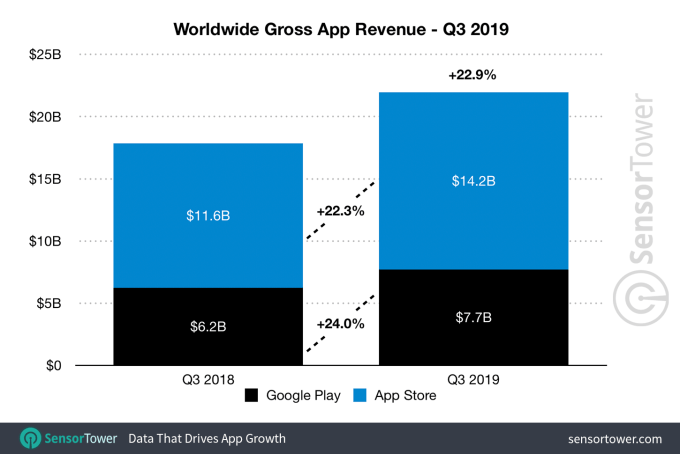
Global app revenue continues to climb, thanks to the growth in mobile gaming and the subscription economy. In the third quarter of 2019, consumer revenue grew 22.9% year-over-year from $17.9 billion to reach an estimated $21.9 billion across both the App Store and Google Play worldwide, according to new data from Sensor Tower.

Notably, the App Store continues to account for the large majority of this revenue, the report found, making up 65% of total spending compared with just 35% on Google Play.

App Store users spent $14.2 billion, up 22.3% from the $11.6 billion they spent in Q3 2018. Google Play generated $7.7 billion in revenue, up 24% from the $6.2 billion spent in the year-ago quarter.

q3 2019 app revenue worldwide

Sensor Tower’s revenue estimates are a bit lower than those provided by App Annie’s recent report, which said the quarter saw $23 billion in consumer spending, not ~$22 billion.

App Annie also estimated nearly 23 billion downloads in Q3, while Sensor Tower claimed 29.6 billion.

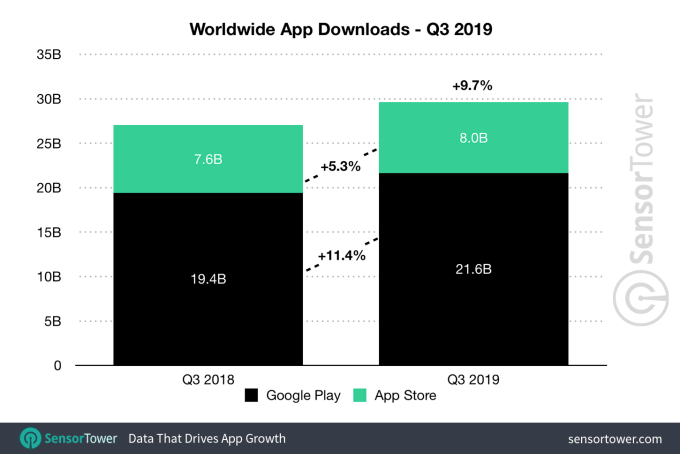
In both cases, Google Play is still said to be the main source for downloads, with nearly three times more first-time installs than the App Store. In Q3, the total number of downloads was up 9.7% year-over-year to 29.6 billion, said Sensor Tower, with Google Play accounting for 21.6 billion of those.

Despite the overall growth, one big app market — China — saw a slight decline, Sensor Tower found. Its installs dropped 6% year-over-year to 2.2 billion in the quarter. But its revenue grew by 26.9% to $4.1 billion, up from $3.2 billion the year prior. This could be attributed to the nine-month game license freeze in China which, though now lifted, had slowed momentum.

Sensor Tower’s charts don’t include third-party app stores, so it’s not a full picture of the Chinese app market, it’s worth noting.

q3 2019 top apps worldwide

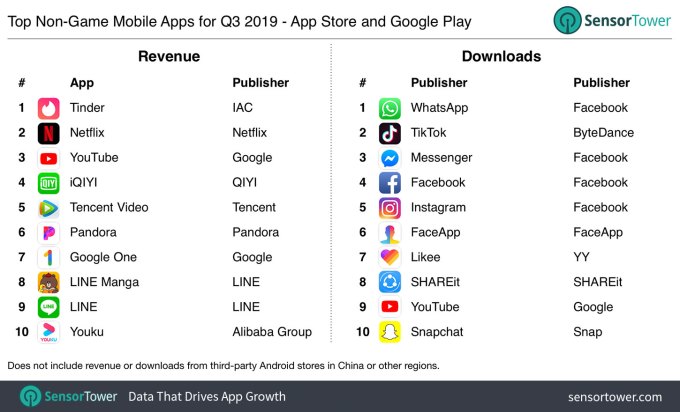
The top money-making (non-game) app in the quarter was again Tinder, which generated $233 million in consumer spending, up 7% over the prior quarter. Netflix was No. 2 and YouTube clocked in at No. 3, at $164 million in Q3.

App Annie has a slightly different ranking. It has Tinder and Netflix leading the top-grossing charts, but puts IQIYI ahead of YouTube. This could be because App Annie has a bigger window into the Chinese app market.

In terms of downloads, TikTok is continuing to disrupt Facebook-owned apps’ dominance over the top of the charts. In Sensor Tower’s rankings, WhatsApp was No. 1 and Messenger was No. 3, but Facebook and Instagram dropped to No. 4 and No. 5, respectively. And TikTok reached No. 2.

q3 2019 app downloads worldwide

This isn’t the first time TikTok has passed Facebook, Sensor Tower said — it did so back in Q4 2018 and in Q1 2019, before dropping to No. 4 again last quarter. But with 177 million downloads in Q3, it’s inching its way up to the top.

App Annie, on the other hand, sees TikTok having just a bit more of climb, sticking it at No. 3 in the quarter, behind Messenger and Facebook. It also called out some Q3 break-out hits, like the return of FaceApp’s popularity (No. 9 in downloads) and the growing subscription revenue of Google One (No. 7 in non-game revenue). Sensor Tower put FaceApp at No. 6 instead, but agreed on Google One.

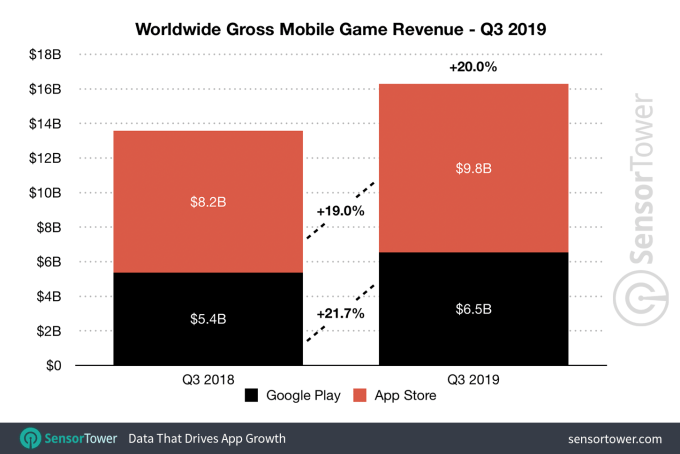
Mobile gaming continues to generate most of the cash, and did so again in Q3 with $16.3 billion in mobile game gross revenue — or 74% of the total in-app spending, the new report said. The App Store accounted for $9.8 billion of that figure, with Google Play users spending $6.5 billion.

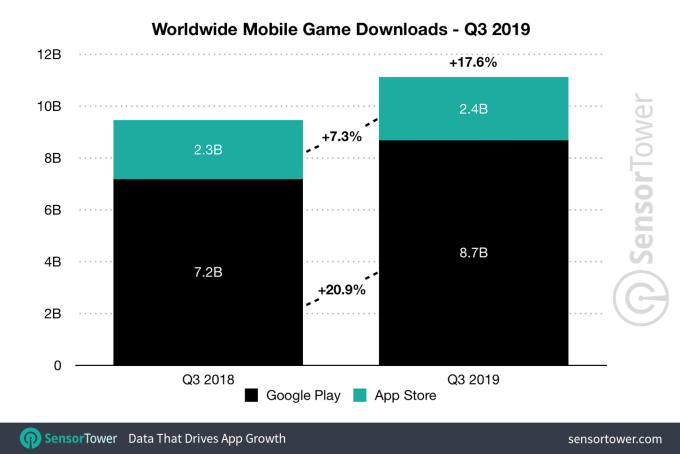
Game downloads across both Google Play and the App Store increased by 17.6% in Q3 from 9.5 billion last year to 11.1 billion.

q3 2019 game revenue worldwide

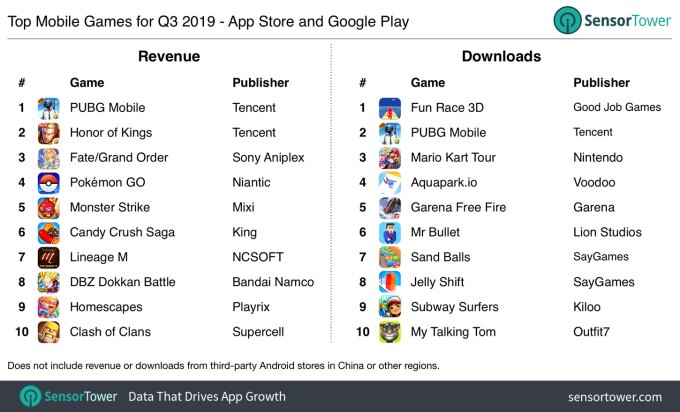
The top three games in the quarter by downloads were Fun Race 3D (123M downloads), PUBG Mobile (94M), and newcomer Mario Kart Tour, which hit 86 million downloads despite only launching in late September.

q3 2019 top games worldwide

PUBG Mobile was the top-grossing game with $496 million in revenue, up 652% over last year. The No. 2 title, Tencent’s Honor of Kings, and No. 3 Aniplex’s Fate/Grand Order generated $377 million and $354 million, respectively.

q3 2019 game downloads worldwide

Image credits: Sensor Tower


from RSSMix.com Mix ID 8176981 https://techcrunch.com/2019/10/10/app-revenue-climbs-23-year-over-year-to-21-9b-in-q3/
http://www.gadgetscompared.com
from Tumblr https://ikonografico.tumblr.com/post/188261027541
via http://www.gadgetscompared.com
Wednesday, October 9, 2019

Daily Crunch: China pressures Apple

The Daily Crunch is TechCrunch’s roundup of our biggest and most important stories. If you’d like to get this delivered to your inbox every day at around 9am Pacific, you can subscribe here.

1. China attacks Apple for allowing Hong Kong crowdsourced police activity app

Apple’s decision to greenlight an app called HKmaps, which is being used by pro-democracy protestors in Hong Kong to crowdsource information about street closures and police presence, is attracting the ire of the Chinese government.

Specifically, an article in Chinese state mouthpiece China Daily attacks the iPhone maker for reversing an earlier decision not to allow the app to be listed on the iOS App Store.

2. What the hell is up with this Essential device?

Essential CEO Andy Rubin tweeted photos of what he called a “radically different formfactor” — basically, it’s a long, skinny phone.

3. Uber’s newest feature alerts drivers that pets will be joining the ride

With Uber Pet, riders will pay a “small surcharge” for the privilege of taking their pets with them. And drivers will have the option of avoiding trips with non-service animals by opting out of Uber Pet trips.

4. Twitter admits it used two-factor phone numbers and emails for serving targeted ads

Twitter finds itself in the same boat as Facebook, which last year was caught using phone numbers and email addresses — given to Facebook to secure users’ accounts — for targeted advertising.

5. Google’s Grasshopper coding class for beginners comes to the desktop

A larger screen and access to a keyboard makes learning to code on the desktop significantly easier than on mobile. For example, in the desktop app Google is able to put columns for the instructions, the code editor and the results next to each other.

6. Amazon, Walmart confront India’s slowing economy as holiday season growth stalls

Even India’s biggest festive season, featuring blinding marketing blitzkrieg and heavy discounts from Amazon India and Walmart’s Flipkart, has failed to escape the pains of a slowing economy.

7. With $15M round and 100K tablets sold, reMarkable CEO wants to make tech ‘more human’

The reMarkable tablet is a strange device in this era of ultra-smart gadgets, with a black and white screen meant for reading, writing and sketching — and nothing more. (Extra Crunch membership required.)


from RSSMix.com Mix ID 8176981 https://techcrunch.com/2019/10/09/daily-crunch-china-pressures-apple/
http://www.gadgetscompared.com
from Tumblr https://ikonografico.tumblr.com/post/188241595751
via http://www.gadgetscompared.com
European risk report flags 5G security challenges

European Union Member States have published a joint risk assessment report into 5G technology which highlights increased security risks that will require a new approach to securing telecoms infrastructure.

The EU has so far resisted pressure from the U.S. to boycott Chinese tech giant Huawei as a 5G supplier on national security grounds, with individual Member States such as the UK also taking their time to chew over the issue.

But the report flags risks to 5G from what it couches as “non-EU state or state-backed actors” — which can be read as diplomatic code for Huawei. Though, as some industry watchers have been quick to point out, the label could be applied rather closer to home in the near future, should Brexit comes to pass…

Back in March, as European telecom industry concern swirled about how to respond to US pressure to block Huawei, the Commission stepped in to issue a series of recommendations — urging Member States to step up individual and collective attention to mitigate potential security risks as they roll out 5G networks.

Today’s risk assessment report follows on from that.

It identifies a number of “security challenges” that the report suggests are “likely to appear or become more prominent in 5G networks” vs current mobile networks — linked to the expanded use of software to run 5G networks; and software and apps that will be enabled by and run on the next-gen networks.

The role of suppliers in building and operating 5G networks is also noted as a security challenge, with the report warning of a “degree of dependency on individual suppliers”, and also of too many eggs being placed in the basket of a single 5G supplier.

Summing up the effects expected to follow 5G rollouts, per the report, it predicts:

  • An increased exposure to attacks and more potential entry points for attackers: With 5G networks increasingly based on software, risks related to major security flaws, such as those deriving from poor software development processes within suppliers are gaining in importance. They could also make it easier for threat actors to maliciously insert backdoors into products and make them harder to detect.
  • Due to new characteristics of the 5G network architecture and new functionalities, certain pieces of network equipment or functions are becoming more sensitive, such as base stations or key technical management functions of the networks.
  • An increased exposure to risks related to the reliance of mobile network operators on suppliers. This will also lead to a higher number of attacks paths that might be exploited by threat actors and increase the potential severity of the impact of such attacks. Among the various potential actors, non-EU States or State-backed are considered as the most serious ones and the most likely to target 5G networks.
  • In this context of increased exposure to attacks facilitated by suppliers, the risk profile of individual suppliers will become particularly important, including the likelihood of the supplier being subject to interference from a non-EU country.
  • Increased risks from major dependencies on suppliers: a major dependency on a single supplier increases the exposure to a potential supply interruption, resulting for instance from a commercial failure, and its consequences. It also aggravates the potential impact of weaknesses or vulnerabilities, and of their possible exploitation by threat actors, in particular where the dependency concerns a supplier presenting a high degree of risk.
  • Threats to availability and integrity of networks will become major security concerns: in addition to confidentiality and privacy threats, with 5G networks expected to become the backbone of many critical IT applications, the integrity and availability of those networks will become major national security concerns and a major security challenge from an EU perspective.

The high level report is a compilation of Member States’ national risk assessments, working with the Commission and the European Agency for Cybersecurity. It’s couched as just a first step in developing a European response to securing 5G networks.

“It highlights the elements that are of particular strategic relevance for the EU,” the report says in self-summary. “As such, it does not aim at presenting an exhaustive analysis of all relevant aspects or types of individual cybersecurity risks related to 5G networks.”

The next step will be the development, by December 31, of a toolbox of mitigating measures, agreed by the Network and Information Systems Cooperation Group, which will be aimed at addressing identified risks at national and Union level.

“By 1 October 2020, Member States – in cooperation with the Commission – should assess the effects of the Recommendation in order to determine whether there is a need for further action. This assessment should take into account the outcome of the coordinated European risk assessment and of the effectiveness of the measures,” the Commission adds.

For the toolbox a variety of measures are likely to be considered, per the report — consisting of existing security requirements for previous generations of mobile networks with “contingency approaches” that have been defined through standardisation by the mobile telephony standards body, 3GPP, especially for core and access levels of 5G networks.

But it also warns that “fundamental differences in how 5G operates also means that the current security measures as deployed on 4G networks might not be wholly effective or sufficiently comprehensive to mitigate the identified security risks”, adding that: “Furthermore, the nature and characteristics of some of these risks makes it necessary to determine if they may be addressed through technical measures alone.

“The assessment of these measures will be undertaken in the subsequent phase of the implementation of the Commission Recommendation. This will lead to the identification of a toolbox of appropriate, effective and proportionate possible risk management measures to mitigate cybersecurity risks identified by Member States within this process.”

The report concludes with a final line saying that “consideration should also be given to the development of the European industrial capacity in terms of software development, equipment manufacturing, laboratory testing, conformity evaluation, etc” — packing an awful lot into a single sentence.

The implication is that the business of 5G security will need to get commensurately large to scale to meet the multi-dimensional security challenge that goes hand in glove with the next-gen tech. Just banning a single supplier isn’t going to cut it.


from RSSMix.com Mix ID 8176981 https://techcrunch.com/2019/10/09/european-risk-report-flags-5g-security-challenges/
http://www.gadgetscompared.com
from Tumblr https://ikonografico.tumblr.com/post/188239427971
via http://www.gadgetscompared.com
Tuesday, October 8, 2019

What the hell is up with this Essential device?

Essential CEO Andy Rubin has been pretty silent over the past year for, well, lots of reasons — both business and otherwise. The company has struggled to sell devices, reportedly shipping only 88,000 handsets in its first year. On a far more serious note, Rubin has been plagued by reports of inappropriate behavior during his time at Google. A bombshell report from The New York Times highlighted sexual misconduct accusations prior to his receiving a $90 million exit package from the company. 

The former Google executive last used Twitter to state that the story “contains numerous inaccuracies about my employment at Google.” Now, a year later, he’s back on the platform touting a new device. It could be the next Essential handset, or it could be something else entirely.

It’s not the shiny “GEM Colorshift material” on the back that’s caught viewers’ eyes, as much as the “new UI for radically different formfactor.” The closet thing I can thing to compare the long, skinny handset to is the new Galaxy Fold when closed. Of course, this has the decided advantage of a full length screen.

The UI appears to be a collection of different widgets, each sporting different apps: weather, maps, calendar and Uber on one, with a full length map on the other. It’s certainly different and even more of a departure from the original Essential handset, which had very little of the industry revolutionizing impact the company was initially hoping for.

A spokesperson for the company confirmed that the new device is in “early testing” in the real world, which is probably why Rubin opted to get out in front of leaks by showing the half-phone on his own terms, rather than grainy leaks. Here’s the official statement from Essential:

We’ve been working on a new device that’s now in early testing with our team outside the lab. We look forward to sharing more in the near future.

There are, of course, way more questions than answers right now, like whether the company is abandoning the first gen’s modular attachment system. Also, is the lack of cellular information at top a sign? Is this why the company acquired CloudMagic? Can one say this is truly “essential”?

At the very least, the existence of such a device does seem to contradict earlier rumors about Rubin canceling the device and attempting to sell the company. Maybe. If I had to venture a guess, I’d say Essential is courting a similar secondary handset market as Palm — though that, too, didn’t exactly set the smartphone world ablaze.

More soon, I suppose.


from RSSMix.com Mix ID 8176981 https://techcrunch.com/2019/10/08/what-the-hell-is-up-with-this-essential-device/
http://www.gadgetscompared.com
from Tumblr https://ikonografico.tumblr.com/post/188227434971
via http://www.gadgetscompared.com