Friday, May 1, 2020

Streaming service Hooq shuts down, ends partnership with Disney’s Hotstar, Grab and others

Hooq, a five-year-old on-demand video streaming service that aimed to become “Netflix for Southeast Asia,” has shut down weeks after filing for liquidation and terminated its partnerships with Disney’s Hotstar, ride-hailing giant Grab, and Indonesia’s VideoMax.

Hooq Digital, a joint venture among Singapore telecom group Singtel (majority owner), Sony Pictures, and Warner Bros Entertainment, discontinued the service on Thursday. It had amassed over 80 million subscribers in nearly half of the dozen markets in Asia.

“For the past 5 years, we gave you unbelievable thrills, heartrending drama, roaring laughs, awesome action, and more. Our goal was to bring you the best entertainment from here to Hollywood. Our hearts are full of gratitude for all of you who shared the journey with us,” it says on its website.

Hooq publicly disclosed that it had raised about $95 million, but the sum was likely higher. News outlet The Ken analyzed the regulatory filings last month to report that Hooq had raised $127.2 million, and its losses in the financial year 2019 had ballooned to $220, suggesting that it had received more capital.

The streaming service said last month that it could not receive new funds from new or existing investors.
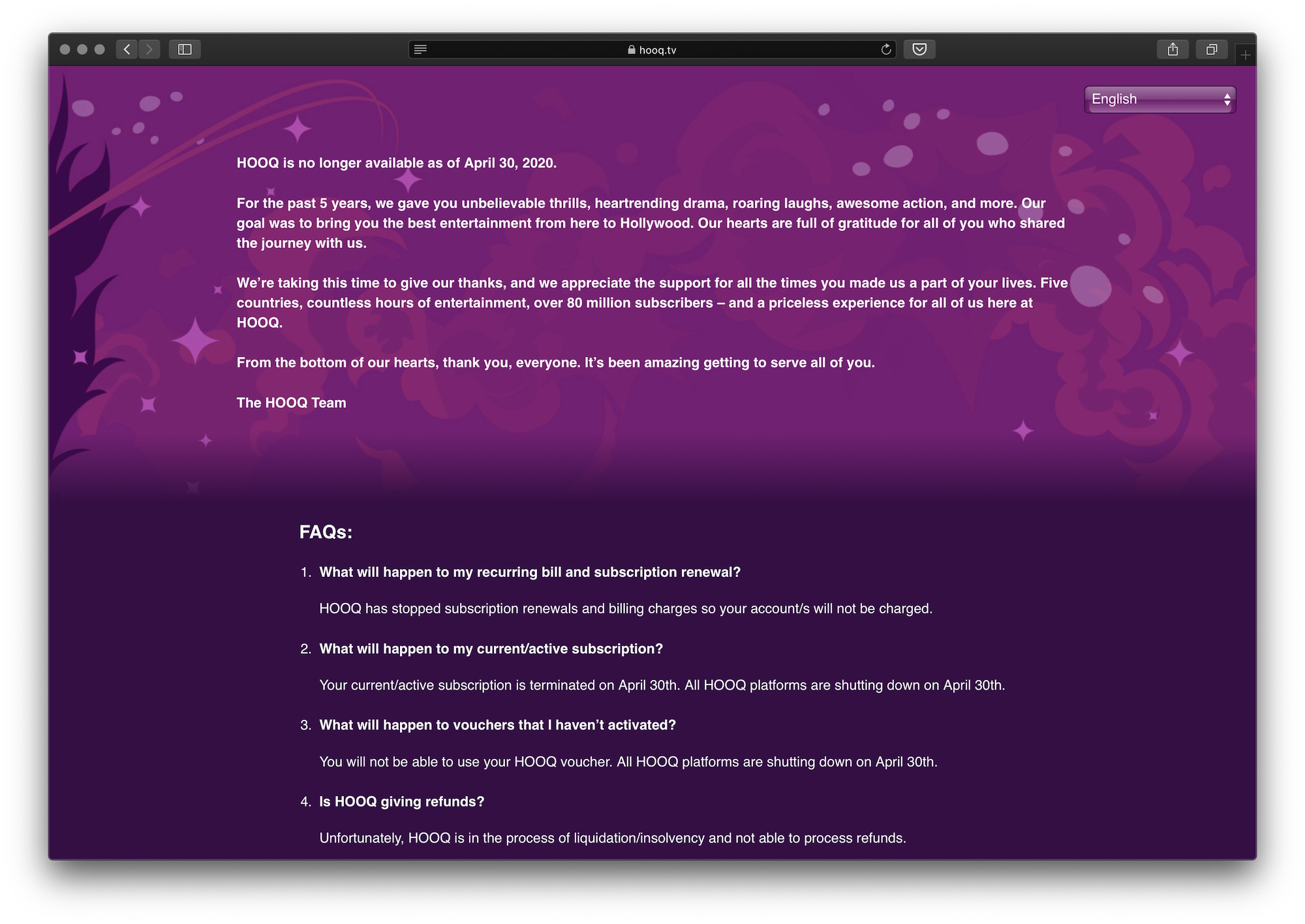
Homepage of Hooq

The service counted India, where it entered into a partnership with Disney’s Hotstar in 2018 and telecom operators Airtel and Vodafone, as its biggest market. The company also maintained a partnership with ride-hailing giant Grab to supply content in its cab, and VideoMAX in Indonesia.

Hooq brought dozens of D.C. universe titles including “Arrow,” “The Flash,” “Wonder Woman” and other popular TV series such as “The Big Bang Theory” to its partners. In India, users began noticing last week that those titles were disappearing from Hotstar.

A spokesperson of Hooq told TechCrunch today that its tie-ups with all its partners including Hotstar have closed. A Hotstar spokesperson did not respond to a request for comment.

Mobile operator Singtel first unveiled Hooq’s liquidation in an exchange filing last month. The Ken reported that the filing left hundreds of employees at Hooq stunned who thought the firm was doing fine financially. Nearly every employee at Hooq has been let go, with select few offered a job at Singtel, according to The Ken.

In an interview with Slator earlier this year, Yvan Hennecart, Head of Localization at HOOQ, said that the company was working to expand its catalog with local content and add 100 original titles in 2020.

“Our focus is mostly on localization of entertainment content; whether it is subtitling or dubbing, we are constantly looking to bring more content to our viewers faster. My role also expands to localization of our platform and any type of collateral information that helps create a unique experience for our users,” he told the outlet.


from RSSMix.com Mix ID 8176981 https://techcrunch.com/2020/05/01/streaming-service-hooq-shuts-down-ends-partnership-with-disneys-hotstar-grab-and-others/
http://www.gadgetscompared.com
from Tumblr https://ikonografico.tumblr.com/post/616914932420804608
via http://www.gadgetscompared.com

Thursday, April 30, 2020

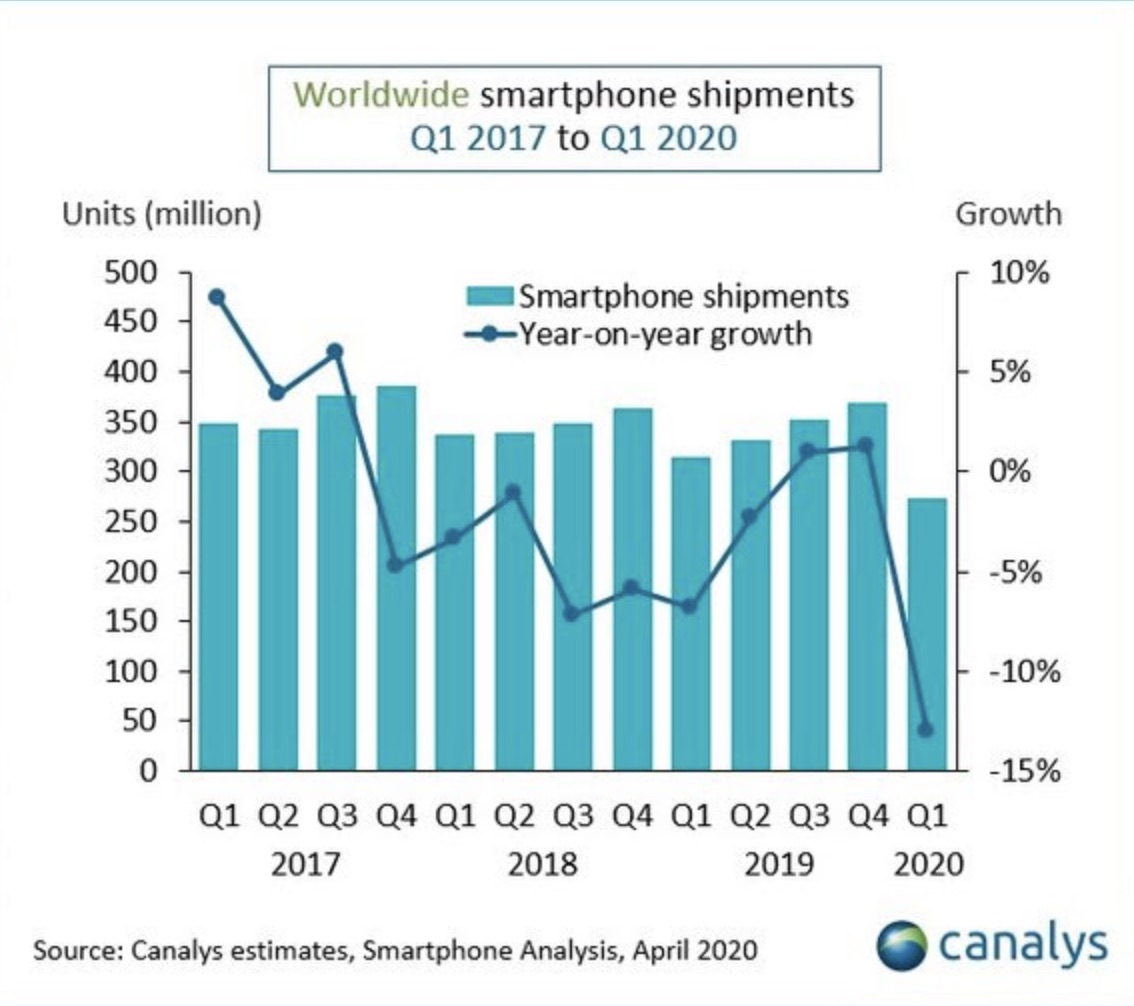
Smartphone shipments dropped 13% globally, and COVID-19 is to blame

We knew it was going to be bad — but not necessarily “lowest level since 2013” bad. As Apple was busy reporting its earnings, Canalys just dropped some of its own figures — and they’re not pretty. After two quarters of much-needed growing, the global smartphone market just took a big hit. And you no doubt already know who the culprit is.

The mobile industry joins countless others that have taken a massive hit due to the COVID-19 pandemic, with shipments dropping 13% from this time last year. Here’s a graph for those of you who are visual learners:

Analyst Ben Stanton used the word “crushed” to describe the novel coronavirus’s impact on the mobile market. “In February, when the coronavirus was centered on China, vendors were mainly concerned about how to build enough smartphones to meet global demand,” he writes. “But in March, the situation flipped on its head. Smartphone manufacturing has now recovered, but as half the world entered lockdown, sales plummeted.”

First it was impact on the global supply chain, which is centered in Asia, along with a drop in demand among consumers in China. As Europe, the U.S. and other locations continue to live under shelter in place orders, demand in those markets has taken a significant hit. People are stuck inside and many have lost jobs — it’s not really the ideal time to consider shelling out $1,000+ for what still seems a luxury for many.

Samsung regained the top spot, while still losing significant numbers. Both it and the number two company, Huawei, were down 17% for the quarter. Apple, at number three, dropped 8%. Chinese manufacturers Xiaomi and Vivo saw some gains, at 9% and 3%, respectively.

There are bound to be rough times ahead as well. Per Stanton, “Most smartphone companies expect Q2 to represent the peak of the coronavirus’ impact.” Apple noted the uncertainty of its own earnings by opting not to issue guidance for next quarter.


from RSSMix.com Mix ID 8176981 https://techcrunch.com/2020/04/30/smartphone-shipments-dropped-13-globally-and-covid-19-is-to-blame/
http://www.gadgetscompared.com
from Tumblr https://ikonografico.tumblr.com/post/616873416370372608
via http://www.gadgetscompared.com

Biloba lets you chat with a doctor if you have questions about your children

Meet Biloba, a French startup that wants to leverage tech to make it easier to keep your children healthy. The company recently launched a new mobile app that lets you chat with a doctor whenever you want between 8 AM and 8 PM. This way, if you have questions about your kids, you can get a quick answer.

Of course, a text conversation will never replace a visit to the pediatrician. But chances are you have a ton of questions, especially if you’re a first-time parent. Instead of browsing obscure discussion forums, you can go straight to a doctor.

Biloba isn’t working with pediatricians specifically. The company is also partnering with nurses and general practitioners. Eventually, the service is going to cost €10 per month but the company is waving fees during the lockdown.

After just three weeks, the startup managed to attract 4,000 users with around 200 conversations per day. Compared to other telemedicine services in France, such as Doctolib, Biloba doesn’t rely on video consultation. This way, it’ll be easier to deal with a large influx of new patients even with a small group of partner doctors.

The subscription business model is interesting for multiple reasons. First, Biloba isn’t covered by the French national healthcare system. In France, patients only get reimbursed if the doctor knows you already. That restriction has been lifted during the lockdown but it’s probably just a temporary lift.

Many parents probably don’t want to pay €120 per year to chat with a doctor when they could pay €0 through the national healthcare system. But if you can afford it, the barrier to medical advice becomes much lower.

Biloba previously released a vaccine reminder app that lets you enter information about your child’s vaccines and get reminders when the next scheduled vaccine is due.


from RSSMix.com Mix ID 8176981 https://techcrunch.com/2020/04/30/biloba-lets-you-chat-with-a-doctor-if-you-have-questions-about-your-children/
http://www.gadgetscompared.com
from Tumblr https://ikonografico.tumblr.com/post/616828090074759168
via http://www.gadgetscompared.com
Wednesday, April 29, 2020

TikTok tops 2 billion downloads

TikTok, the widely popular video sharing app developed by one of the world’s most valued startups (ByteDance), continues to grow rapidly despite suspicion from the U.S. as more people look for ways to keep themselves entertained amid the coronavirus pandemic.

The global app and its Chinese version, called Douyin, have amassed over 2 billion downloads on Google Play Store and Apple’s App Store, mobile insight firm Sensor Tower said Wednesday.

TikTok is the first app after Facebook’s marquee app, WhatsApp, Instagram and Messenger to break past the 2 billion downloads figure since January 1 of 2014, a Sensor Tower official told TechCrunch. (Sensor Tower began its app analysis on that date.)

A number of apps from Google, the developer of Android, including Gmail and YouTube, have amassed over 5 billion downloads, but they ship pre-installed on most Android smartphones and tables.

TikTok’s 2 billion download milestone, a key metric to assess an app’s growth, comes five months after it surpassed 1.5 billion downloads.

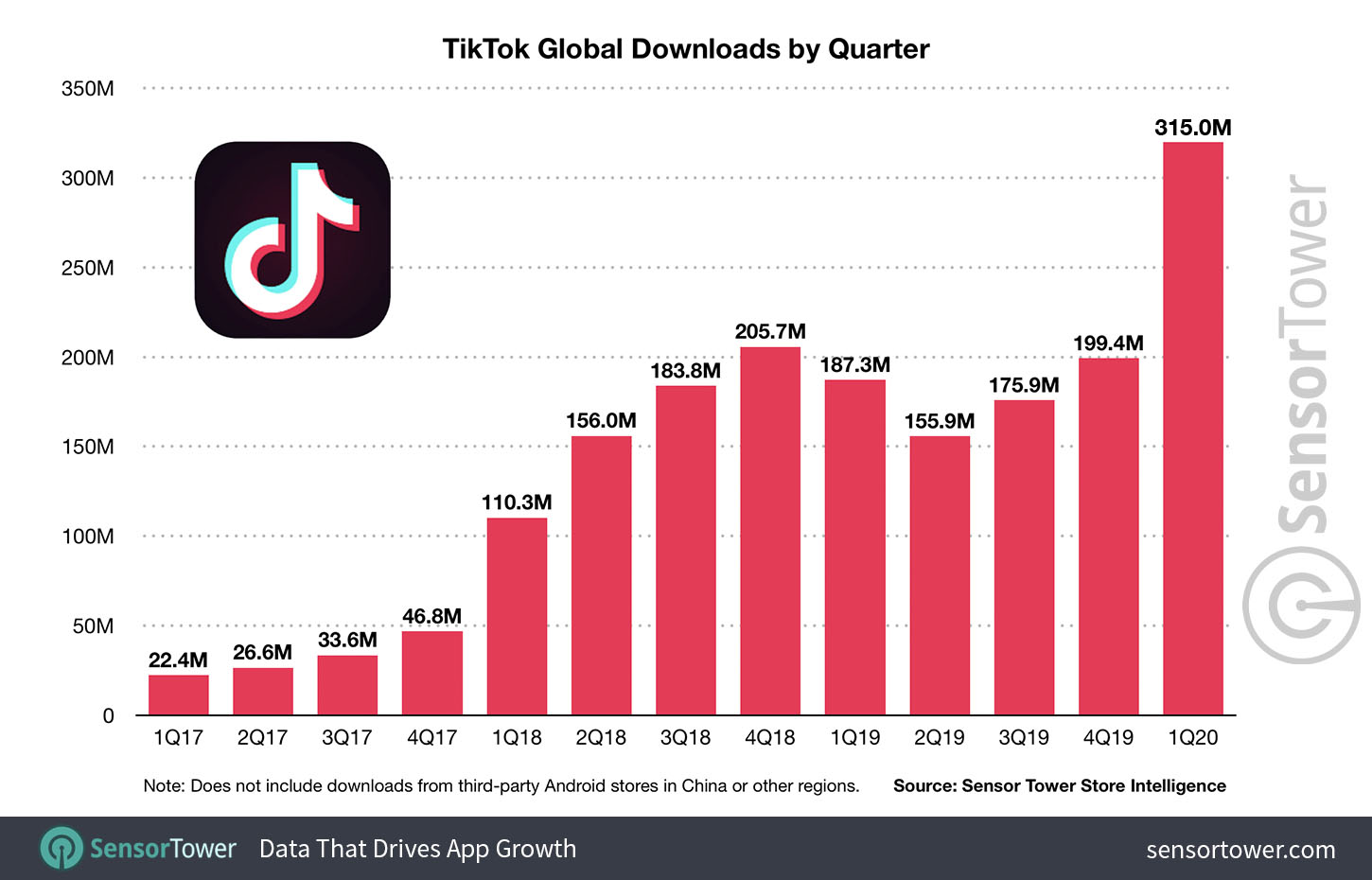
In the quarter that ended on March 31, TikTok was downloaded 315 million times — the highest number of downloads for any app in a quarter and — surpassing its previous best of 205.7 million downloads in Q4 2018. Facebook’s WhatsApp, the second most popular app by volume of downloads, amassed nearly 250 million downloads in Q1 this year, Sensor Tower told TechCrunch.

As the app gains popularity, it is also clocking more revenue. Users have spent about $456.7 million on TikTok to date, up from $175 million five months ago. Much of this spending — about 72.3% — has happened in China. Users in the United States have spent about $86.5 million on the app, making the nation the second most important market for TikTok from the revenue standpoint.

Craig Chapple, a strategist at Sensor Tower, said that not all the downloads are as organic as TikTok, which launched outside of China in 2017 and has engaged in a “large user acquisition campaign.” But he attributed some of the surge in downloads to the COVID-19 outbreak that has driven more people than ever to look for new apps.

India, TikTok’s largest international market, accounts for 30.3% of the app’s downloads, according to Sensor Tower. The app has been downloaded 611 million times in the world’s second largest internet market.

From a platform’s standpoint, 75.5% of all of TikTok’s downloads have occurred through Google Play Store. But the vast majority of spending has come from users on Apple’s ecosystem ($435.3 million of $456 million).

TikTok’s parent firm ByteDance, which was valued at $75 billion two years ago, counts Bank of China, Bank of America, Barclays Bank, Citigroup, Goldman Sachs, JP Morgan Chase, UBS, SoftBank Group, General Atlantic, and Sequoia Capital China among some of its investors.


from RSSMix.com Mix ID 8176981 https://techcrunch.com/2020/04/29/tiktok-tops-2-billion-downloads/
http://www.gadgetscompared.com
from Tumblr https://ikonografico.tumblr.com/post/616779039193071616
via http://www.gadgetscompared.com

Fairphone teams up with /e/OS on a box-fresh ‘deGoogled’ handset

The makers of the world’s most ethical smartphone, the Fairphone 3, have teamed up for a version of the device with even less big tech on board.

The Netherlands-based device maker has partnered with France’s /e/OS to offer a “de-Googled” version of its latest handset, running an Android AOSP fork out of the box that’s itself built atop a fork of CyanogenMod (remember them?) — called LineageOS (via Engadget).

“The deGoogled Fairphone 3 is most likely the first privacy conscious and sustainable phone,” runs the blurb on /e/OS’ website. “It combines a phone that cares for people and planet and an OS and apps that care for your privacy.”

A pithy explainer of its “privacy by design ecosystem” — and the point of “Android without Google” — further notes: “We have removed many pieces of code that send your personal data to remote servers without your consent. We don’t scan your data in your phone or in your cloud space, and we don’t track your location a hundred times a day or collect what you’re doing with your apps.”

When the Fairphone 3 launched last September it came with Android 9 preloaded. But the company touted a post-launch update that would make it easy for buyers to wipe Google services off their slate and install the Android Open Source Project, which it recommended for advanced users.

The new /e/OS flavor offers a third OS option.

Per Engadget, Fairphone said it polled members of its community asking which alternative OS to offer and /e/OS got more votes than a number of others. The company also highlighted /e/OS’ privacy by design as a factor in the choice, lauding how it shuts down “unwanted data flows,” meaning users have more control over what their phone is doing.

The e/OS flavor of the Fairphone 3 ships from May 6, priced at just under €480 — a €30 premium on the Googley flavor of Android you get on the standard Fairphone 3.

Existing owners of Fairphone’s third-gen handset can manually install /e/OS gratis via an installer on its website.

When the Fairphone 3 launched last year the company told us only around 5% of Fairphone users opt to go full open source — which suggests the /e/OS Fairphone 3 will be a niche choice for even these discerning buyers.


from RSSMix.com Mix ID 8176981 https://techcrunch.com/2020/04/29/fairphone-teams-up-with-e-os-on-a-box-fresh-degoogled-handset/
http://www.gadgetscompared.com
from Tumblr https://ikonografico.tumblr.com/post/616762052234575872
via http://www.gadgetscompared.com

Tuesday, April 28, 2020

WhatsApp eyes credit feature for users in India

WhatsApp, which began testing its mobile payments feature in India two years ago, could offer at least one more financial service to people in its biggest market.

In a filing with the local regulator in India, the company has listed credit as one of the areas it could explore in the country. The Facebook -owned service declared with the local regulator earlier this month providing credit or loans as one of the “main objects to be pursued by it in the country.”

At an event in Bangalore late last year, Abhijit Bose, WhatsApp’s head in India, said he believed that the mobile payments market in India, which has attracted dozens of local and international firms in recent years, is still at a very early stage in the country and may eventually see firms move beyond just offering a way for people to send money to one another.

WhatsApp has yet to receive approval from New Delhi for a nationwide rollout of Pay in India. Local media reports claimed earlier this year that WhatsApp had started to expand Pay’s reach in the country in various phases.

Ajit Mohan, a Facebook VP and India head, told TechCrunch in an interview last week that only 1 million WhatsApp users in India, same as before, have access to its mobile payment service.

Dozens of payment services in India have expanded to credit, or online lending, in recent quarters as they search for a business model in the country. A number of firms, including Paytm, India’s most-valued startup, and MobiKwik today offer small ticket credit to millions of users in India.

Tens of millions of users have started to digitally transact money in India in recent years. But the local payments body has removed most of the fees they could levy on banks and merchants to make money. The move has resulted in firms exploring other financial services, such as credit and insurance and target merchants to make money.

This year, Paytm has expanded to serve merchants, launching new gadgets such as a stand that displays QR check-out codes that comes with a calculator and a battery pack, a portable speaker that provides voice confirmations of transactions and a point-of-sale machine with built-in scanner and printer. The company is offering these gadgets as part of a subscription service that helps it establish a steady flow of revenue. Paytm’s Money arm, which offers lending, insurance and investing services, has amassed more than 3 million users.

Flipkart’s PhonePe, another major player in India’s payments market, today serves more than 175 million users and over 8 million merchants. Its app serves as a platform for other businesses to reach users. The company is currently not taking a cut for the real estate on its app.

WhatsApp’s expansion in mobile payments in India, estimated to grow to $1 trillion by 2023 (according to Credit Suisse), could create new challenges for other players. Especially now that Facebook has reaffirmed its commitment to India, the world’s second largest internet market but one that makes little contribution to American tech giants’ bottom lines.

Facebook invested $5.7 billion in Reliance Jio Platforms this month to acquire a 9.99% stake in the Indian telecom giant. Over the weekend, JioMart, an e-commerce venture run by Jio’s parent firm, began testing an “ordering system” on WhatsApp, teasing the first peek at the collaboration between Facebook and Indian telecom giant Reliance Jio Platforms.


from RSSMix.com Mix ID 8176981 https://techcrunch.com/2020/04/28/whatsapp-eyes-credit-feature-for-users-in-india/
http://www.gadgetscompared.com
from Tumblr https://ikonografico.tumblr.com/post/616699752198897664
via http://www.gadgetscompared.com

Shopify launches Shop, a new mobile shopping app

While Shopify is best-known for powering the online stores of more than 1 million businesses, the company is launching a consumer shopping app of its own today, simply called Shop.

The app is actually an update and rebrand of Arrive, an app for tracking packages for Shopify merchants and other retailers, which the company says has been used by 16 million consumers already.

Shop includes those same package tracking capabilities, but it also allows consumers to browse a feed of recommended products, learn more about each brand and make purchases using the one-click Shop Pay checkout process.

Carl Rivera, the general manager of Shop, told me that the app is a response to a broader shift — not just from desktop to mobile commerce, but also from mobile web to native mobile apps. The challenge, he suggested, is that most of us only download and shop from a handful of native apps, so it can be hard for an independent brand to launch an app of their own.

“What we want to do with Shop is give them a place to call their own,” Rivera said.

Shopify Shop overview

Image Credits: Shop

Shop provides customized product recommendations to each shopper, but Rivera noted that these recommendations all come from brands that you’ve already shown an interested in, either by purchasing a product from their Shopify store or by following their profiles in the app.

He contrasted this with product recommendations on other online stores, which he said offer “a feed of products from brands you don’t know, brands you don’t care about — most these platforms are driven by advertising.” Shop, Rivera said, will not include any ads, and it will be available for free to both shoppers and brands.

He added that he’s been working on Shop “basically since I came on-board” in late 2018. However, the current COVID-19 pandemic and resulting economic crisis prompted his team (and Shopify at large) to ask “What are the things we can today to best support merchants?”

One of their answers: a feature that allows shoppers to browse local merchants, see which ones currently support delivery and in-store purchase, then make purchases to support them.


from RSSMix.com Mix ID 8176981 https://techcrunch.com/2020/04/28/shopify-launches-shop-a-new-mobile-shopping-app/
http://www.gadgetscompared.com
from Tumblr https://ikonografico.tumblr.com/post/616652575464423424
via http://www.gadgetscompared.com