Thursday, June 25, 2020

Apple Maps to tell you to refine location by scanning the skyline

With iOS 14, Apple is going to update Apple Maps with some important new features, such as cycling directions, electric vehicle routing and curated guides. But the app is also going to learn one neat trick.

In dense areas where you can’t get a precise location, Apple Maps will prompt you to raise your phone and scan buildings across the street to refine your location.

As you may have guessed, this feature is based on Look Around, a Google Street View-inspired feature that lets you … look around as if you were walking down the street. It’s a bit more refined than Street View as everything is in 3D so you can notice the foreground and the background.

Look Around is only available in a handful of U.S. cities for now, such as San Francisco, New York, Chicago, Washington, DC, and Las Vegas. But the company is still expanding it with Seattle coming on Monday and major Japanese cities this fall. Some areas that are only accessible on foot will also be available in the future.

When you scan the skyline to refine your location, Apple doesn’t send any data to its servers. Matching is done on your device.

When it comes to guides, Apple has partnered with AllTrails, Lonely Planet, The Infatuation, Washington Post, Louis Vuitton and others to add curated lists of places to Apple Maps. When you tap on the search bar and scroll down on the search card, you can see guides of nearby places.

When you open a guide, you can see all the places on the map or you can browse the guide itself to see those places in a list view. You can share places and save them in a user-made guide — Apple calls it a collection in the current version of Apple Maps.

You can also save a curated guide altogether if you want to check it out regularly. Places get automatically updated.
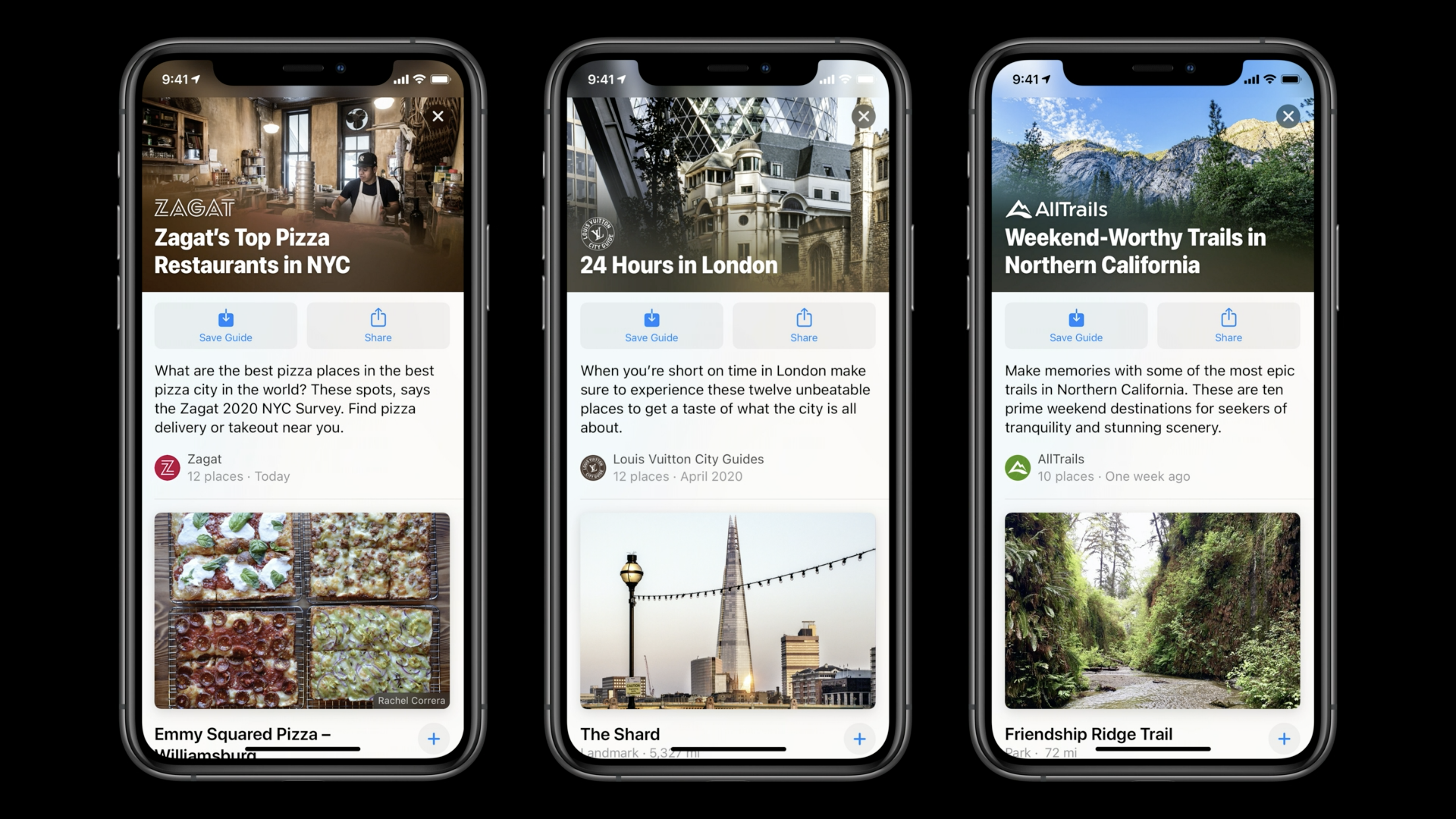
Image Credits: Apple

As for EV routing, Apple Maps will let add your car, name it and choose a charger type — Apple has partnered with BMW and Ford for now. When you’re planning a route, you can now select the car you’re going to be using. If you select your electric car, Apple Maps will add charging spots on the way. You can tap on spots to see if they are free or paid and the connector type.

Waze users will also be happy to learn that Apple Maps will be able to warn you if you’re exceeding the speed limit. You can also view speed and red light cameras on the map.

In some cities with congestion zones and license plate access, you’ll be able to add your license plate. The information is kept on the device. It’ll refine directions for those cities.
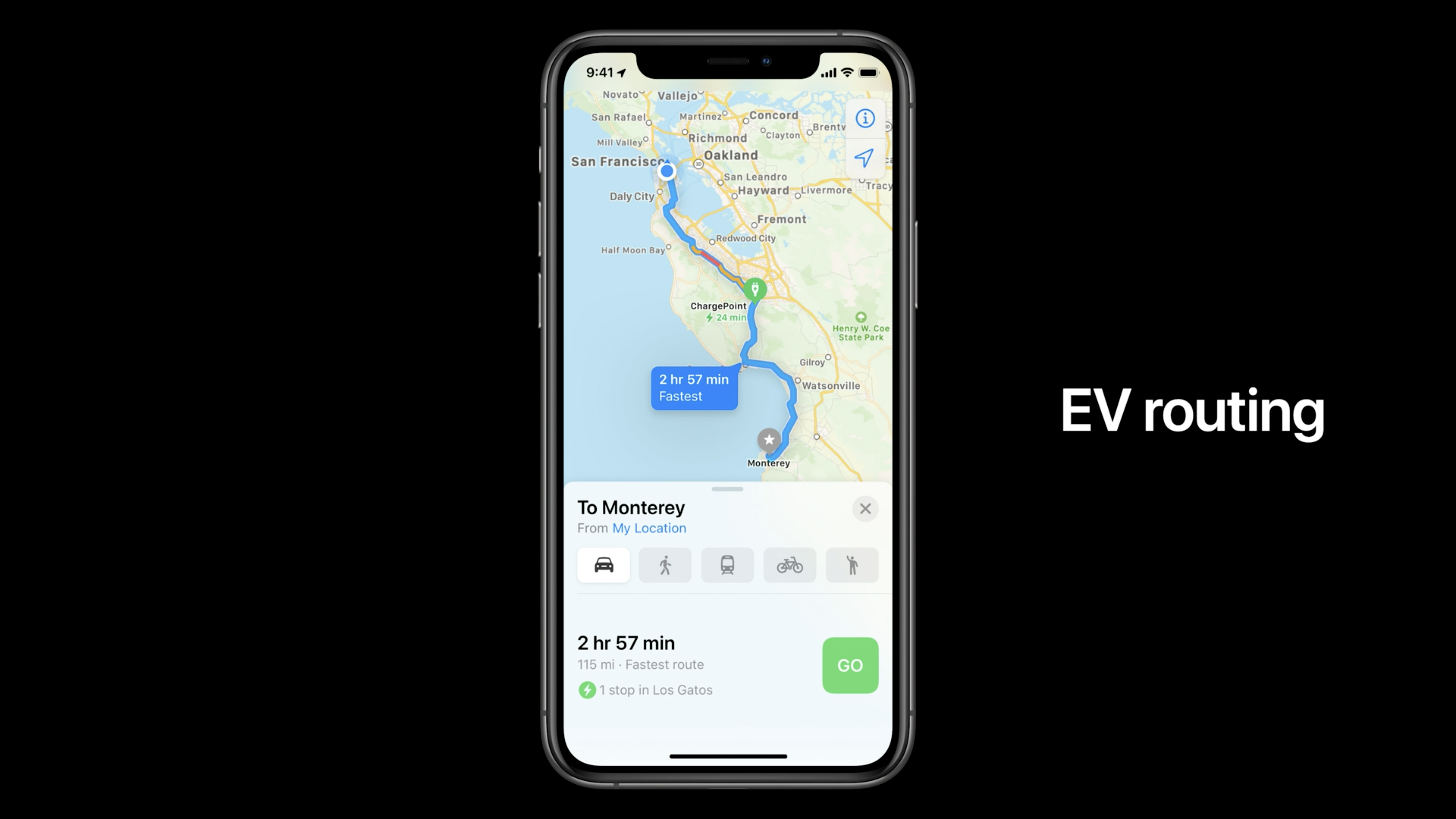
Image Credits: Apple

Finally, my favorite new feature is cycling directions. It’s only going to be available in New York City, Los Angeles, San Francisco, Shanghai and Beijing at first. Apple ticks all the right boxes, such as taking into consideration cycling paths and elevation. Turn-by-turn directions look slightly different from driving directions with a different framing and a more vertical view.

Google Maps also features cycling directions, but they suck. I can’t wait to try it out to see whether cycling directions actually make sense in Apple Maps. The new version of Apple Maps will ship with iOS 14 this fall.
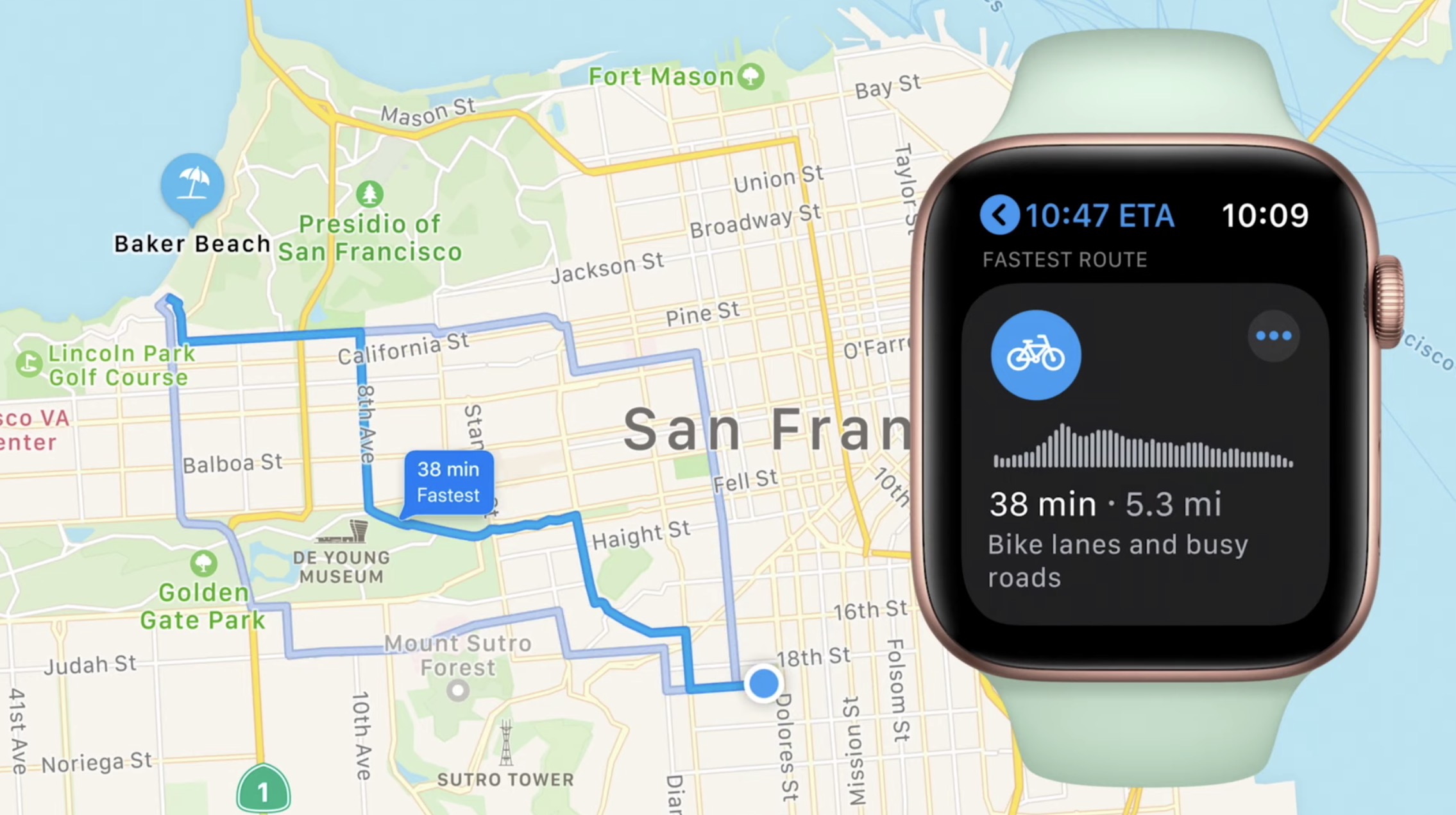
Image Credits: Apple


from RSSMix.com Mix ID 8176981 https://techcrunch.com/2020/06/25/apple-maps-to-tell-you-refine-location-by-scanning-the-skyline/
http://www.gadgetscompared.com
from Tumblr https://ikonografico.tumblr.com/post/621930418166513664
via http://www.gadgetscompared.com

Wednesday, June 24, 2020

China’s GPS competitor is now fully launched

For decades, the United States has had a monopoly on positioning, navigation, and timing technology with its Global Positioning System (GPS), a constellation of satellites operated by the military that today provides the backbone for location on billion of devices worldwide.

As those technologies have become not just key to military maneuvers but the very foundation of modern economies, more and more governments around the world have sought ways to decouple from usage of the U.S.-centric system. Russia, Japan, India, the United Kingdom and the European Union have all made forays to build out alternatives to GPS, or at least, to augment the system with additional satellites for better coverage.

Few countries though have made the investment that China has made into its Beidou (北斗) GPS alternative. Over twenty years, the country has spent billions of dollars and launched nearly three dozen satellites to create a completely separate system for positioning. According to Chinese state media, nearly 70% of all Chinese handsets are capable of processing signals from Beidou satellites.

Now, the final puzzle piece is in place, as the last satellite in the Beidou constellation was launched Tuesday morning into orbit, according to the People’s Daily.

It’s just another note in the continuing decoupling of the United States and China, where relations have deteriorated over differences of market access and human rights. Trade talks between the two countries have reached a standstill, with one senior Trump administration advisor calling them off entirely. The announcement of a pause in new issuances of H-1B visas is also telling, as China is the source of the second largest number of petitions according to USCIS, the country’s immigration agency.

While the completion of the current plan for Beidou offers Beijing new flexibility and resiliency for this critical technology, ultimately, positioning technologies are mostly not adversarial — additional satellites can offer more redundancy to all users, and many of these technologies have the potential to coordinate with each other, offering more flexibility to handset manufacturers.

Nonetheless, GPS spoofing and general hacking of positioning technologies remains a serious threat. Earlier this year, the Trump administration published a new executive order that would force government agencies to develop more robust tools to ensure that GPS signals are protected from hacking.

Given how much of global logistics and our daily lives are controlled by these technologies, further international cooperation around protecting these vital assets seems necessary. Now that China has its own fully-working system, they have an incentive to protect their own infrastructure as much as the United States does to continue to provide GPS and positioning more broadly to the highest standards of reliability.


from RSSMix.com Mix ID 8176981 https://techcrunch.com/2020/06/24/chinas-gps-competitor-is-now-fully-launched/
http://www.gadgetscompared.com
from Tumblr https://ikonografico.tumblr.com/post/621836025120063488
via http://www.gadgetscompared.com

Privacy assistant Jumbo raises $8 million and releases major update

A year after its initial release, Jumbo has two important pieces of news to announce. First, the company has released a major update of its app that protects your privacy on online services. Second, the company has raised an $8 million Series A funding round.

If you’re not familiar with Jumbo, the app wants to fix what’s broken with online privacy today. Complicated terms of services combined customer-hostile default settings have made it really hard to understand what personal information is out there. Due to recent regulatory changes, it’s now possible to change privacy settings on many services.

While it’s possible, it doesn’t mean it’s easy. If you’ve tried to adjust your privacy settings on Facebook or LinkedIn, you know that it’s a convoluted process with a lot of sub-menus and non-descriptive text.

Similarly, social networks have been around for more than a decade. While you were comfortable sharing photos and public messages with a small group of friends ten years ago, you don’t necessarily want to leave this content accessible to hundreds or even thousands of “friends” today.

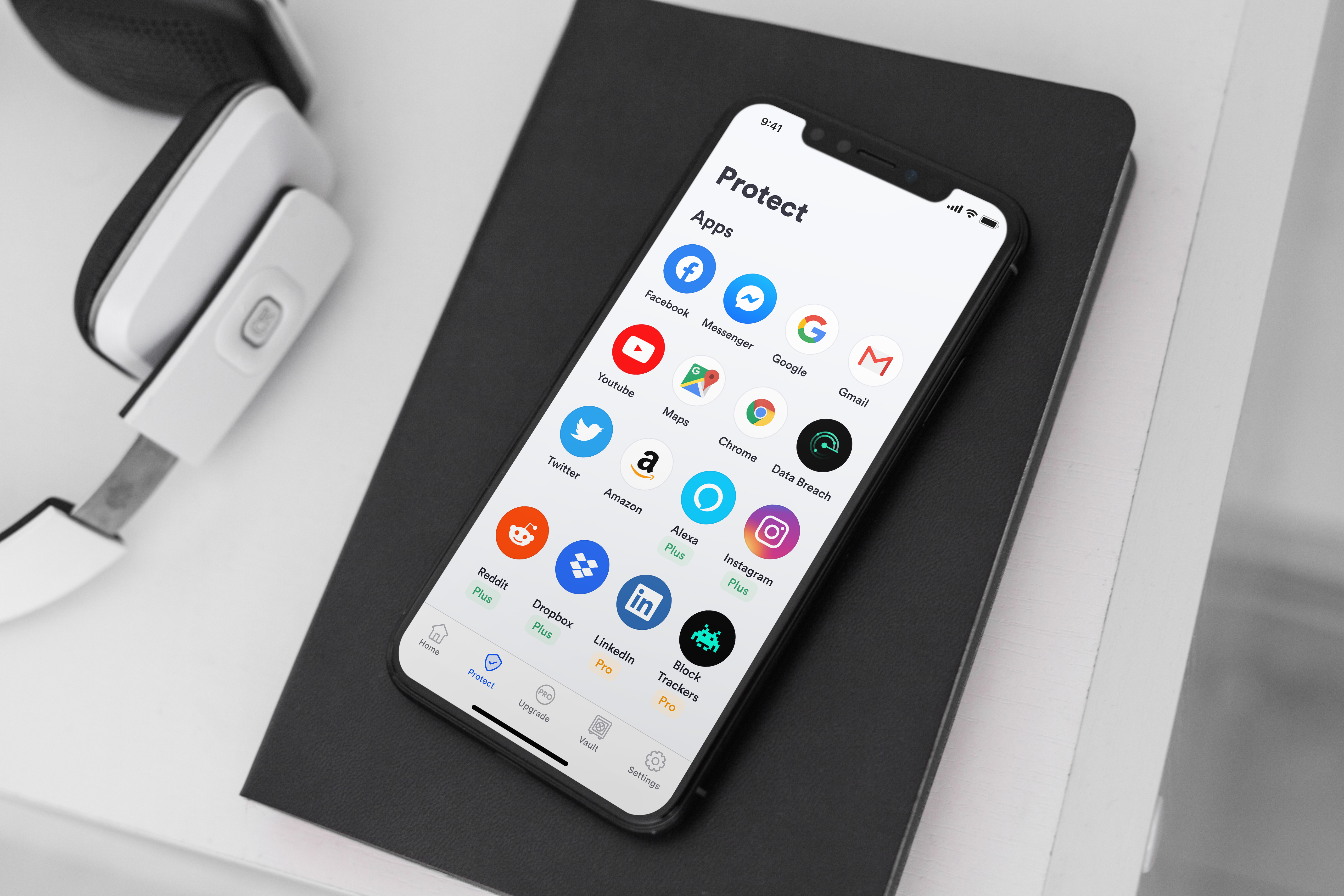
The result is an iPhone and Android app that puts you in charge of your privacy. It’s essentially a dashboard that lets you control your privacy on the web. You first connect the app to various online services and you can then control those services from Jumbo. Jumbo doesn’t limit itself to what you can do with APIs as it can mimic Javascript calls on web pages that are unaccessible to the APIs.

For instance, if you connect your Facebook account, you can remove your profile from advertising lists, delete past searches, change the visibility of posts you’re tagged in and more. On Google, you can delete your history across multiple services — web searches, Chrome history, YouTube searches, Google Map activities, location history, etc.

More fundamentally, Jumbo challenges the fact that everything should remain online forever. Conversations you had six months ago might not be relevant today, so why can’t you delete those conversations?

Jumbo lets you delete and archive old tweets, Messenger conversations and old Facebook posts. The app can regularly scan your accounts and delete everything that is older than a certain threshold — it can be a month, a year or whatever you want.

While your friends will no longer be able to see that content, Jumbo archives everything in a tab called Vault.

With today’s update, everything has been refined. The main tab has been redesigned to inform you of what Jumbo has been doing over the past week. The company now uses background notifications to perform some tasks even if you’re not launching the app every day.

The data breach monitoring has been improved. Jumbo now uses SpyCloud to tell you exactly what has been leaked in a data breach — your phone number, your email address, your password, your address, etc.

It’s also much easier to understand the settings you can change for each service thanks to simple toggles and recommendations that you can accept or ignore.

A clear business model

Jumbo’s basic features are free, but you’ll need to buy a subscription to access the most advanced features. Jumbo Plus lets you scan and archive your Instagram account, delete your Alexa voice recordings, manage your Reddit and Dropbox accounts, and track more than one email address for data breaches.

Jumbo Pro lets you manage your LinkedIn account (and you know that LinkedIn’s privacy settings are a mess). You can also track more information as part of the data breach feature — your ID, your credit card number and your social security number. It also lets you activate a tracker blocker.

This new feature in the second version of Jumbo replaces default DNS settings on your phone. All DNS requests are routed through a Jumbo-managed networking profile on your phone. If you’re trying to access a tracker, the request is blocked, if you’re trying to access some legit content, the request goes through. It works in the browser and in native apps.

You can pay what you want for Jumbo Plus, from $3 per month to $8 per month. Similarly, you can pick what you want to pay for Jumbo Pro between $9 per month and $15 per month.

You might think that you’re giving a ton of personal information to a small startup. Jumbo is well aware of that and tries to reassure its user base with radical design choices, transparency and a clear business model.

Jumbo doesn’t want to mine your data. Your archived data isn’t stored on Jumbo’s servers. It remains on your phone and optionally on your iCloud or Dropbox account as a backup.

Jumbo doesn’t even have user accounts. When you first open the app, the app assigns you with a unique ID in order to send you push notifications but that’s about it. The company has also hired companies for security audits.

“We don’t store email addresses so we don’t know why people subscribe,” Jumbo CEO Pierre Valade told me.

Profitable by 2022

Jumbo has raised an $8 million funding round. It had previously raised a $3.5 million seed round. This time, Balderton Capital is leading the round. The firm had already invested in Valade’s previous startup, Sunrise.

A lot of business angels participated in the round as well, and Jumbo is listing them all on its website. This is all about being transparent again.

Interestingly, Jumbo isn’t betting on explosive growth and eyeballs. The company says it has enough funding until February 2022. By then, the startup hopes it can attract 100,000 subscribers to reach profitability.


from RSSMix.com Mix ID 8176981 https://techcrunch.com/2020/06/24/privacy-assistant-jumbo-raises-8-million-and-releases-major-update/
http://www.gadgetscompared.com
from Tumblr https://ikonografico.tumblr.com/post/621824718548418560
via http://www.gadgetscompared.com

Tuesday, June 23, 2020

iOS 14’s App Clips will save you from always needing ‘an app for that’

The App Store ecosystem today is home to nearly 2 million apps. That means finding new apps to download is now more challenging than ever. This, in turn, leads app developers to funnel more money into App Store Search ads, traditional SEO and digital advertising in an effort to acquire new users. A new feature called App Clips, arriving in iOS 14 later this year, will give developers another option to introduce their app to users. With App Clips, users can instead load just a small part of an app on demand, when required. And when they’re done, the App Clip disappears.

The concept behind App Clips isn’t new. Google’s Android platform has for several years offered tiny app-on-demand downloads called “Instant Apps.”

Like Instant Apps, Apple’s App Clips are about making apps as seamless to use as the web. They are fast, ephemeral and eliminate the barrier to entry that is downloading an app from the App Store.

Today, many users don’t want to bother with a full app download when they’re in a hurry. For example, if a user is trying to pay for parking, they’re more likely to swipe their credit card in the meter to save time, instead of downloading the city’s parking app.

A customer waiting in line to place a food or drink order also doesn’t want to bother downloading the restaurant’s app to browse a menu and pay — they’ll just speak their order at the counter. And a customer wanting to rent a scooter just wants to tap, pay and be on their way.

Image Credits: Apple

An App Clip would work in any of of these scenarios, and many others, by making it as easy to use apps as it is to tap to check out with Apple Pay or launch a website.

While Apple will allow users to launch clips by way of a QR code, a new “App Clip Code” arriving later this year will offer an upgraded experience to kicking off these apps you find suggested to you out in the real world. App Clip Codes will combine both NFC and a visual code, so users can either tap or scan the code to access the App Clip experience.

Image Credits: Apple

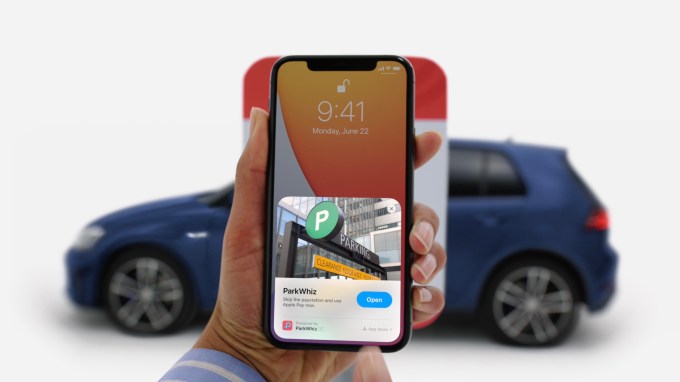
For example, an App Clip Code placed on a parking meter would allow a user to quickly load just the part of the app where they pay for their time. They can even skip manual credit card entry by using Apple Pay, if included in a given App Clip.

The App Clips themselves are less than 10 MB in size and ship bundled with the app on the App Store. They’re built using the same UI technologies developers use today to build apps, like UIKit or SwiftUI. But using an App Clip doesn’t trigger the app to download to the user’s device.

A key advantage App Clips offer is how they address concerns over data privacy. Because App Clips are essentially a way to run app code on demand, they’re restricted from tapping into iPhone’s more sensitive data — like health and fitness information, for example. Plus, the App Clip and all its data will automatically disappear if it’s not used again within some period of time.

However, if a user begins to launch a particular App Clip more regularly — perhaps one for their favorite coffee order at their local shop, for instance — the App Clip’s lifetime is extended and it can get smarter. In this example, the App Clip could cache the customer’s last order and present it as a recommendation, to speed up the ordering process. Eventually, this repeat user may decide to download the full app.

In that case, the hand-off is seamless as well — iOS will automatically migrate the authorizations for things like Camera, Microphone and Bluetooth access, which the App Clip had already requested. Select data can also be migrated.

Image Credits: Apple

There are other ways for users to encounter App Clips besides out in the real world, though that may be a primary use case.

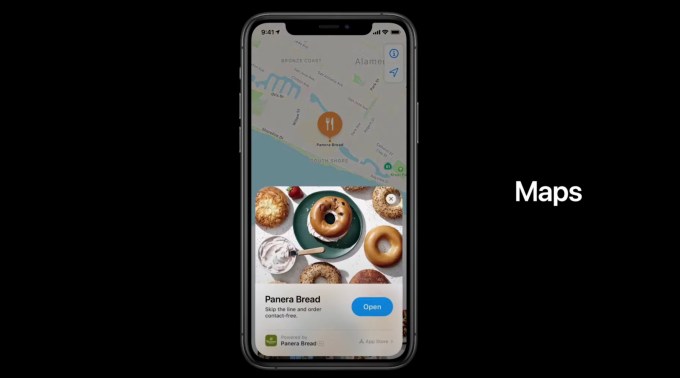
Apple says App Clips can be sent as links in iMessage, popped up as a suggestion when you’re browsing a mobile site in Safari, shown on a business’s details page in Apple Maps or may appear in Siri’s Nearby suggestions.

The idea is that wherever a user may be on their device — or out in the world — the App Clip can be there, too.


from RSSMix.com Mix ID 8176981 https://techcrunch.com/2020/06/23/ios-14s-app-clips-will-save-you-from-always-needing-an-app-for-that/
http://www.gadgetscompared.com
from Tumblr https://ikonografico.tumblr.com/post/621771851869339648
via http://www.gadgetscompared.com

What went wrong with Quibi?

Two months after Quibi’s high-profile launch as a short-form mobile-native TV app led by Jeffrey Katzenberg and Meg Whitman, it is evident the startup is greatly underperforming relative to the hundreds of millions of dollars already spent on content and marketing. 

According to a Wall Street Journal report, “daily downloads peaked at 379,000 on its April 6 launch day but didn’t exceed 20,000 on any day in the first week of June, according to Sensor Tower.” The article says Quibi is on pace for just 2 million subscribers by year-end, from its predicted 7.2 million. Most of the current subscriber base is on free trials, so even just maintaining the current pace of subscriber growth for several more months will be challenging. Quibi hasn’t released any of its own stats on subscribers, which it almost certainly would do to combat the negative perception among investors and press, if the stats showed a lot of traction.

I argued in 2018 that Facebook should turn its IGTV into a Quibi competitor, and I continue to believe there’s untapped opportunity for premium, mobile-native storytelling apps. So what went wrong with Quibi? There appear to have been four key mistakes:

  1. Miscalculating the risk of launching during the COVID-19 lockdown.
  2. Failing to see the central role of interactivity in mobile-native entertainment.
  3. Creating misaligned financial incentives with the wrong content partners.
  4. Launching Quibi like a movie instead of like a startup.


    from RSSMix.com Mix ID 8176981 https://techcrunch.com/2020/06/23/what-went-wrong-with-quibi/
    http://www.gadgetscompared.com

from Tumblr https://ikonografico.tumblr.com/post/621752989539057664
via http://www.gadgetscompared.com
Fandango adds new features to highlight health precautions and distancing in movie theaters

As movie theaters reopen across the United States and the world, there are lingering questions about what kinds of measures those theaters will be taking to keep staff and moviegoers safe in the midst of the ongoing COVID-19 pandemic.

These concerns were illustrated last week, when AMC CEO Adam Aron said in an interview that the theater chain would not be requiring that patrons wear masks except in locations where they’re legally required to do so — because the company “did not want to be drawn into a political controversy.” Naturally, those comments prompted a controversy of their own, leading AMC to reverse its decision.

So it makes sense for NBCUniversal-owned movie ticketing app Fandango to highlight the different safety measures that theaters are taking.

It’s useful from an informational perspective, so that moviegoers understand and prepare for the experience in theaters, and perhaps choose theaters based on how serious they seem about safety. But it’s also a savvy marketing move, as those theaters will need to convince moviegoers that it’s safe to return.

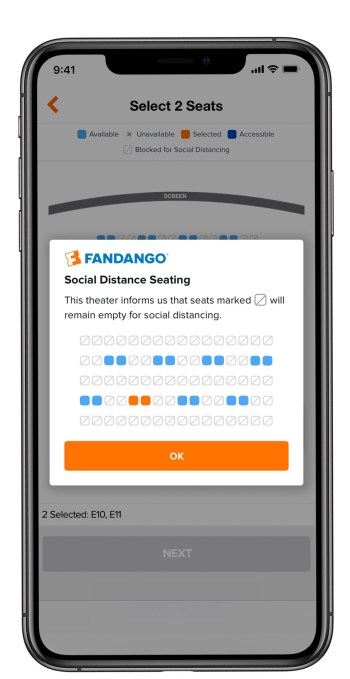
Fandango social distance seating

Image Credits: Fandango

The new features include what Fandango is pitching as a “one-stop shop” to view the safety measures announced by more than 100 theater chains, with information about auditorium occupancy, social distance seating, mask/protective equipment policies, enhanced cleaning measures and special concession arrangements. There will also be instructional videos, social distance seating maps and a way to search for reopened theaters by location.

Since movie theaters have been closed for the past few months, Fandango also says it will be extending expired rewards from its Fandango VIP+ loyalty programs for another 60 days.

“We are working closely with our friends in exhibition to help get their ticketing back online and film fans back in seats with peace of mind,” said Melissa Heller, Fandango’s vice president of domestic ticketing, in a statement. “In addition to our new product features, Fandango’s mobile ticketing will be an added benefit, helping moviegoers and cinema employees reduce the number of contact points at the box office and throughout the theater.”


from RSSMix.com Mix ID 8176981 https://techcrunch.com/2020/06/23/fandango-adds-new-features-to-highlight-health-precautions-and-distancing-in-movie-theaters/
http://www.gadgetscompared.com
from Tumblr https://ikonografico.tumblr.com/post/621745432871272448
via http://www.gadgetscompared.com
Facebook tests Forecast, an app for making predictions about world events, like COVID-19

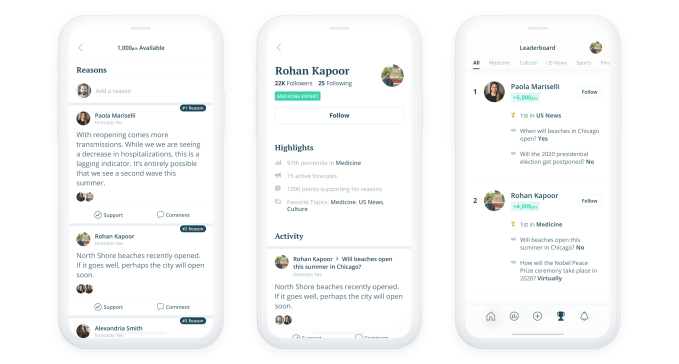
Forecast, a new project from Facebook’s internal R&D group, NPE Team, is launching today to build a community around predictions. The iOS app will allow users to ask questions and then use in-app points to make predictions about what might happen in the future. Users can also create, discuss and view these crowdsourced predictions.

At launch, only invited participants in the U.S. and Canada will be allowed to make predictions and engage in conversations, while the app is in beta testing. But these predictions and related discussions will be publicly accessible on the Forecast website and made shareable.

Before today, Facebook tested the product internally with a small set of employees. Their initial forecasts will form the initial core content in the app at launch.

Starting now, Facebook will invite members of the health, research and academic communities to make predictions about the COVID-19 pandemic and its impact on the world.

At a time when Facebook and other major tech platforms are under fire for their role in aiding the spread of misinformation, fake news, propaganda, conspiracy theories, and other non-factual content presented as truth, an app focused on making “guesses” about the future seems ill-advised — however educated those guesses may be. This is particularly concerning because much of the app’s content will focus on guesses about COVID-19.

Forecast’s predictions may help show what people are thinking, but COVID-19 isn’t a game. To understand the world, scientists form a hypothesis, which is essentially an expanded form of an educated guess. But they don’t then crowdsource voting to determine if a hypothesis is true — they test, experiment, gather supporting data, try to prove and disprove the hypothesis, and ultimately aim to publish their findings and have them peer-reviewed.

The Forecast app turns the hypothesis into the end result, in a way. The app lets users make a forecast and explain their reasoning — in other words, form a hypothesis. But instead of doing the work to test the forecast, through the application of the scientific method, Forecast will track the votes a given question receives.

E.g. “When will the first COVID-19 vaccine candidate begin phase 3 trials?” or “When will most U.S. residents be treated with a COVID-19 vaccine?” In non-COVID questions, you may come across something like “Will the US Presidential Election be fully or partially postponed?” 

Questions will be reviewed by the Forecast team and edited for clarity, if needed. Users will be notified if their question is published.

At some point, the question will be determined as “settled,” based on an elapsed time period or because an event has occurred. For instance, if users were guessing when a vaccine would be released, and then it’s actually released, the questions around that topics would be “settled.”

Forecast’s polls are given aesthetically pleasing charts and graphs which can be shared outside the app. That means users could start posting these guesses and the crowdsourced responses to sites like Facebook, where the line between fact and fiction has already blurred. That could further complicate people’s understanding of what is already a complex topic: the COVID-19 pandemic.

Facebook users who see these shared “forecasts” may believe they have some basis in science and research, when instead, they are the result of a social polling app.

Of course, there is some fun in betting on world events and seeing if they turn out to be true, and there is even some value in organizing a wider community’s collective “best guesses” about a future event to gain an understanding of what people are thinking at a given time. Crowdsourced predictions have their place, as well. But spreading out specific, COVID-19 predictions to Facebook seems like an idea that’s fraught with potential problems and complications.

And Facebook’s goal here is only to test its own hypothesis — that a standalone, community-based predictions app that rewards a participatory audience with social credit will surface insightful voices and thoughtful discussions.

In the end, however, it seems like Facebook is looking for some angle that could prompt thought leaders to engage in meaningful discussions about subjects they know best on a Facebook platform. These sorts of discussions are difficult to have in Facebook’s comments section around a post — as comments, more often than not, are a place people go to troll, argue, threaten and otherwise derail a conversation. Forecast organizes these experts around a topic and allows them to debate. As a self-contained space with a vetted crowd of participants, that could be interesting. Making the data broadly shareable is an issue, however.

Facebook says the questions in Forecast will be moderated for clarity using Forecast’s own moderation guidelines and Facebook’s Community Standards. That means questions can’t mention death, sexual or violent assault of any individual, including public figures. (This isn’t meant to be some sort of new internet Death Clock, for example.) Hate speech isn’t allowed. Questions around illegal content or those involving personal information also aren’t permitted, along with other guidelines detailed here.

The Forecast app is live on the iOS App Store here.


from RSSMix.com Mix ID 8176981 https://techcrunch.com/2020/06/23/facebook-tests-forecast-an-app-for-making-predictions-about-world-events-like-covid-19/
http://www.gadgetscompared.com
from Tumblr https://ikonografico.tumblr.com/post/621734122586505216
via http://www.gadgetscompared.com