Wednesday, October 7, 2020

YouTube Premium subscribers get a new perk with launch of testing program

YouTube has long allowed its users to test new features and products before they go live to a wider audience. But in a recent change, YouTube’s latest series of experiments are being limited to those who subscribe the Premium tier of YouTube’s service. Currently, paid subscribers are the only ones able to test several new product features, including one that allows iOS users to watch YouTube videos directly on the homescreen.

This is not the same thing as the Picture-in-Picture option that’s become available to app developers with iOS 14, to be clear. Instead, YouTube says this feature allows users who are scrolling on their YouTube homepage to watch videos with the sound on while they scroll through their feed.

Two other experiments are related to search. One lets you filter topics you search for by additional languages, including Spanish, French, or Portuguese. The other lets you use voice search to pull up videos when using the Chrome web browser.

Image Credits: YouTube, screenshot via TechCrunch

None of these tests will be very lengthy, however. Two of the three new experiments wrap up on Oct. 20, 2020 for example. The other wraps on Oct. 27. And they’ve only been live for a few weeks.

In years past, YouTube had allowed all users to try out new features in development from a dedicated site dubbed “TestTube.” In more recent years, however, it began to use the website YouTube.com/new to direct interested users to upcoming features before they rolled out publicly. For example, when YouTube introduced its redesign in 2017, users could visit that same website to opt-in to the preview ahead of its launch.

Now, the site is being used to promote other limited-time tests.

YouTube says the option to test the features was highlighted to Premium subscribers a few weeks ago within the YouTube app. It’s also the first time that YouTube has run an experimentation program tied to the Premium service, we’re told.

The company didn’t make a formal public announcement, but the addition was just spotted by several blogs, including XDA Developers and Android Central, for example.

Contrary to some reports, however, it does not appear that YouTube’s intention is to close off all its experiments to anyone except its paid subscribers. The company’s own help documentation, in fact, notes this limitation will only apply to “some” of its tests. 

YouTube also clarified to TechCrunch that the tests featured on the site represent only a “small minority” of those being run across YouTube. And they are not at all inclusive of the broader set of product experiments the company runs, according to the company.

In addition, non-Premium users can opt to sign up to be notified of additional opportunities to participate in other YouTube research studies, if they choose. This option appears at the bottom of the YouTube.com/new page. 

YouTube says the goal with the new experiments is two-fold. It allows product teams to feedback on different features and it allows Premium subscribers to act as early testers, if they want to.

Premium users who choose to participate can opt into and out of the new features individually, but can only try out one experiment at a time.

This could serve to draw more YouTube users to the Premium subscription, as there’s a certain amount of clout involved with being able to try out features and products ahead of the general public. Consider it another membership perk then — something extra on top of the baseline Premium tier features like ad-free videos, downloads, background play and more.

YouTube, which today sees over 2 billion monthly users, said earlier this year it’s converted at least 20 million users to a paid subscription service. (YouTube Premium / YouTube Music). As of Q3 2020, YouTube was the No. 3 largest app by consumer spend worldwide across iOS and Android, per App Annie data.


from RSSMix.com Mix ID 8176981 https://techcrunch.com/2020/10/07/youtube-premium-subscribers-get-a-new-perk-with-launch-of-testing-program/
http://www.gadgetscompared.com
from Tumblr https://ikonografico.tumblr.com/post/631360034339717120
via http://www.gadgetscompared.com

Tuesday, October 6, 2020

Google adds ‘Stories’ to its search app for iOS and Android

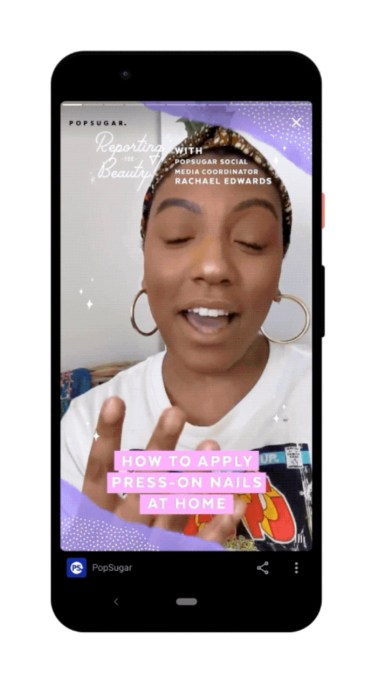
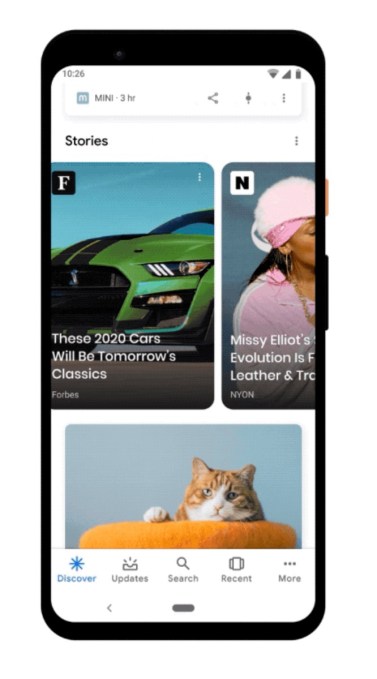
Google announced today it’s introducing a Stories feature to its Google app for iOS and Android, which now reaches over 800 million people per month. In a new carousel within the app, users in supported markets will be presented with a row of tappable visual Stories from participating publishers. These Stories can include full screen video, photos, and audio and can link out to the publisher’s other content, if desired.

The company has been developing its own Stories product for some time. In 2018, it introduced AMP Stories, based on technology developed for Google’s Accelerated Mobile Pages project. The Stories, which are already integrated into mobile Google Search, are meant to give Google its own alternative to the Stories offering found in other apps like Snapchat, Instagram and Facebook. But, in Google’s case, Stories are focused on publisher content.

Image Credits: Google

Today, Google is referring to this visual content as “Web Stories,” not AMP Stories, and is integrating the experience into the Google search app in the U.S., India and Brazil to start.

Here, users will see the row of Web Stories at the top of the Discover tab, where they can tap to enter the full-screen Story experience. Like Stories found in other apps, you can tap to move forward to the next page in a Google Web Story or swipe to move to a different Story in the carousel.

Image Credits: Google

Publishers are responsible for authoring their Stories and have control over Story monetization, hosting, and sharing and adding links to the Stories, Google notes. To create these Stories, the publishers can use drag-and-drop tools like the Web Story editor for WordPress, MakeStories, or NewsroomAI. Technical users can instead opt to code Web Stories themselves.

Early adopters of the format have been using Web Stories on their homepage, on social channels, in newsletters, and more, in addition to having them featured in Google Search, the company says.

Image Credits: Google

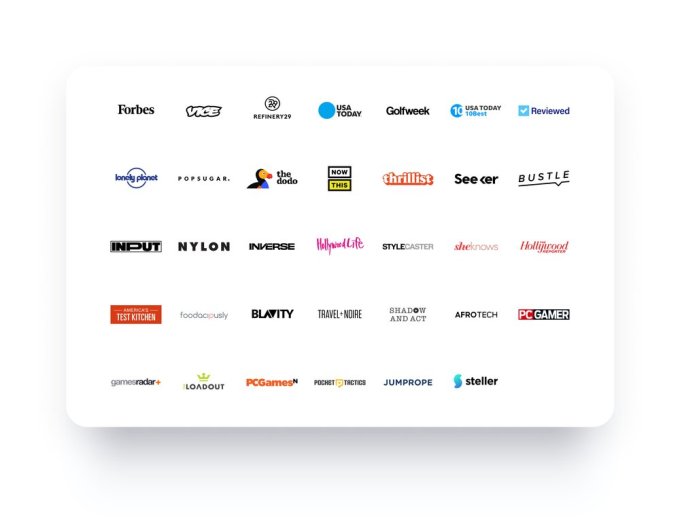
Google has been working with a number of publishers to help them create Web Stories for Search and now, its native mobile app. Partners include Forbes, Vice, Refinery29, USA Today, Lonely Planet, Now This, Thrillist, Popsugar, The Dodo, Bustle, Input, Nylon, The Hollywood Reporter, Blavity, PC Gamer, Golfweek, and many others. The publishers and Google collaborated on the new product and helped build out its features, Google says.

To date, over 2,000 websites have published Stories that have been indexed by Google.

The update to the Google app on iOS and Android is rolling out today.


from RSSMix.com Mix ID 8176981 https://techcrunch.com/2020/10/06/google-adds-stories-to-its-search-app-for-ios-and-android/
http://www.gadgetscompared.com
from Tumblr https://ikonografico.tumblr.com/post/631265758813601792
via http://www.gadgetscompared.com
Tone raises $4M to help e-commerce brands text with their customers

While many companies are using chatbots and other forms of automation to manage their communication with customers, Boston-based Tone is betting that humans will remain a key part of the equation.

“The traditional models of bots and humans is, ‘Hello, I’m a bot, now you get to battle with me to finally get to a human,’” said Tone CEO Tivan Amour. “Our verison of that is, ‘I’m a human using AI to get you the answers you need more quickly.’”

Amour and his co-founders Vlad Pick and Kyle Weidman previously created a bicycle startup called Fortified Bicycle, and he said they “figured out that the best way to close our customers on these $750 to $1,000 orders was to actually engage them in text message conversations.”

After all, when it comes to “high consideration” purchases like bicycles, people usually want discuss their questions and concerns with another human being. Over time, the Fortified team built what Amour said was a “semi-automated system” to help its sales team stay on top of these conversations.

“We started bragging to our friends about it, ‘You’ve gotta do this, it’s the future of mobile commerce,’” he recalled. “And they’d say, ‘Okay, that’s cool, but we don’t have any of the systems of doing that, we don’t have the salespeople.’”

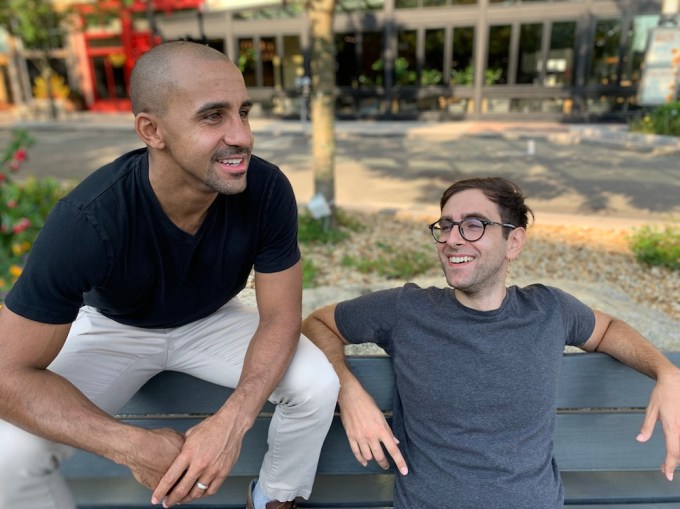
Tone’s founders

So after selling Fortified Bicycle, Amour and Pick created Tone to help any e-commerce business manage similar text message conversations. Tone employs its own team of human agents to actually do the texting, assisted by software that helps them find the information they need.

It integrates with e-commerce systems like Shopify and Magento, and it’s already working with more than 1,000 brands like ThirdLove, Peak Design and Usual Wines — who are seeing as much as a 26% increase in revenue and a 15% increase in order size.

Amour also noted that specific Tone agents are assigned to specific brands, which means that customers will be talking to the same person whenever they have a question for that business. In some cases, customers have been talking to the same agent for months or years. (Update: Tone clarified that this isn’t a person, but a single persona that’s probably an amalgamation of multiple agents.)

“Particularly in a post-COVID world, it’s pretty clear that online shopping has become the dominant form of shoping, but I think nobody has thought about how you replace that human experience that you get in traditional retail,” he said.

Tone is announcing today that it has raised $4 million in seed funding led by Bling Capital, with participation from Day One Ventures, One Way Ventures, TIA Ventures and executives from Google, Facebook, Dropbox and Uber.

With the new funding, Amour said Tone will be able to build out the “relationship automation” aspect of the product. He also suggested that the platform could eventually expand beyond text messaging, but it sounds like that’s not a big priority.

“In theory, we’re a conversational sales platform more than we are an SMS company,” he said. “However there are a bunch of trends right now [such as the growth of mobile commerce] that make SMS the most obvious place for this sort of innovation.”


from RSSMix.com Mix ID 8176981 https://techcrunch.com/2020/10/06/tone-seed-funding/
http://www.gadgetscompared.com
from Tumblr https://ikonografico.tumblr.com/post/631265757453484032
via http://www.gadgetscompared.com
Google Assistant comes to gaze-powered accessible devices

People who rely on gaze-tracking to interact with their devices on an everyday basis now have a powerful new tool in their arsenal: Google Assistant. Substituting gaze for its original voice-based interface, the Assistant’s multiple integrations and communication tools should improve the capabilities of the Tobii Dynavox devices it now works on.

Assistant will now be possible to add as a tile on Tobii’s eye-tracking tablets and mobile apps, which present a large customizable grid of commonly used items that the user can look at to activate. It acts as an intermediary with a large collection of other software and hardware interfaces that Google supports.

For instance smart home appliances — which can be incredibly useful for people with certain disabilities — may not have an easily accessible interface for the gaze-tracking device, necessitating other means or perhaps limiting what actions a user can take. Google Assistant works with tons of that stuff out of the box.

“Being able to control the things around you and ‘the world’ is central to many of our users,” said Tobii Dynavox’s CEO, Fredrik Ruben. “The Google assistant ecosystem provides almost endless possibilities – and provides a lot of normalcy to our community of users.”

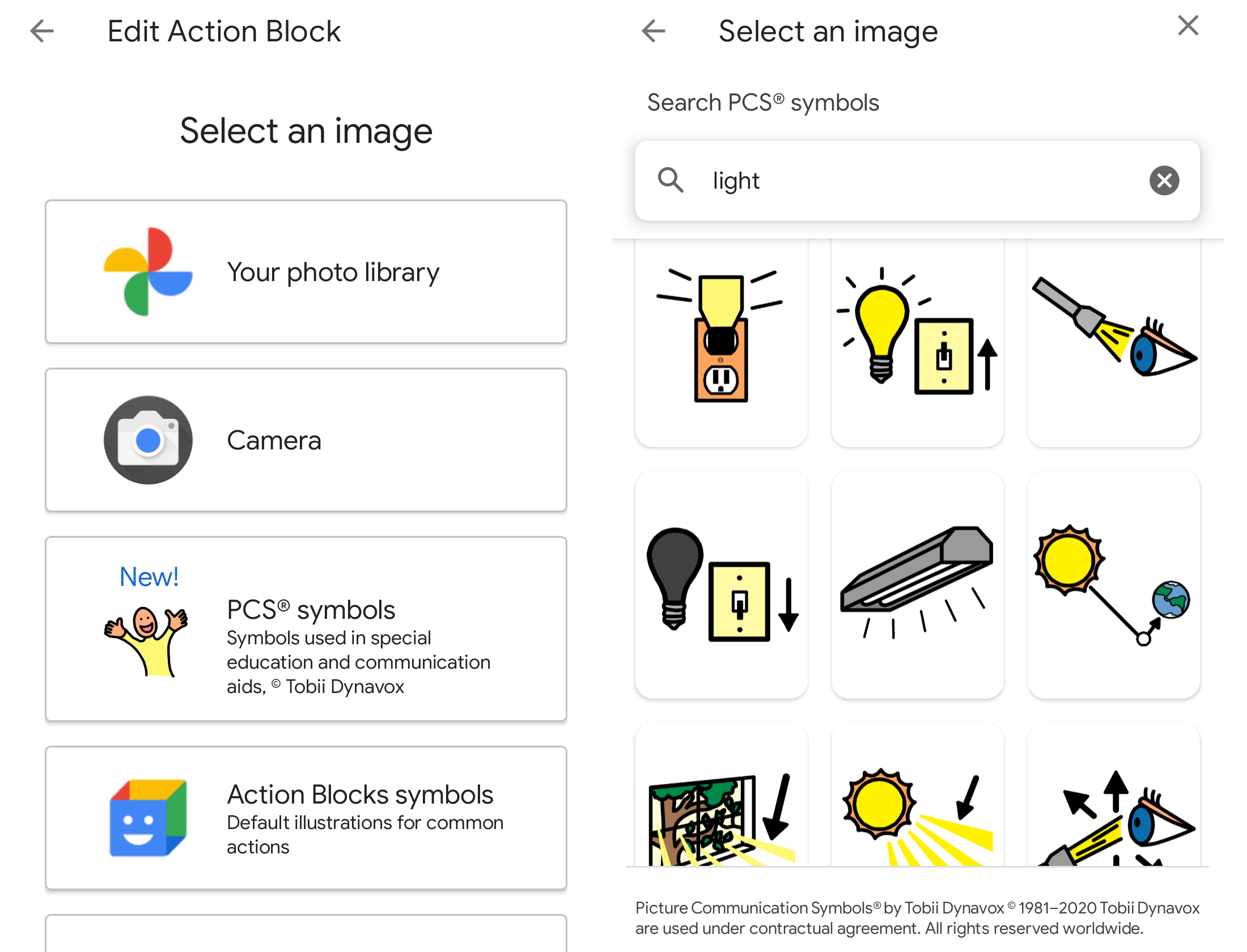
Users will be able to set up Assistant tiles for commands or apps, and automate inquiries like “what’s on my calendar today?” The setup process just requires a Google account, and then the gaze-tracking device (in this case Tobii Dynavox’s mystifyingly named Snap Core First app) has to be added to the Google Home app as a smart speaker/display. Then Assistant tiles can be added to the interface and customized with whatever commands would ordinarily be spoken.

Tobii and Google interface for adding actions using pictorial icons.

Image Credits: Google / Tobii Dynavox

Ruben said the integration of Google’s software was “technically straightforward.” “Because our software itself is already built to support a wide variety of access needs and is set up to accommodate launching third-party services, there was a natural fit between our software and Google Assistant’s services,” he explained.

Tobii’s built-in library of icons (things like lights with an up arrow, a door being opened or closed, and other visual representations of actions) can also be applied easily to the Assistant shortcuts.

For Google’s part, this is just the latest in a series of interesting accessibility services the company has developed, including live transcription, detection when sign language is being used in group video calls, and speech recognition that accommodates non-standard voices and people with impediments. Much of the web is not remotely accessible but at least the major tech companies put in some good work now and then to help.


from RSSMix.com Mix ID 8176981 https://techcrunch.com/2020/10/06/google-assistant-comes-to-gaze-powered-accessible-devices/
http://www.gadgetscompared.com
from Tumblr https://ikonografico.tumblr.com/post/631265756676538368
via http://www.gadgetscompared.com
Monday, October 5, 2020

Accessibility’s nextgen breakthroughs will be literally in your head

Predicting the future of technology for people with visual impairments is easier than you might think. In 2003, I wrote an article entitled “In the Palm of Your Hand” for the Journal of Visual Impairment & Blindness from the American Foundation for the Blind. The arrival of the iPhone was still four years away, but I was able to confidently predict the center of assistive technology shifting from the desktop PC to the smart phone. 

“A cell phone costing less than $100,” I wrote, “will be able to see for the person who can’t see, read for the person who can’t read, speak for the person who can’t speak, remember for the person who can’t remember, and guide the person who is lost.” Looking at the tech trends at the time, that transition was as inevitable as it might have seemed far-fetched.

We are at a similar point now, which is why I am excited to play a part of Sight Tech Global, a virtual event Dec. 2-3 that is convening the top technologists to discuss how AI and related technologies will usher in a new era of remarkable advances for accessibility and assistive tech, in particular for people who are blind or visually impaired.

To get to the future, let me turn to the past. I was walking around the German city of Speyer in the 1990s with pioneering blind assistive tech entrepreneur Joachim Frank. Joachim took me on a flight of fancy about what he really wanted from assistive technology, as opposed to what was then possible. He quickly highlighted three stories of how advanced tech could help him as he was walking down the street with me. 

  • As I walk down the street, and walk by a supermarket, I do not want it to read all of the signs in the window. However, if one of the signs notes that kasseler kipchen (smoked porkchops, his favorite) are on sale, and the price is particularly good, I would like that whispered in my ear.
  • And then, as a young woman approaches me walking in the opposite direction, I’d like to know if she’s wearing a wedding ring.
  • Finally, I would like to know that someone has been following me for the last two blocks, that he is a known mugger, and that if I quicken my walking speed, go fifty meters ahead, turn right, and go another seventy meters, I will arrive at a police substation! 

Joachim blew my mind. In one short walk, he outlined a far bolder vision of what tech could do for him, without bogging down in the details. He wanted help with saving money, meeting new friends and keeping himself safe. He wanted abilities which not only equaled what people with normal vision had, but exceeded them. Above all, he wanted tools which knew him and his desires and needs. 

We are nearing the point where we can build Joachim’s dreams.  It won’t matter if the assistant whispers in your ear, or uses a direct neural implant to communicate. We will probably see both. But, the nexus of tech will move inside your head, and become a powerful instrument for equality of access. A new tech stack with perception as a service. Counter-measures to outsmart algorithmic discrimination. Tech personalization. Affordability. 

That experience will be built on an ever more application rich and readily available technology stack in the cloud. As all that gets cheaper and cheaper to access, product designers can create and experiment faster than ever. At first, it will be expensive, but not for long as adoption – probably by far more than simply disabled people – drives down price. I started my career in tech for the blind by introducing a reading machine that was a big deal because it halved the price of that technology to $5,000. Today even better OCR is a free app on any smartphone.

We could dive into more details of how we build Joachim’s dreams and meet the needs of millions of others of individuals with vision disabilities. But it will be far more interesting to explore with the world’s top experts at Sight Tech Global on Dec. 2-3 how those tech tools will become enabled In Your Head!

Registration is free and open to all. 


from RSSMix.com Mix ID 8176981 https://techcrunch.com/2020/10/05/accessibilitys-nextgen-breakthroughs-will-be-literally-in-your-head/
http://www.gadgetscompared.com
from Tumblr https://ikonografico.tumblr.com/post/631167626265100288
via http://www.gadgetscompared.com
Thursday, October 1, 2020

Google takes aim at ‘beauty filters’ with design changes coming to Pixel phones

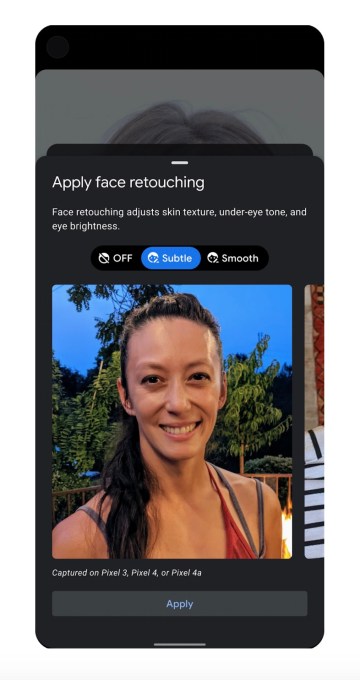
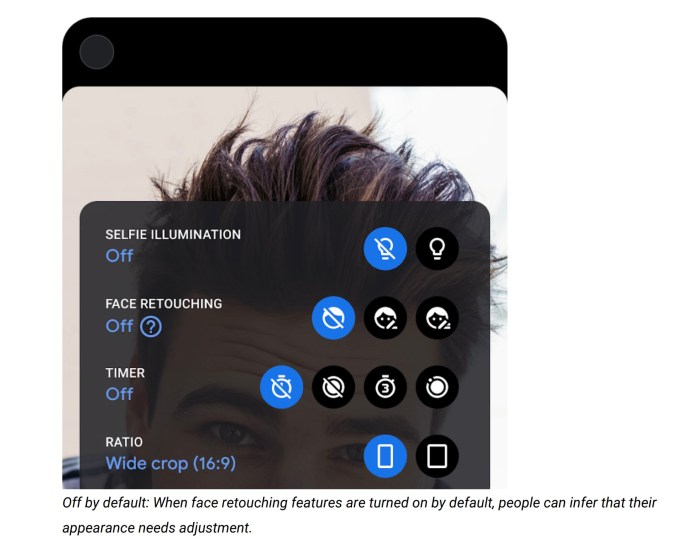
Google is taking aim at photo face filters and other “beautifying” techniques that mental health experts believe can warp a person’s self-confidence, particularly when they’re introduced to younger users. The company says it will now rely on expert guidance when applying design principles for photos filters used by the Android Camera app on Pixel smartphones. In the Pixel 4a, Google has already turned off face retouching by default, it says, and notes the interface will soon be updated to include what Google describes as “value-free” descriptive icons and labels for the app’s face retouching effects.

That means it won’t use language like “beauty filter” or imply, even in more subtle ways, that face retouching tools can make someone look better. These changes will also roll out to the Android Camera app in other Pixel smartphones through updates.

The changes, though perhaps unnoticed by the end user, can make a difference over time.

Google says that more than 70% of photos on Android are shot with the front-facing camera and over 24 billion photos have been labeled as “selfies” in Google Photos.

Image Credits: Google

But the images our smartphones are showing us are driving more people to be dissatisfied with their own appearance. According to the American Academy of Facial Plastic and Reconstructive Surgery, 72% of their members last year said their patients sought them out in order to improve their selfies, a 15% year-over-year increase. In addition, 80% of parents said they’re worried about filters’ impact and two-thirds of teens said they’ve been bullied over how they look in photos.

Google explains it sought the help of child and mental health experts to better understand the impact of filters on people’s well-being. It found that when people weren’t aware a photo filter had been applied, the resulting photos could negatively impact mental well-being as they quietly set a beauty standard that people would then compare themselves against over time.

Image Credits: Google

In addition, filters that use terminology like “beauty,” “beautification,” “enhancement” and “touch up” imply there’s something wrong with someone’s physical appearance that needs to be corrected. It suggests that the way they actually look is bad, Google explains. The same is true for terms like “slimming,” which imply a person’s body needs to be improved.

Google also found that even the icons used could contribute to the problem.

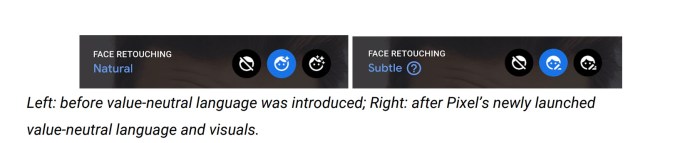
It’s often the case that face retouching filters will use “sparkling” design elements on the icon that switches the feature on. This suggests that using the filter is making your photo better.

To address this problem, Google will update to using value-neutral language for its filters, along with new icons.

Image Credits: Google

For example, instead of labeling a face retouching option as “natural,” it will relabel it to “subtle.” And instead of sparkling icons, it instead shows an icon of the face with an editing pen to indicate which button to push to enable the feature.

Adjustment levels will also follow new guidelines, and use either numbers and symbols or simple terms like “low” and “high,” rather than those that refer to beauty.

Image Credits: Google

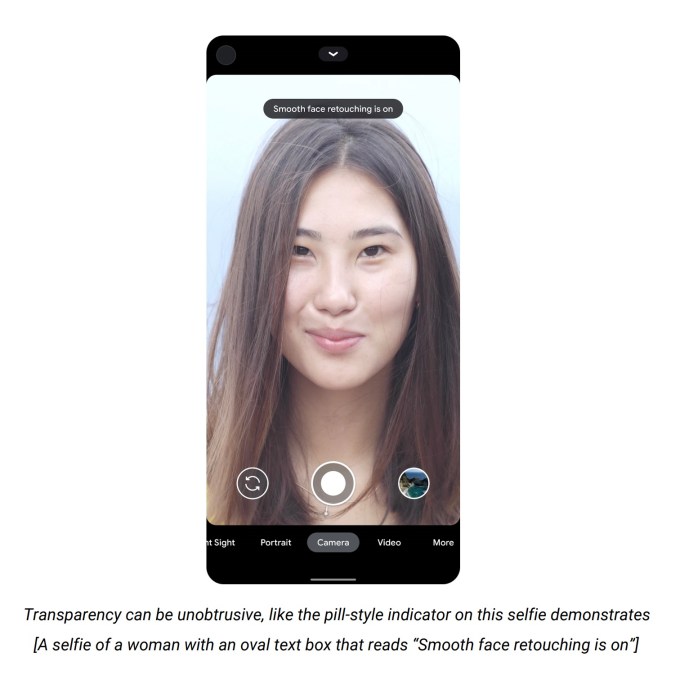
Google says the Camera app, too, should also make it obvious when a filter has been enabled — both in the real-time capture and afterwards. For example, an indicator at the top of the screen could inform the user when a filter has been turned on, so users know their image is being edited.

In Pixel smartphones, starting with the Pixel 4a, when you use face retouching effects, you’ll be shown more information about how each setting is being applied and what specific changes it will make to the image. For instance, if you choose the “subtle” effect, it will explain that it adjusts your skin texture, under-eye tone and eye brightness. Being transparent about the effects applied can help to demystify the sometimes subtle tweaks that face retouching filters are making to our photos.

Face retouching will also be shut off in the new Pixel devices announced on Wednesday, including the Pixel 4a 5G and Pixel 5. And the changes to labels and descriptions are coming to Pixel phones through an upcoming update, Google says, which will support Pixel 2 and later devices.


from RSSMix.com Mix ID 8176981 https://techcrunch.com/2020/10/01/google-takes-aim-at-beauty-filters-with-design-changes-coming-to-pixel-phones/
http://www.gadgetscompared.com
from Tumblr https://ikonografico.tumblr.com/post/630827797375533056
via http://www.gadgetscompared.com
Google now has three mid-range Pixel phones

The Pixel has always been a mixed bag. The first-generation product was announced roughly this time four years ago, with Google finally offering a full-throated entry into the smartphone space after years of device partnerships.

Of course, by 2016, the market was already mature — particularly for Android phones. But while it was easy to write off those initial devices as Nexus-like references for future software updates, Google made it clear that it was taking the line seriously. It put any doubts to rest two years later, with its $1.1 billion acquisition of the design team from a struggling HTC.

But Google’s had struggles of its own. Slow Pixel 3 sales left the company in a tough spot, as the overall market took a hit. Google was able to correct the ship with the launch of the Pixel 3a, joining the likes of Apple and Samsung in offering budget versions of its smartphone flagship as consumers grew weary of premium prices.

It’s a strategy that makes sense. Two primary devices: a flagship and a budget model. Of course, the line has never been particularly clear for Google. For one thing, the company just doesn’t chase premium hardware in the same way that Apple, Samsung or Huawei does. Rather, it insists setting itself apart with its software — even for things like imaging. That often results in a less pronounced gap between devices. It also dulls the company’s edge with features that, more often than not, come to other Android devices.

But today’s hardware event blurred those lines more than ever. The dual-launch of the Pixel 5 and 4a 5G was arguably the most confusing element about a morning event with words “Launch Night” in its title.

Image Credits: Google

While pre-show rumors and leaks revealed a lot about the devices that ultimately proved true, they didn’t do much to distinguish the differences between the products. Turns out there’s an obvious reason: There really isn’t that much of a difference. If anything, the 4a 5G feels like a stepping stone toward the Pixel 5 — a device that would, perhaps, more fittingly have been named the Pixel 5a, if the company’s naming conventions worked that way.

We already knew that both devices were going to sport 5G. That seems to be Google taking advantage of Qualcomm’s aggressive push to bring the next-gen wireless technology to more budget devices. Really, the big driver here is that both devices utilize the same processors: Qualcomm’s Snapdragon 765G. It is, as I’m sure you’re aware, a mid-tier processor. It’s a step down from the 865 currently found in the majority of this year’s flagships.

Likely, the decision was a cost-cutting measure, but we’ve seen evidence from a number of manufacturers that it’s possible to produce an 865-sporting device priced in the middle six digits. Both devices also sport the same dual-camera set up on the rear and the same resolution screens — though the 4a 5G’s is actually bigger (albeit with a lower pixel density), at 6.2 inches to the 5’s 6.0.

There are some differences between the products to justify the $200 pricing gap. For starters, the 5 features a 100% recycled aluminum body, whereas the 4a 5G is polycarbonate. The cheaper phone lacks waterproofing and the reverse wireless charging found on the 5. It also sports a smaller battery, though both devices have been upgraded in that respect over the 4 and 4a. Battery life, after all, was the biggest complaint against the Pixel 4 — and either way you’re going to need more milliamp hours to handle the strains of 5G and, in the case of the 5, reverse charging.

So, are you clear on all of this? Me neither, to be honest. Google’s smartphone line now contains three devices. There’s a mid-tier handset, a slightly lower-mid-tier handset and an even lower-mid-tier handset. That’s three distinct devices with about a $300 price difference, all released within months of one another. It’s as if Google saw the 3a’s successes and decided “screw it, we’re making all of our products mid-range.” Affordability isn’t a bad thing, of course, but if you’re going to release three separate products over roughly a two-month span, you owe it to yourself and your fans to offer clearer value propositions.

Some of this is going to self-correct. For starters, it seems likely that the three devices will turn into two by this time next year. I don’t foresee the company keeping both an LTE and 5G model around in late-2021. There’s also the fact that the company has been undergoing a bit of an executive shakeup among the Pixel line — something that appears to point to a dramatic rethink of the line. It’s likely that the 4a, 4a 5G and 5 were already pretty far into development when Google started its executive shuffling.

Hopefully all of this will cause the company to rethink the Pixel line from the ground up and determine what Google can bring to the table that the competition can’t.


from RSSMix.com Mix ID 8176981 https://techcrunch.com/2020/10/01/google-now-has-three-mid-range-pixel-phones/
http://www.gadgetscompared.com
from Tumblr https://ikonografico.tumblr.com/post/630820245113913344
via http://www.gadgetscompared.com