Monday, December 21, 2020

OnePlus’ latest concept phone changes color to ‘breathe’ with the user

Back in January, OnePlus showed off its first concept phone. The aptly (if plainly) named Concept One sported color-shifting glass, giving the effect of an “invisible camera” on the rear of the device. The concept wasn’t particularly useful — if anything it was a fun diversion from boring old phone updates.

From that standpoint, the OnePlus 8T Concept is more of the same. It’s not particularly useful as far as smartphone updates go — and more to the point, there’s absolutely zero guarantee this technology will ever make it onto an actual phone. Once again, the headlining technology has more to do with how the phone looks than how it actually functions.

The big thing here is something called ECMF, or Electronic Color, Material and Finish. Basically it’s a color-changing film that coats the phone. It has metal oxide, which activates when voltage is applied, changing the glass from dark blue to light silver.

Image Credits: OnePlus

OnePlus says, “Our designers took inspiration for these colors from the multi-hued flowing water in the hot springs of Pamukkale, Turkey. Nature has perfected many designs, and by drawing inspiration from Pamukkale and other natural elements, we can craft new interaction experiences that are more natural, intuitive, and effortless.”

As for the utility of such technologies, OnePlus suggests a coat that changes color to notify the user of incoming calls. Weirder still is a future that uses mmWave technology to capture a user’s breathing pattern, “enabling the color to change in sync and effectively making the phone a biofeedback device.”

As far as new phone features, this one is firmly in the “why not” column.


from RSSMix.com Mix ID 8176981 https://techcrunch.com/2020/12/21/oneplus-latest-concept-phone-changes-color-to-breathe-with-the-user/
http://www.gadgetscompared.com
from Tumblr https://ikonografico.tumblr.com/post/638135960165646336
via http://www.gadgetscompared.com

Friday, December 18, 2020

Unfold launches lightweight, link-centric profiles called Bio Sites

Unfold, the social media startup acquired by Squarespace last year, is launching a new tool for users to share all the links that are important with them.

This is the first step Unfold has taken beyond its story-format authoring tools. Co-founder Andy McCune told me that the team has a bigger vision now — just as Squarespace has become “the all-in-one platform for your web presence,” Unfold aims to become “the all-in-one platform for your social presence.”

“We’re both playing in very saturated spaces with a lot of competitors,” McCune said. “We both stand out because we appeal to the person that cares about design. That’s always been the North Star.”

In the case of the new Bio Sites, he said one of the goals is to help Unfold users — whether they’re individuals or large brands — become less reliant on a single social media platform. After all, he noted that when you build a following on Instagram, you’re building on “borrowed territory,” and “you don’t really own your audience.”

Unfold Bio Sites

Image Credits: Unfold

By creating a simple profile that highlights the links of your choice, then by linking your Instagram and other social profiles to your Bio Site, you can then point audiences to other channels where you have more control — or at least diversify the platforms that you’re relying on.

McCune and his co-founder Alfonso Cobo aren’t the first ones to think of this idea. For example, Linktree raised funding earlier this year, and there are other startups creating similar products. But Cobo said Bio Sites benefit from Unfold’s design-centric approach, allowing users to create simple profiles that aren’t just functional, but also looks great and reflect their personality.

Cobo also noted that Bio Sites are created from the Unfold native app — it’s launching on Android today, with plans for iOS in January. The feature will be available available to all Unfold users, including free users, but subscribers to the premium Unfold+ and Unfold for Brands tiers get additional features like custom URLs.

“We’re really going to be expanding in the next few weeks with presence and expressibility tools to help users stand out in different ways,” Cobo said. “We’re also very interested in commerce and will be exploring that route in the future, too.”


from RSSMix.com Mix ID 8176981 https://techcrunch.com/2020/12/18/unfold-bio-sites/
http://www.gadgetscompared.com
from Tumblr https://ikonografico.tumblr.com/post/637864160846397440
via http://www.gadgetscompared.com

From India’s richest man to Amazon and 100s of startups: The great rush to win neighborhood stores

After spending more than a decade disrupting the neighborhood stores in the U.S. and several other markets, Amazon and Walmart are employing an unusual strategy in India to face off this competitor: Friending them.

Walmart and Amazon, both of which face restrictions from New Delhi on what all they could do in India, have partnered with tens of thousands of neighborhood stores in the world’s second-largest internet market this year to leverage the vast presence of these mom and pop stores.

In June this year, at the height of the pandemic, Amazon announced “Smart Stores.” Through this India-specific program, for instance, Amazon is providing physical stores with software to maintain a digital log of the inventory they have in the shop and supplying them with a QR code.

When consumers walk to the store and scan this QR code with the Amazon app, they see everything the shop has to offer, in addition to any discounts and past reviews from customers. They can select the items and pay for it using Amazon Pay. Amazon Pay in India supports a range of payments services, including the popular UPI, and debit and credit cards.

The world’s largest e-commerce giant also maintains partnerships that allow it to turn tens of thousands of neighborhood stores as its delivery point for customers — and sometimes even rely on them for inventory.

India has over 60 million small businesses that dot the thousands of cities, towns and villages across the country. These mom and pop stores offer all kinds of items, are family run, and pay low wages and little to no rent.

This has enabled them to operate at an economics that is better than most — if not all — of their digital counterparts, and their scale allows them to offer unmatched fast delivery.

Krishna Shah, a New Delhi-based doctor, on paper is one of the perfect customers of e-commerce services. She lives in an urban city, uses digital payments apps and her earnings put her in the top 5% income level in the country. Yet, when she needed to buy food for her cats and needed it as soon as possible, she realized the major giants would take hours, if not longer. She ended up placing a call to a neighborhood store, which delivered the item within 10 minutes.

That neighborhood store, which employs fewer than half a dozen people, was competing with over a dozen giants and heavily funded startups including Grofers and BigBasket — and it won.

At stake is India’s retail market, which is estimated to be worth $1.3 trillion by 2025, from about $700 billion last year, according to Boston Consulting Group and the Retailers’ Association India. E-commerce, by several estimates, accounts for just 3% of the retail market in the country.

If that figure wasn’t small enough already, consider this: Some of the biggest customers of Flipkart and Amazon are these small retail stores. An executive with direct knowledge of the matter told TechCrunch that during some sales, as high as 40% of all smartphone units are bought by physical stores. The idea is, the executive said, to buy the devices at a discounted price, sit on them for a few days and when Amazon and Flipkart are done with their sales, sell the same phones at their standard prices.

Sujeet Kumar, co-founder of Udaan, a Bangalore-based startup that works with merchants, said that even as smartphones and the internet have reached all corners of India, e-commerce hasn’t been able to disrupt the retail market.

“The problem is that it is very difficult for e-commerce companies to build a supply chain and distribution network that is more efficient than those established by neighborhood stores. These mom and pop stores operate on an insanely different kind of cost economics. E-commerce companies are not able to match it,” he said.


from RSSMix.com Mix ID 8176981 https://techcrunch.com/2020/12/18/from-indias-richest-man-to-amazon-and-100s-of-startups-the-great-rush-to-win-neighborhood-stores/
http://www.gadgetscompared.com
from Tumblr https://ikonografico.tumblr.com/post/637856587293343744
via http://www.gadgetscompared.com

Thursday, December 17, 2020

Gawq wants to burst your ‘echo chamber’ with its smarter news app

A new startup called Gawq wants to tackle the problem of fake news and the “echo chamber” problem created by social media, where our view of the world is shaped by manipulative algorithms and personalized feeds. Through Gawq’s newly launched mobile news app, it aims to present news from a range of sources, while allowing users to filter between news, opinion, paid content, and more, as well as compare sources, check facts, and even review the publication’s content for accuracy.

The idea for Gawq comes from Joshua Dziabiak, co-founder and now board member at the now profitable insurance tech startup The Zebra. Dziabiak stepped down from his day-to-day role this March, and founded Gawq shortly after.

“It started as a passion project and then it transformed into a business,” Dziabiak explains. “I wanted to do something that had a larger social impact. And this idea — this problem — has surfaced and been magnified in really big ways over the past year, especially,” he says.

When news is served up through social media channels, people are presented with their own version of reality, as the algorithms begin to filter out the news that doesn’t engage them and show them more of what does. Over time, this system led some publishers to pursue clicks and outrage with over-the-top, sensational headlines, but it also spawned a network of publications that would slant and bias the news in ways that better connected them with an either right- or left-leaning audience.

As a result, the media environment overall began to center itself around eyeballs and not necessarily news quality, Dziabiak says. While there is still quality journalism being created, it can sometimes be hard to find among all the noise.

“I believe journalists and content creators need a new measure for success. One that is based on the core ethics of journalism, and not the number of clicks or shares,” Dziabiak notes.
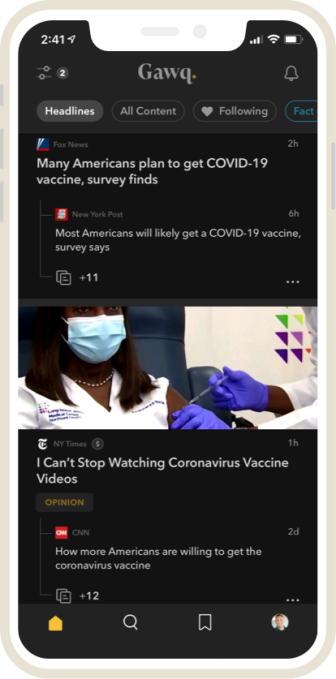
Image Credits: Gawq

The Gawq name is meant to be a reminder of how today’s headlines often scream for our attention. But it misses the mark for an app about news accuracy. At its core, Gawq is a news aggregator where you are not meant to “gawk” at headlines, but actually read and consider the news with a more critical eye.

At launch, the app organizes over 150 different top media sources of all types and sizes, including those that lean one way or the other. The publishers cover topics like U.S. and world news, politics, sports, business, tech, entertainment, science, lifestyle news, and more.

Gawq also organizes the day’s news without using any sort of algorithms or personalization engines, but instead by topic. As you read, you click to compare coverage of the story with other sources to get a better idea of how different outlets are writing about the same topic. With a clever red and blue slider bar at the top of the screen, you can drag your finger over to the red side to see the coverage from right-leaning sources, or you can drag it to the blue side to see the more left-leaning coverage.

The company says it uses data from three different nonprofits who audit media — AllSides, Media Bias Fact Check, and Ad Fontes Media —  to determine if sources are “right” or “left.”
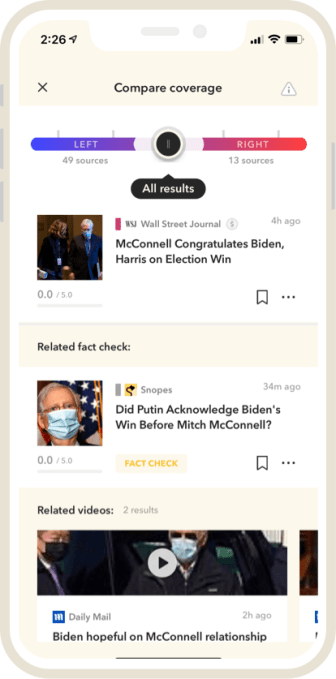
Image Credits: Gawq

Just below the slider bar are the related fact checks to the topic at hand, for easy reference.

While Gawq will allow users to toggle some news sources on or off within the app’s settings, it uses language that deters you from doing so by reminding you that it works best when you maintain a “diverse set of media.”

In addition, Gawq introduces a “smart labels” feature to automatically identify and tag non-news — like op-ed’s, sponsored content, or even celeb gossip, if you hate that sort of thing. You can toggle these on or off, too, if you want to hide anything that’s not hard news.

Another nice feature — for the news consumer at least, if not the publisher — is that Gawq loads articles by default into a “reader mode” that strips the ads and distractions that tend to fill the pages on news websites these days. You can still click to view the article on the website, if you prefer.

While much of the above is related to how the news is presented to the reader, Gawq’s bigger bet is that it can create a Wikipedia-like community of news reviewers who will rate stories for adherence to journalistic practices. This is a more ambitious and perhaps overly optimistic endeavour.

On every article, users can click a review button that walks them through a short quiz where they’re asked to rate the story’s balance, the details provided, and whether the headline was clickbait. Users then add a comment and submit their report. This review process was built off the core ethics of journalism as defined by the Society of Professional Journalists, Dziabiak says.
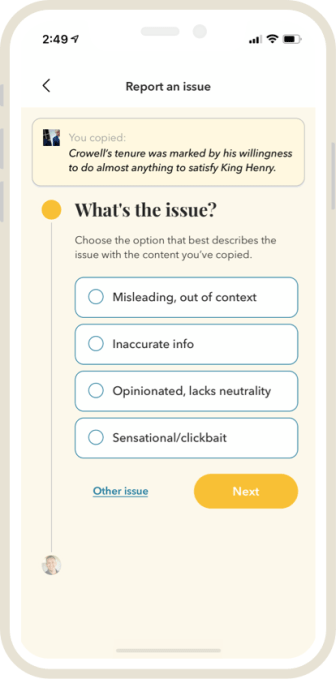
Image Credits: Gawq

Likely, only a minority of Gawq users would rate the stories. But over time and with scale, the reviews could help give outlets an accurate rating on news accuracy and their tendencies towards sensationalism, in the eyes of news consumers. That data may have external value, but for now, Gawq’s business model is “TBD,” Dziabiak admits.

The problem Gawq aims to tackle is a difficult one. And arguably, those who need to widen their worldview will be least likely to download a new app to do so. They’re often passive news consumers who have sat back ingesting news (and often, outrage and lies) from ever-personalized social media feeds. They then click on one favorite news TV channel for everything else. But there is a growing number of people who want a more neutral media landscape, and Gawq can help them find it with how it positions news as right, left or centered when comparing sources.

The startup is currently self-funded and has a small team of engineers, mostly working on a contract basis. Gawq has not ruled out future investment, however.

The app is a free download on iOS and Android.


from RSSMix.com Mix ID 8176981 https://techcrunch.com/2020/12/17/gawq-wants-to-burst-your-echo-chamber-with-its-smarter-news-app/
http://www.gadgetscompared.com
from Tumblr https://ikonografico.tumblr.com/post/637781122670116865
via http://www.gadgetscompared.com

PhotoRoom launches background-removal app on Android

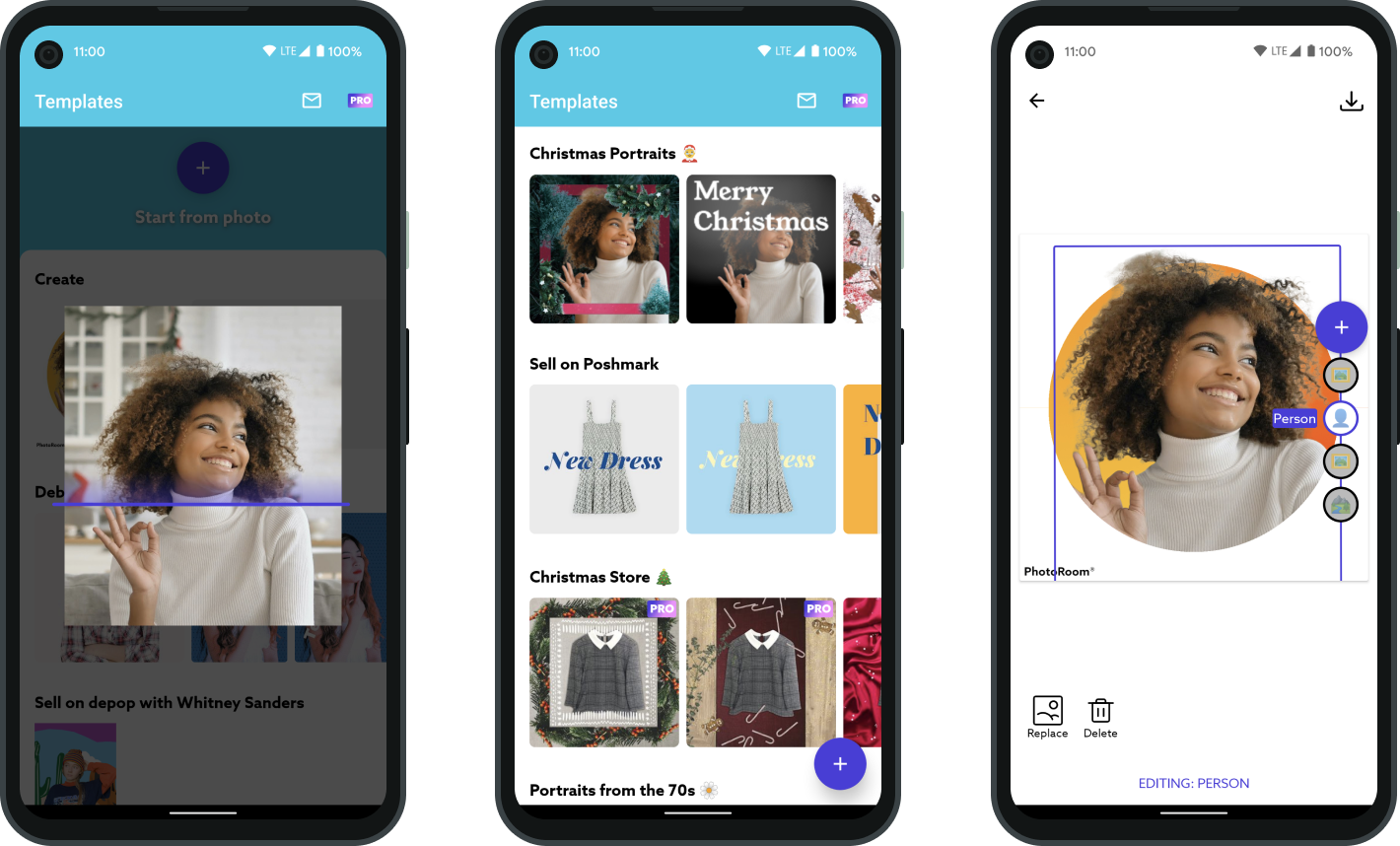
French startup PhotoRoom is launching its app on Android today. The company has been working on a utility photography app that lets you remove the background from a photo, swaps it for another background and tweaks your photo.

And it’s been working well on iOS already as the company attended Y Combinator, doubled its annual recurring revenue to $2 million and raised a $1.2 million seed round.

In particular, influencers and people reselling clothes and fashion items have been relying on PhotoRoom . They use their phone as their main creativity platform. Like other professional photography apps, the startup relies on subscriptions to generate revenue ($9.49 per month or $46.99 per year).

PhotoRoom relies on machine learning to identify objects and separate them from the rest of the photo. This way, you can manipulate a specific part of your photo.

Image Credits: PhotoRoom

When the startup raised its seed round after Y Combinator, it chose to raise from Nicolas Wittenborn’s Adjacent fund, Liquid2 Ventures as well as two groups:

  • A group of business angels focused on machine learning, such as Yann LeCun (Chief AI Scientist at Facebook), Zehan Wang (Head of Twitter Machine Learning Cortex, co-founder of Magic Poney), Nicolas Pinto (Perceptio founder), etc.
  • And another group of business angels focused on mobile subscriptions, such as Holger Seim (Blinkist), Jacob Eiting (RevenueCat), John Bonten (advisor for Calm and Spotify) and Eric Setton (Tango).

With this funding round, the company plans to grow the team from 3 to 8 persons and work on its deep learning algorithm. If you want to learn more about PhotoRoom, feel free to read my take on the product:


from RSSMix.com Mix ID 8176981 https://techcrunch.com/2020/12/17/photoroom-launches-background-removal-app-on-android/
http://www.gadgetscompared.com
from Tumblr https://ikonografico.tumblr.com/post/637762251339743232
via http://www.gadgetscompared.com
Wednesday, December 16, 2020

Facebook highlights small businesses as it ramps up Apple criticism

Facebook already made it clear that it isn’t happy about Apple’s upcoming restrictions on app tracking and ad targeting, but the publicity battle entered a new phase today.

Over the summer, Apple announced that beginning in iOS 14, developers will have to ask users for permission in order to use their IDFA identifiers for ad targeting. On one level, it’s simply giving users a choice, but since they’ll have to opt-in to participate, the assumption is that we’ll see a dramatic reduction in app tracking and targeting.

The actual change was delayed until early next year, but in the meantime Facebook suggested that this might mean the end of its Audience Network (which uses Facebook data to target ads on other websites and apps) on iOS.

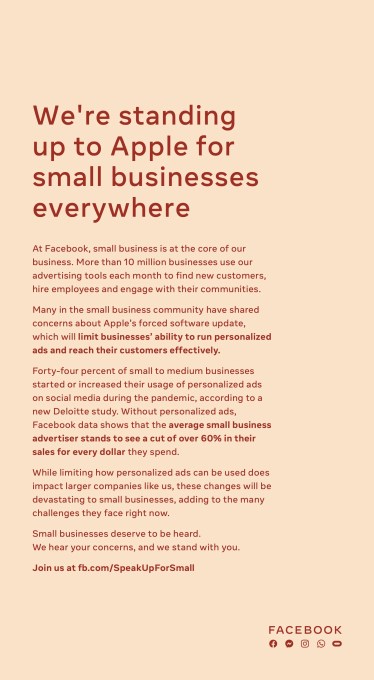
Then, this morning, Facebook placed print ads in The New York Times, Wall Street Journal and Washington Post declaring that it’s “standing up to Apple for small businesses everywhere,” and it published a blog post and website making the same argument.

While it’s easy to see all of this as an attempt to put a more sympathetic face on a PR campaign that’s really just protecting Facebook’s ad business, Dan Levy — the company’s vice president of ads and business products — got on a call with reporters today to argue otherwise.

Facebook ad

Image Credits: Facebook

For one thing, he said that with its “diversified” advertising business, Facebook won’t feel the impact as keenly as small businesses, particularly since it already acknowledged potential ad targeting challenges in its most recent earnings report.

“We’ve already been factoring this into our expectations for the business,” he said.

In contrast, Levy said small businesses rely on targeting in order to run efficient advertising campaigns — and because they’ve got small budgets, they need that efficiency. He predicted that if Apple moves forward with its plans, “Small businesses will struggle to stay afloat and many aspiring entrepreneurs may never get off the ground.”

Levy was joined by two small business owners, Monique Wilsondebriano of Charleston Gourmet Burger Company in South Carolina and Hrag Kalebjian of Henry’s House of Coffee in San Francisco. Kalebjian that while business in the coffee shop is down 40% year-over-year, his online sales have tripled, and he credited targeted Facebook campaigns for allowing him to tell personal stories about his family’s love for Armenian coffee.

Wilsondebriano, meanwhile, said that when she and her husband Chevalo started a business selling their homemade burger marinade, “we did not have the option to run radio ads or TV ads, we just didn’t have a budget for that” — and so they turned to Facebook and Instagram. With the marinade now available in 50 states and 17 countries, Wilsondebriano said, “It makes me sad that if this update happens, so many small businesses won’t get that same opportunity that Cheval and I had.”

Levy also suggested that Apple’s bottom line might benefit from the changes — if developers make less money on ads from Facebook and other platforms, they may need to rely more on subscriptions or in-app transactions (with Apple collecting its much-discussed fee), and they might turn to Apple’s own targeted advertising platform.

A number of ad industry groups have taken also issue with Apple’s policy, with SVP Craig Federighi fighting back in a speech criticizing what he called “outlandish” and “false” claims from the adtech industry. In that speech, Federighi said Apple’s App Tracking Transparency feature is designed “to empower our users to decide when or if they want to allow an app to track them in a way that could be shared across other companies’ apps or websites.”


from RSSMix.com Mix ID 8176981 https://techcrunch.com/2020/12/16/facebook-apple-small-business/
http://www.gadgetscompared.com
from Tumblr https://ikonografico.tumblr.com/post/637705603277586432
via http://www.gadgetscompared.com

Tuesday, December 15, 2020

2021 holds even more Samsung foldables

The foldable category got off to a famously rocky start. Fifteen months after the release of the first Galaxy Fold, Samsung has time to work out some of the issues with the original device in a fairly public fashion, given the world the better-received Galaxy Z Flip and Z Fold 2 this year.

Likely due to various stumbles from mobile manufacturers, the form factor has yet to redefine the industry in a meaningful way – but meaningful change takes time. And in case there was any doubt surrounding Samsung’s commitment to foldable displays, Mobile President TM Roh penned a letter on the company’s site, noting an expansion of the portfolio next year.

Whether that means an additional device or something more meaningful remains to be seen, though it does seem to suggest the arrival of at least one more affordable model. Price has certainly been a major hurdle for the adoption of these products. In the letter Roh notes that he/the company will be “sharing more in January” – perhaps an allusion to CES or a standalone Samsung event. Roh adds,

True to our heritage of staying ahead of the curve with trailblazing mobile tech, we’ll be expanding our portfolio of foldables, so this groundbreaking category is more accessible to everyone. And while we’re already known for our revolutionary cameras, we’ll never stop trying to outdo ourselves — so be on the lookout for super-intelligent, pro-grade camera and video capabilities in 2021. We’ve also been paying attention to people’s favorite aspects of the Galaxy Note experience and are excited to add some of its most well-loved features to other devices in our lineup.

Nothing particularly earth-shattering. With the race to 5G devices in the rear-view, the focus is seemingly back on cameras, in addition to folding screens. More after the holidays, no doubt.


from RSSMix.com Mix ID 8176981 https://techcrunch.com/2020/12/15/2021-holds-even-more-samsung-foldables/
http://www.gadgetscompared.com
from Tumblr https://ikonografico.tumblr.com/post/637592380568190976
via http://www.gadgetscompared.com