Monday, August 23, 2021

African fintech OPay valued at $2B in SoftBank Vision Fund 2-led $400M funding

Chinese-backed and Africa-focused fintech company OPay raised $400 million in new financing led by SoftBank Vision Fund 2, Bloomberg reported Monday, valuing the company at $2 billion.

The round, which marks the Fund’s first investment in an African startup, drew participation from existing investors like Sequoia Capital China, Redpoint China, Source Code Capital, and Softbank Ventures Asia. Other investors, including DragonBall Capital and 3W Capital, also took part in the new financing round.

This news comes three months after The Information reported that the company was in talks to raise “up to $400 million at a $1.5 billion valuation” from a group of Chinese investors. The new financing also comes two years after OPay announced two funding rounds in 2019 — $50 million in June and a $120 million Series B in November.

In an emailed statement, OPay CEO Yahui Zhou said OPay “wants to be the power that helps emerging markets reach a faster economic development.” The company, founded in 2018, had an exclusive presence in Nigeria before last year.

While the company started with providing customers with digital services in their everyday life from mobility and logistics to e-commerce and fintech at cheap rates, those super app plans have been largely underwhelming.

Right now, it’s the company’s mobile money and payment arm that thrives the most. By simply allowing unbanked and underbanked users in Nigeria to send and receive money and pay bills through a network of thousands of agents, OPay has grown at an exponential rate.

The company plays in an extremely competitive fintech market. Nigeria is Africa’s most populous nation, and with a large share of its people underbanked and unbanked, fintech is the most promising digital sector in the country. The same can be said for the continent as a whole. Mobile money services have long catered to the needs of the underbanked. Per GSMA, Africa had more than 160 million active mobile money users generating over $495 billion in transaction value last year.

Parent company Opera reported that OPay’s monthly transactions grew 4.5x to over $2 billion in December last year. OPay also claims to process about 80% of bank transfers among mobile money operators in Nigeria and 20% of the country’s non-merchant point of sales transactions. Last year, the company also said it acquired an international money transfer license with a WorldRemit partnership also in the works.

Per Bloomberg, the company’s monthly transaction volumes exceed $3 billion at the moment.

Last year, OPay expanded to Egypt, and according to the company, that’s an entry point to the Middle East market.

In a statement, Kentaro Matsui, a managing director at SoftBank Group Corp, said, “We believe our investment will help the company extend its offering to adjacent markets and replicate its successful business model in Egypt and other countries in the region.”

SoftBank joins a growing list of high-flying investors (Dragoneer, Sequoia, SVB Capital, among others) that have cut their first checks in African ventures this year. As the continent continues to show promise, fintech remains its poster child. This year up to half of the total investments raised have emerged from the sector; it contributed to more than 25% last year.

In addition, fintech has produced the most mega-rounds so far. TymeBank raised $109 million in February, Flutterwave bagged a $170 million round in March, while Chipper Cash secured $100 million in May.

OPay’s fundraise is the largest of the lot in terms of size and value, making it the second African fintech unicorn after Flutterwave and the third African unicorn after e-commerce giant Jumia. The three make up the five billion-dollar tech companies on the continent, which includes Interswitch and Fawry.


from RSSMix.com Mix ID 8176981 https://techcrunch.com/2021/08/23/african-fintech-opay-valued-at-2b-in-softbank-vision-fund-2-led-400m-funding/
http://www.gadgetscompared.com
from Tumblr https://ikonografico.tumblr.com/post/660324608890830848
via http://www.gadgetscompared.com


Friday, August 20, 2021

SiriusXM launches ‘TikTok Radio,’ a music channel featuring viral hits hosted by TikTok stars

If viral TikTok songs like Dr. Dog’s “Where’d All the Time Go?” or Bo Burnham’s “Bezos I” weren’t already stuck in your head on loop, now they could be. Today SiriusXM launched a TikTok Radio channel, which features TikTok creators as channel hosts. The station is designed to sound like a “radio version of the platform’s ‘For You’ feed,” Sirius XM said.

SiriusXM, parent company to Pandora, announced this music channel in May, teasing the launch with curated Pandora playlists from influencers like Bella Poarch, whose lipsync video of Millie B’s “Soph Aspin Send [M to the B]” is the most liked video on TikTok.

With its TikTok partnership, SiriusXM is looking to capture a younger audience — on the TikTok app itself, DJ Habibeats (@djhabibeats) and DJ CONST (@erinconstantineofficial) will each go live on TikTok each week while DJing on TikTok Radio. Other creator hosts on TikTok Radio — like Billy (@8illy), Cat Haley (@itscathaley), HINDZ (@hindzsight), Lamar Dawson (@dirrtykingofpop) and Taylor Cassidy (@taylorcassidyj) — will deliver “The TikTok Radio Trending Ten,” a weekly countdown of songs trending on TikTok. To promote the station during its first week, artists like Ed Sheeran, Lil Nas X and Normani will appear on air.

Music has such a strong footing in TikTok culture that it regularly influences the Billboard charts — Fleetwood Mac’s “Rumours,” originally released in 1978, appeared in the top 10 Billboard albums again in 2020 after it was featured in a viral TikTok. Even a Fortnite-themed parody of Estelle’s “American Boy” — originally uploaded in 2018 to YouTube — had a beautiful moment on TikTok. 

“We’re so excited to launch TikTok Radio on SiriusXM, which opens up artists and creators like this amazing group of hosts to new audiences,” said Ole Obermann, TikTok’s global head of Music, in a statement. “Now SiriusXM subscribers will have a new road to discover the latest trends in music and get a first listen to tomorrow’s musical superstars. The channel captures song-breaking music culture that creates so much joy and entertainment on TikTok through video in an all-audio format.”

Though SiriusXM’s subscriber base continues to expand — it saw a 34% year-over-year growth from last year to now — it still dwarfs in comparison to streaming giants like Spotify, which has 165 million paid users. SiriusXM reported a total of 34.5 million subscribers as of Q2 this year, the most it’s ever had, but even Apple Music and Amazon Music have reported nearly double the subscribers. Pandora has 6.5 million paid subscribers. Over the last few years, SiriusXM and Pandora have struck deals with companies like SoundCloud, Simplecast and Stitcher to become more competitive in both music and podcast streaming. 

Still, other streaming companies have also shown interest in the market of Gen Z-ers on TikTok who want to listen to full versions of the catchy songs they hear in short videos. Apple Music and Spotify both host curated “viral hits” playlists. But a full-time satellite music channel is taking the trend a step further.


from RSSMix.com Mix ID 8176981 https://techcrunch.com/2021/08/20/siriusxm-launches-tiktok-radio-a-music-channel-featuring-viral-hits-hosted-by-tiktok-stars/
http://www.gadgetscompared.com
from Tumblr https://ikonografico.tumblr.com/post/660075562091560960
via http://www.gadgetscompared.com

Thursday, August 12, 2021

Medal.tv, a video clipping service for gamers, enters the livestreaming market with Rawa.tv acquisition

Medal.tv, a short-form video clipping service and social network for gamers, is entering the live streaming market with the acquisition of Rawa.tv, a Twitch rival based in Dubai, which had raised around $1 million to date. The seven-figure, all cash deal will see two of Rawa’s founders, Raya Dadah and Phil Jammal, now joining Medal and further integrations between the two platforms going forward.

The Middle East and North African region (MENA) is one of the fastest-growing markets in gaming and still one that’s mostly un-catered to, explained Medal.tv CEO Pim de Witte, as to his company’s interest in Rawa.

“Most companies that target that market don’t really understand the nuances and try to replicate existing Western or Far-Eastern models that are doomed to fail,” he said. “Absorbing a local team will increase Medal’s chances of success here. Overall, we believe that MENA is an underserved market without a clear leader in the livestreaming space, and Rawa brings to Medal the local market expertise that we need to capitalize on this opportunity,” de Witte added.

Medal.tv’s community had been asking for the ability to do livestreaming for some time, the exec also noted, but the technology would have been too expensive for the startup to build using off-the-shelf services at its scale, de Witte said.

“People increasingly connect around live and real-time experiences, and this is something our platform has lacked to date,” he noted.

But Rawa, as the first livestreaming platform dedicated to Arab gaming, had built out its own proprietary live and network streaming technology that’s now used in all its products. That technology is now coming to Medal.tv.

Image Credits: Medal.tv

The two companies were already connected before today, as Rawa users have been able to upload their gaming clips to Medal.tv, and some Rawa partners had joined Medal’s skilled player program. Going forward, Rawa will continue to operate as a separate platform, but it will become more tightly integrated with Medal, the company says. Currently, Rawa sees around 100,000 active users on its service.

The remaining Rawa team will continue to operate the livestreaming platform under co-founder Jammal’s leadership following the deal’s close, and the Rawa HQ will remain based in Dubai. However, Rawa’s employees have been working remotely since the start of the pandemic, and it’s unclear if that will change in the future, given the uncertainty of Covid-19’s spread.

Medal.tv detailed its further plans for Rawa on its site, where the company explained it doesn’t aim to build a “general-purpose” livestreaming platform where the majority of viewers don’t pay — a call-out that clearly seems aimed at Twitch. Instead, it says it will focus on matching content with viewers who would be interested in subscribing to the creators. This addresses on of the challenges that has faced larger platforms like Twitch in the past, where it’s been difficult for smaller streamers to get off the ground.

The company also said it will remain narrowly focused on serving the gaming community as opposed to venturing into non-gaming content, as others have done. Again, this differentiates itself from Twitch which, over the years, expanded into vlogs and even streaming old TV shows. And it’s much different from YouTube or Facebook Watch, where gaming is only a subcategory of a broader video network.

The acquisition follows Medal.tv’s $9 million Series A led by Horizons Ventures in 2019, after the startup had grown to 5 million registered users and “hundreds of thousands” of daily active users. Today, the company says over 200,000 people create content every day on Medal, and 3 million users are actively viewing that content every month.


from RSSMix.com Mix ID 8176981 https://techcrunch.com/2021/08/12/medal-tv-a-video-clipping-service-for-gamers-enters-the-livestreaming-market-with-rawa-tv-acquisition/
http://www.gadgetscompared.com
from Tumblr https://ikonografico.tumblr.com/post/659350674563268608
via http://www.gadgetscompared.com
A new Senate bill would totally upend Apple and Google’s app store dominance

With two giants calling the shots and collecting whatever tolls they see fit, mobile software makers have long complained that app stores take an unfair cut of the cash that should be flowing directly to developers. Hearing those concerns, a group of senators introduced a new bill this week that, if passed, would greatly diminish Apple and Google’s ability to control app purchases in their operating systems and completely shake up the way that mobile software gets distributed.

The new bill, called the Open App Markets Act, would enshrine quite a few rights that could benefit app developers tired of handing 30 percent of their earnings to Apple and Google. The bill, embedded in full below, would require companies that control operating systems to allow third party apps and app stores.

It would also prevent those companies from blocking developers from telling users about lower prices for their software that they might find outside of official app stores. Apple and Google would also be barred from leveraging “non-public” information collecting through their platforms to create competing apps.

“This legislation will tear down coercive anticompetitive walls in the app economy, giving consumers more choices and smaller startup tech companies a fighting chance,” said Senator Richard Blumenthal (D-CT), who introduced the bipartisan bill with Sen. Marsha Blackburn (R-TN), and Sen. Amy Klobuchar (D-MN). Klobuchar chairs the Senate’s antitrust subcommittee and Blackburn and Blumenthal are both subcommittee members.

Senator Blackburn called Apple and Google’s app store practices a “direct affront to a free and fair marketplace” and Sen. Klobuchar noted that their behavior raises “serious competition concerns.”

The bill draws on information collected earlier this year from that subcommittee’s hearing on app stores and competition. In the hearing, lawmakers heard from Apple and Google as well as Spotify, Tile and Match Group, three companies that argued their businesses have been negatively impacted by anti-competitive app store policies.

“… We urge Congress to swiftly pass the Open App Markets Act,” Spotify Chief Legal Officer Horacio Gutierrez said of the new bill. “Absent action, we can expect Apple and others to continue changing the rules in favor of their own services, and causing further harm to consumers, developers, and the digital economy.”

The Coalition for App Fairness, a developer advocacy group, praised the bill for its potential to spur innovation in digital markets. “The bipartisan Open App Markets Act is a step towards holding big tech companies accountable for practices that stifle competition for developers in the U.S. and around the world,” CAF executive director Meghan DiMuzio said.

Hoping to head off future regulatory headaches, Apple dropped its own fees for companies that generate less than $1 million in App Store revenue from 30 to 15 percent last year. Google followed suit with its own gesture, dropping fees to 15 percent for the first $1 million in revenue a developer earns through the Play Store in a year. Some developers critical of the companies’ practices saw those changes as little more than a publicity stunt.

Developers have long complained about the high tolls they pay to distribute their software through the world’s two major mobile operating systems. That fight escalated over the last year when Epic Games circumvented Apple’s payments rules by allowing Fortnite players to pay Epic directly, setting off a legal fight that has huge implications for the mobile software world. Following a May trial, the verdict is expected later this year.

Unlike Apple, Google does allow apps to be “sideloaded,” installed onto devices outside of the Google Play Store. But documents unsealed in Epic’s parallel case against Google revealed that the Play Store’s creator knows the sideloading process is a terrible experience for users — something the company brings up when pressuring developers to stick with its official app marketplace.

The counterargument here is that official app stores make apps safer and smoother for consumers. While Apple and Google extract heavy fees for selling mobile software through the App Store and the Google Play Store, the companies both argue that streamlining apps through those official channels protects people from malware and allows for prompt software updates to patch security concerns that could jeopardize user privacy.

Adam Kovacevich, a former Google policy executive who leads the new tech-backed industry group Chamber of Progress, called the new bill “a finger in the eye” for Android and iPhone owners.

“I don’t see any consumers marching in Washington demanding that Congress make their smartphones dumber,” Kovacevich said. “And Congress has better things to do than intervene in a multi-million dollar dispute between businesses.”

At least in Google’s case, the counterargument has its own counterargument. Android has long been notorious for malware, but apparently most of that malicious software isn’t making its way onto devices through sideloading — it’s walking through the Google Play Store’s front door.


from RSSMix.com Mix ID 8176981 https://techcrunch.com/2021/08/12/open-app-markets-act-app-stores-apple-google/
http://www.gadgetscompared.com
from Tumblr https://ikonografico.tumblr.com/post/659343144766341120
via http://www.gadgetscompared.com

Consumer goods software company Aforza bags $22M to open US headquarters

Aforza, developing cloud and mobile apps for consumer goods companies, announced a $22 million Series A round led by DN Capital.

The London-based company’s technology is built on the Salesforce and Google Cloud platforms so that consumer goods companies can digitally transform product distribution and customer engagement to combat issues like unprofitable promotions and declining market share, Aforza co-founder and CEO Dominic Dinardo told TechCrunch. Using artificial intelligence, the company recommends products and can predict the order a retailer can make with promotions and pricing based on factors like locations.

The global market for consumer packaged goods apps is forecasted to reach $15 billion by 2024. However, the industry is still using outdated platforms that, in some cases, lead to a loss of 5% of sales when goods are out of stock, Dinardo said.

Aforza’s trade promotion designer mobile image. Image Credits: Aforza

Dinardo and his co-founders, Ed Butterworth and Nick Eales, started the company in 2019. All veterans of Salesforce, they saw how underserved the consumer goods industry was in terms of moving to digital.

Aforza is Dinardo’s first time leading a company. However, from his time at Salesforce he feels he got an education like going to “Marc Benioff’s School of SaaS.” The company raised an undisclosed seed round in 2019 from Bonfire Ventures, Daher Capital, DN Capital, Next47 and Salesforce Ventures.

Then the pandemic happened, which had many of the investors leaning in, which was validation of what Aforza was doing, Dinardo said.

“Even before the pandemic, the consumer goods industry was challenged with new market entrants and horrible legacy systems, but then the pandemic turned off pathways to customers,” he added. “Our mission is to improve the lives of consumers by bringing forth more sustainable products and packaging, but also helping companies be more agile and handle changes as the biggest change is happening.”

Joining DN Capital in the round were Bonfire Ventures, Daher Capital and Next47.

Brett Queener, partner at Bonfire Ventures, said he helped incubate Aforza with Dinardo and Eales, something his firm doesn’t typically do, but saw a unique opportunity to get in on the ground floor.

Also working at Salesforce, he saw the consumer goods industry as a major industry with a compelling reason to make a technology shift as customers began expecting instant availability and there were tons of emerging startups coming into the direct-to-consumer space.

Those startups don’t have a year or two to pull together the kind of technology it took to scale. With Aforza, they can build a product that works both online and off on any device, Queener said. And rather than planning promotions on a quarterly basis, companies can make changes to their promotional spend in real time.

“It is time for Aforza to tell the world about its technology, time to build out its footprint in the U.S. and in Europe, invest more in R&D and execute the Salesforce playbook,” he said. “That is what this round is about.”

Dinardo intends on using the new funding to continue R&D and to double its employee headcount over the next six months as it establishes its new U.S. headquarters in the Northeast. It is already working with customers in 20 countries.

As to growth, Dinardo said he is using his past experiences at startups like Veeva and Vlocity, which was acquired by Salesforce in 2020, as benchmarks for Aforza’s success.

“We have the money and the expertise — now we need to take a moment to breathe, hire people with the passion to do this and invest in new product tiers, digital assets and even payments,” he said.


from RSSMix.com Mix ID 8176981 https://techcrunch.com/2021/08/12/consumer-goods-software-company-aforza-bags-22m-to-open-u-s-headquarters/
http://www.gadgetscompared.com
from Tumblr https://ikonografico.tumblr.com/post/659309184315260928
via http://www.gadgetscompared.com

Wednesday, August 11, 2021

Google launches Android 12 beta 4, hitting the platform stability milestone

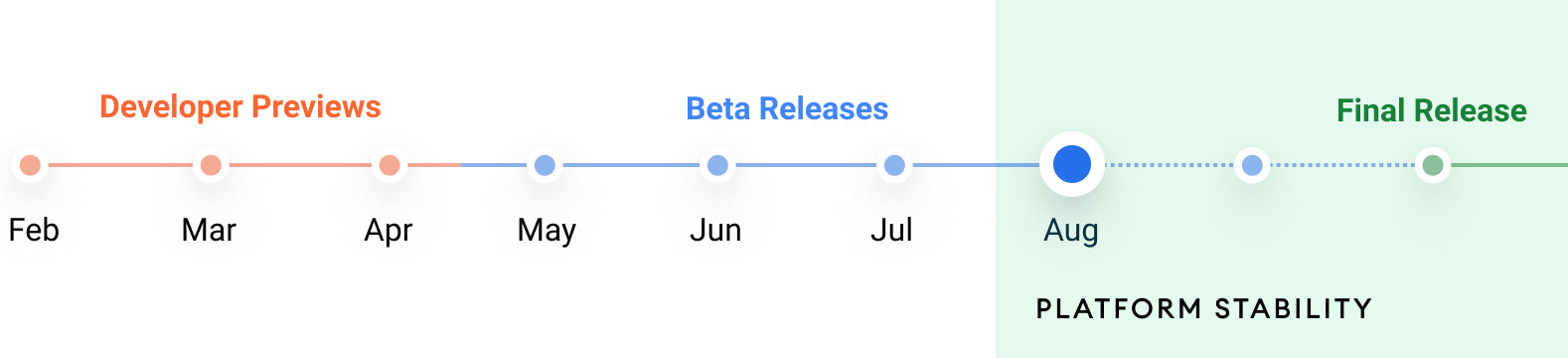
Google has now taken another step toward the public release of the latest version of the Android operating system, Android 12. The company today released the fourth beta of Android 12, whose most notable new feature is that it has achieved the Platform Stability milestone — meaning the changes impacting Android app developers are now finalized, allowing them to test their apps without worrying about breaking changes in subsequent releases.

While the updated version of Android brings a number of new capabilities for developers to tap into, Google urges its developers to first focus on releasing an Android-12-compatible update. If users find their app doesn’t work properly when they upgrade to the new version of Android, they may stop using the app entirely or even uninstall it, the company warns.

Among the flagship consumer-facing features in Android 12 is the new and more adaptive design system called “Material You,” which lets users apply themes that span across the OS to personalize their Android experience. It also brings new privacy tools, like microphone and camera indicators that show if an app is using those features, as well as a clipboard read notification, similar to iOS, which alerts to apps that read the user’s clipboard history. In addition, Android 12 lets users play games as soon as they download them, through a Google Play Instant feature. Other key Android features and tools, like Quick Settings, Google Pay, Home Controls and Android widgets, among others, have been improved, too.

Google has continued to roll out smaller consumer-facing updates in previous Android 12 beta releases, but beta 4 is focused on developers getting their apps ready for the public release of Android, which is expected in the fall.

Image Credits: Google

The company suggested developers look out for changes that include the new Privacy Dashboard in Settings, which lets users see which apps are accessing what type of data and when, and other privacy features like the indicator lights for the mic and camera, clipboard read tools, and new toggles that lets users turn off mic and camera access across all apps.

There’s also a new “stretch” overscroll effect that replace the older “glow” overscroll effect systemwide, new splash screen animations for apps and keygen changes to be aware of. And there are a number of SDKs and libraries that developers use that will need to be tested for compatibility, including those from Google and third parties.

The new Android 12 beta 4 release is available on supported Pixel devices, and on devices from select partners including ASUS, OnePlus, Oppo, Realme, Sharp and ZTE. Android TV developers can access beta 4 as well, via the ADT-3 developer kit.


from RSSMix.com Mix ID 8176981 https://techcrunch.com/2021/08/11/google-launches-android-12-beta-4-hitting-the-platform-stability-milestone/
http://www.gadgetscompared.com
from Tumblr https://ikonografico.tumblr.com/post/659252591623028736
via http://www.gadgetscompared.com

WhatsApp gains the ability to transfer chat history between mobile operating systems

WhatsApp users will finally be able to move their entire chat history between mobile operating systems — something that’s been one of users’ biggest requests to date. The company today introduced a feature that will soon become available to users of both iOS and Android devices, allowing them to move their WhatsApp voice notes, photos and conversations securely between devices when they switch between mobile operating systems.

The company had been rumored to be working on such functionality for some time, but the details of which devices would be initially supported or when it would be released weren’t yet known.

In product leaks, WhatsApp had appeared to be working on an integration into Android’s built-in transfer app, the Google Data Transfer Tool, which lets users move their files from one Android device to another, or switch from iOS to Android.

The feature WhatsApp introduced today, however, works with Samsung devices and Samsung’s own transfer tool, known as Smart Switch. Today, Smart Switch helps users transfer contacts, photos, music, messages, notes, calendars and more to Samsung Galaxy devices. Now, it will transfer WhatsApp chat history, too.

WhatsApp showed off the new tool at Samsung’s Galaxy Unpacked event, and announced Samsung’s newest Galaxy foldable devices would get the feature first in the weeks to come. The feature will later roll out to Android more broadly. WhatsApp didn’t say when iOS users would gain access, but a spokesperson for WhatsApp told TechCrunch the team is working to bring the feature to users worldwide.

To use the feature, WhatsApp users will connect their old and new device via a USB-C to Lightning cable, and launch Smart Switch. The new phone will then prompt you to scan a QR code using your old phone and export your WhatsApp history. To complete the transfer, you’ll sign into WhatsApp on the new device and import the messages.

Building such a feature was non-trivial, the company also explained, as messages across its service are end-to-end encrypted by default and stored on users’ devices. That meant the creation of a tool to move chat history between operating systems required additional work from both WhatsApp as well as operating system and device manufacturers in order to build it in a secure way, the company said.

“Your WhatsApp messages belong to you. That’s why they are stored on your phone by default, and not accessible in the cloud like many other messaging services,” noted Sandeep Paruchuri, product manager at WhatsApp, in a statement about the launch. “We’re excited for the first time to make it easy for people to securely transfer their WhatsApp history from one operating system to another. This has been one of our most requested features from users for years and we worked together with operating systems and device manufacturers to solve it,” he added.


from RSSMix.com Mix ID 8176981 https://techcrunch.com/2021/08/11/whatsapp-gains-the-ability-to-transfer-chat-history-between-mobile-operating-systems/
http://www.gadgetscompared.com
from Tumblr https://ikonografico.tumblr.com/post/659244985993084928
via http://www.gadgetscompared.com