Tuesday, June 23, 2020

Facebook tests Forecast, an app for making predictions about world events, like COVID-19

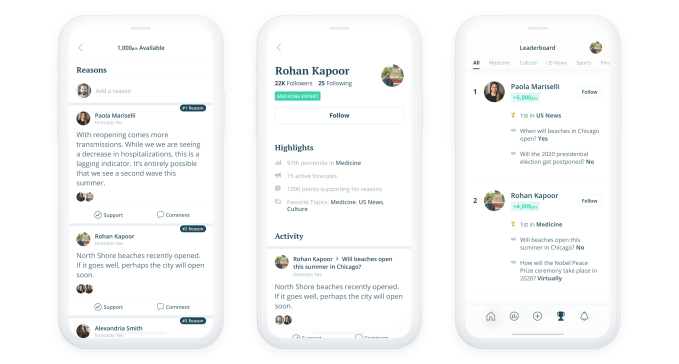
Forecast, a new project from Facebook’s internal R&D group, NPE Team, is launching today to build a community around predictions. The iOS app will allow users to ask questions and then use in-app points to make predictions about what might happen in the future. Users can also create, discuss and view these crowdsourced predictions.

At launch, only invited participants in the U.S. and Canada will be allowed to make predictions and engage in conversations, while the app is in beta testing. But these predictions and related discussions will be publicly accessible on the Forecast website and made shareable.

Before today, Facebook tested the product internally with a small set of employees. Their initial forecasts will form the initial core content in the app at launch.

Starting now, Facebook will invite members of the health, research and academic communities to make predictions about the COVID-19 pandemic and its impact on the world.
At a time when Facebook and other major tech platforms are under fire for their role in aiding the spread of misinformation, fake news, propaganda, conspiracy theories, and other non-factual content presented as truth, an app focused on making “guesses” about the future seems ill-advised — however educated those guesses may be. This is particularly concerning because much of the app’s content will focus on guesses about COVID-19.

Forecast’s predictions may help show what people are thinking, but COVID-19 isn’t a game. To understand the world, scientists form a hypothesis, which is essentially an expanded form of an educated guess. But they don’t then crowdsource voting to determine if a hypothesis is true — they test, experiment, gather supporting data, try to prove and disprove the hypothesis, and ultimately aim to publish their findings and have them peer-reviewed.

The Forecast app turns the hypothesis into the end result, in a way. The app lets users make a forecast and explain their reasoning — in other words, form a hypothesis. But instead of doing the work to test the forecast, through the application of the scientific method, Forecast will track the votes a given question receives.

E.g. “When will the first COVID-19 vaccine candidate begin phase 3 trials?” or “When will most U.S. residents be treated with a COVID-19 vaccine?” In non-COVID questions, you may come across something like “Will the US Presidential Election be fully or partially postponed?” 

Questions will be reviewed by the Forecast team and edited for clarity, if needed. Users will be notified if their question is published.

At some point, the question will be determined as “settled,” based on an elapsed time period or because an event has occurred. For instance, if users were guessing when a vaccine would be released, and then it’s actually released, the questions around that topics would be “settled.”

Forecast’s polls are given aesthetically pleasing charts and graphs which can be shared outside the app. That means users could start posting these guesses and the crowdsourced responses to sites like Facebook, where the line between fact and fiction has already blurred. That could further complicate people’s understanding of what is already a complex topic: the COVID-19 pandemic.

Facebook users who see these shared “forecasts” may believe they have some basis in science and research, when instead, they are the result of a social polling app.

Of course, there is some fun in betting on world events and seeing if they turn out to be true, and there is even some value in organizing a wider community’s collective “best guesses” about a future event to gain an understanding of what people are thinking at a given time. Crowdsourced predictions have their place, as well. But spreading out specific, COVID-19 predictions to Facebook seems like an idea that’s fraught with potential problems and complications.

And Facebook’s goal here is only to test its own hypothesis — that a standalone, community-based predictions app that rewards a participatory audience with social credit will surface insightful voices and thoughtful discussions.

In the end, however, it seems like Facebook is looking for some angle that could prompt thought leaders to engage in meaningful discussions about subjects they know best on a Facebook platform. These sorts of discussions are difficult to have in Facebook’s comments section around a post — as comments, more often than not, are a place people go to troll, argue, threaten and otherwise derail a conversation. Forecast organizes these experts around a topic and allows them to debate. As a self-contained space with a vetted crowd of participants, that could be interesting. Making the data broadly shareable is an issue, however.

Facebook says the questions in Forecast will be moderated for clarity using Forecast’s own moderation guidelines and Facebook’s Community Standards. That means questions can’t mention death, sexual or violent assault of any individual, including public figures. (This isn’t meant to be some sort of new internet Death Clock, for example.) Hate speech isn’t allowed. Questions around illegal content or those involving personal information also aren’t permitted, along with other guidelines detailed here.

The Forecast app is live on the iOS App Store here.


from RSSMix.com Mix ID 8176981 https://techcrunch.com/2020/06/23/facebook-tests-forecast-an-app-for-making-predictions-about-world-events-like-covid-19/
http://www.gadgetscompared.com
from Tumblr https://ikonografico.tumblr.com/post/621734122586505216
via http://www.gadgetscompared.com

Monday, June 22, 2020

Apple unveils iOS 14 and macOS Big Sur features for India, China and other international markets

Apple will roll out a range of new features and improvements that are aimed at users in India, China and other international markets with its yearly updates to iOS, iPadOS, and macOS operating systems, it unveiled today.

iOS 14, which is rolling out to developers today and will reach general users later this year, introduces new bilingual dictionaries to support French and German; Indonesia and English; Japanese and Simplified Chinese; and Polish and English. For its users in China, one of Apple’s biggest overseas markets, the iPhone-maker said the new operating system will introduce support for Wubi keyboard.

For users in India, Apple is adding 20 new document fonts and upgrading 18 existing fonts with “more weights and italics” to give people greater choices. For those living in the world’s second largest internet market, Mail app now supports email addresses in Indian script.

Apple said it will also deliver a range of additional features for India, building on the big momentum it kickstarted last year.

Messages now feature corresponding full-screen effects when users send greetings such as “Happy Holi” in one of the 23 Indian local languages.

More interestingly, iOS 14 will include smart downloads, which will allow users in India to download Indian Siri voices and software updates as well as download and stream Apple TV+ shows over cellular networks — a feature that is not available elsewhere in the world.

The feature further addresses the patchy networks that are prevalent in India — despite major improvements in recent years. Last year, Apple beamed a feature for users in India that enabled users in the nation to set an optimized time of the day in on-demand streaming apps such as Hotstar and Netflix for downloading videos.

New improvements further shows Apple’s growing focus on India, the world’s second largest smartphone market. Apple chief executive Tim Cook said earlier this year that the company will launch its online store in the country later this year, and open its first physical store next year. A source familiar with the matter told TechCrunch last month that the global pandemic had not affected the plan.

iOS 14 will also allow users in Ireland and Norway to utilize the autocorrection feature as the new update adds support for Irish Gaelic and Norwegian Nynorsk. And there’s also a redesigned Kana keyboard for Japan, which will enable users there to type numbers with repeated digits more easily on the redesigned Numbers and Symbols plane.

All the aforementioned features — except email addresses in Indian script in Mail and smart downloads for users in India — will also ship with iPadOS 14. And the aforementioned new bilingual dictionaries, new fonts for India, and localized messages are coming to macOS Big Sur.

Additionally, Apple says on the desktop operating system it has also enhanced predictive input for Chinese and Japanese results in more accurate and contextual predictions.


from RSSMix.com Mix ID 8176981 https://techcrunch.com/2020/06/22/apple-unveils-ios-14-and-macos-big-sur-features-for-india-china-and-other-international-markets/
http://www.gadgetscompared.com
from Tumblr https://ikonografico.tumblr.com/post/621669952775176192
via http://www.gadgetscompared.com
Apple’s new Translate app works offline with 11 languages

Translation is an everyday smartphone task for millions of people, but outside a few minor features, Apple has generally ceded the capability to its rivals. That changes today with a new first-party iOS app called, naturally, Translate, which works with 11 languages, no internet connection required.

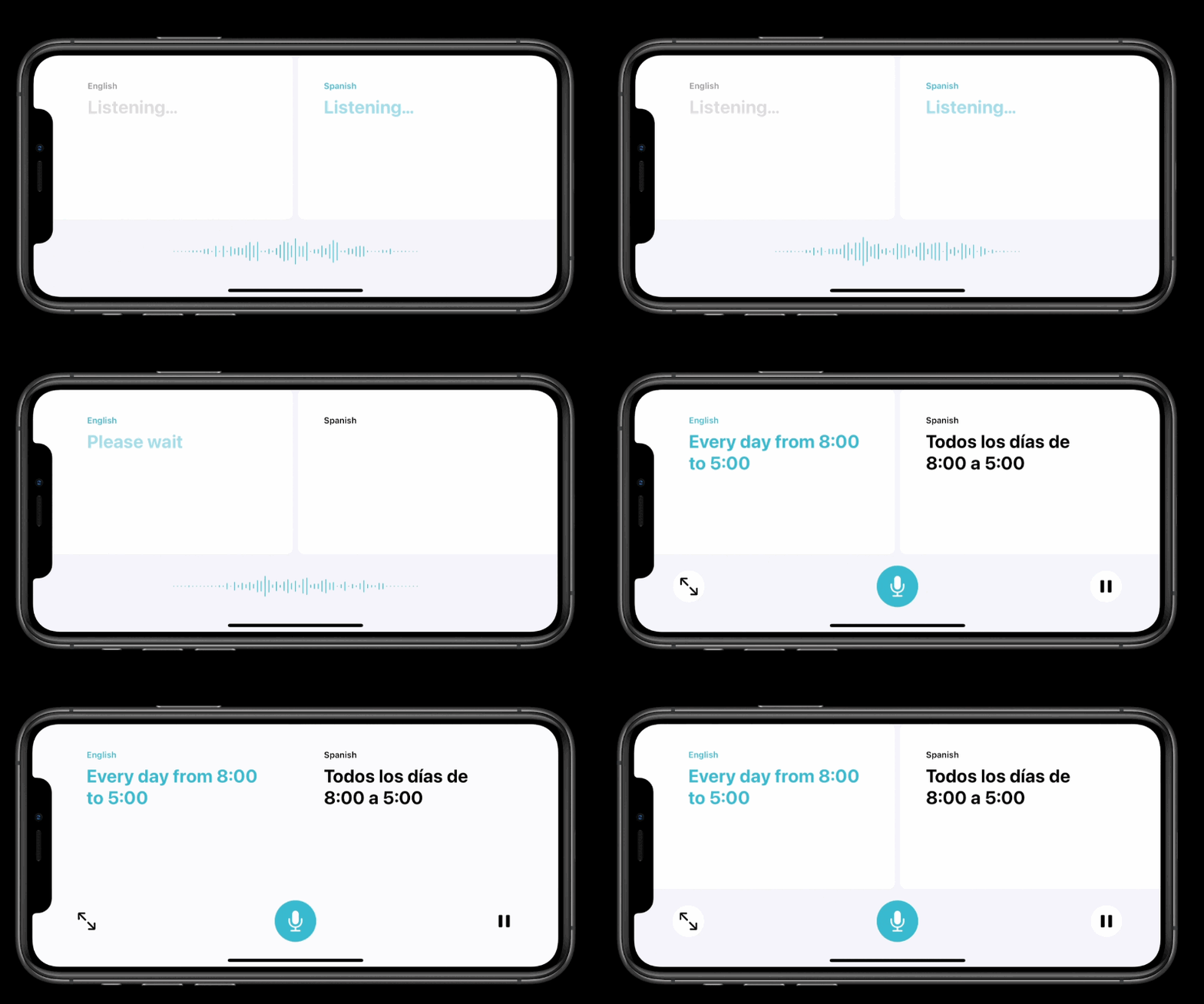
The app is intended for use with speech or short written sentences, not to translate whole web pages or documents. The interface is simple, with a language selector, text field and record button as well as a few extra widgets like favorites and a dictionary.

At launch Translate will support English, Mandarin Chinese, French, German, Spanish, Italian, Japanese, korean, Arabic, Portuguese, and Russian, with others to come. You simply select a pair of languages and paste or record a snippet of text or audio. The translation should show up immediately.

There’s also a landscape mode that further simplifies the interface:

The best part is that unlike many translation apps out there, Apple’s is entirely offline, meaning you can use it whether you have good or bad signal, if you’re out in the middle of nowhere in a country where you don’t get service, or if you’re just trying to save data.

There were no specific release details so the app will probably appear when you upgrade to iOS 14.


from RSSMix.com Mix ID 8176981 https://techcrunch.com/2020/06/22/apples-new-translate-app-works-offline-with-11-languages/
http://www.gadgetscompared.com
from Tumblr https://ikonografico.tumblr.com/post/621662397665509377
via http://www.gadgetscompared.com

Apple unveils iOS 14 with home screen widgets

During the virtual keynote of WWDC, Apple shared the first details about iOS 14, the next major version of iOS that is going to be released later this year. The most visual change is that the home screen is getting widgets.

“This year, we spent time rethinking the iconic experience of the iPhone,” SVP of Software Engineering Craig Federighi said. “We’ve rethought some of the core elements of iOS.”

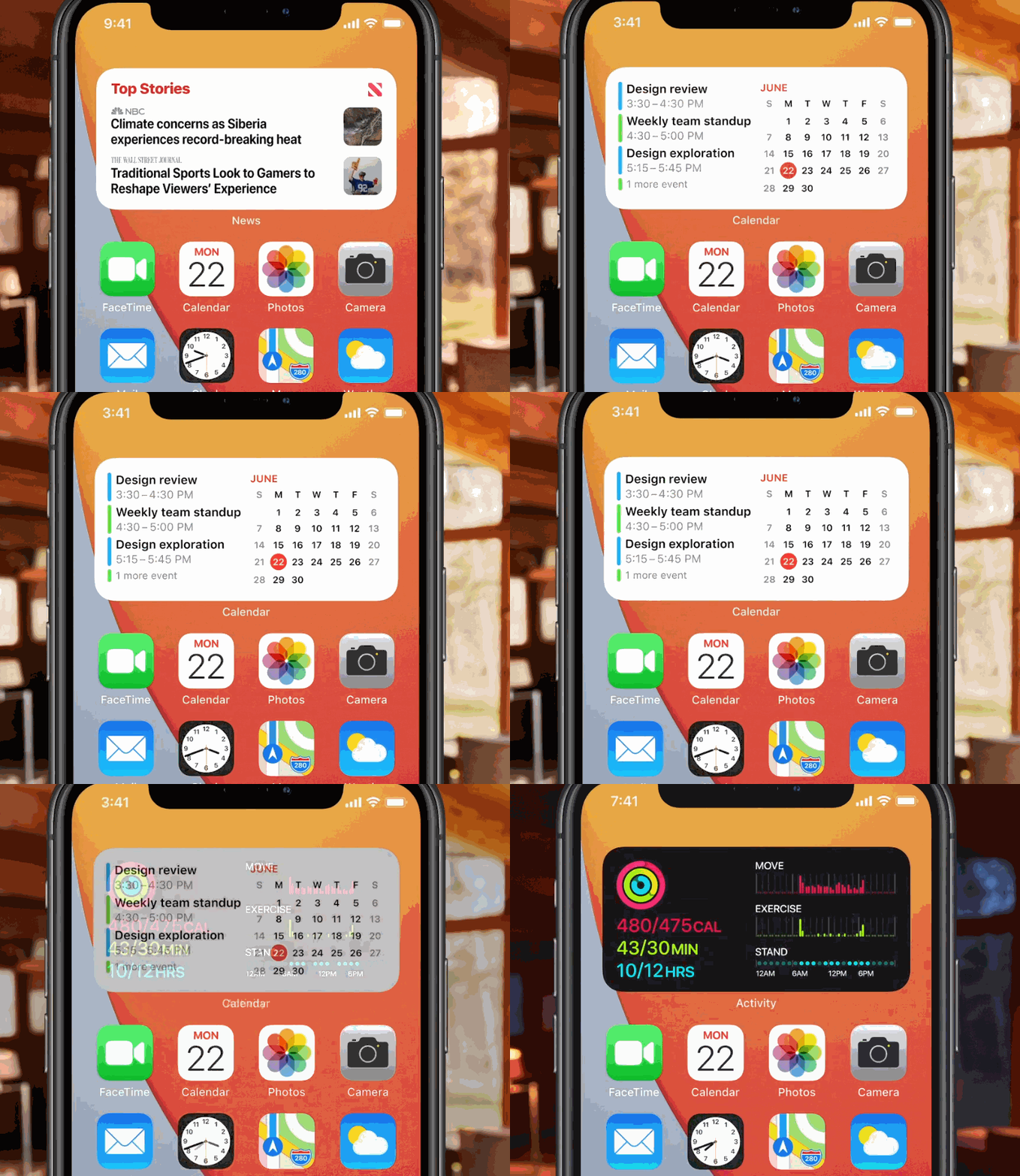
As you know, iOS already comes with widgets in the Today view — swipe left on the home screen to access widgets. Widgets have been completely redesigned. Some of them take the full width of the device, others can be limited to a small square. You can now have two columns of widgets.

But widgets are no longer limited to the Today view. You can drag them out of the Today view and drop them on your home screen. There’s also a new widget gallery that lets you add widgets when you’re moving icons around on the home screen.

Image Credits: Apple

As for home screen organization, Apple knows that a lot of people have an endless list of icons, making the home screen harder to use. Apple is adding some smart organization features.

“Today’s home screen is great but as we get more apps we end up with this — lots and lots of pages,” Federighi said.

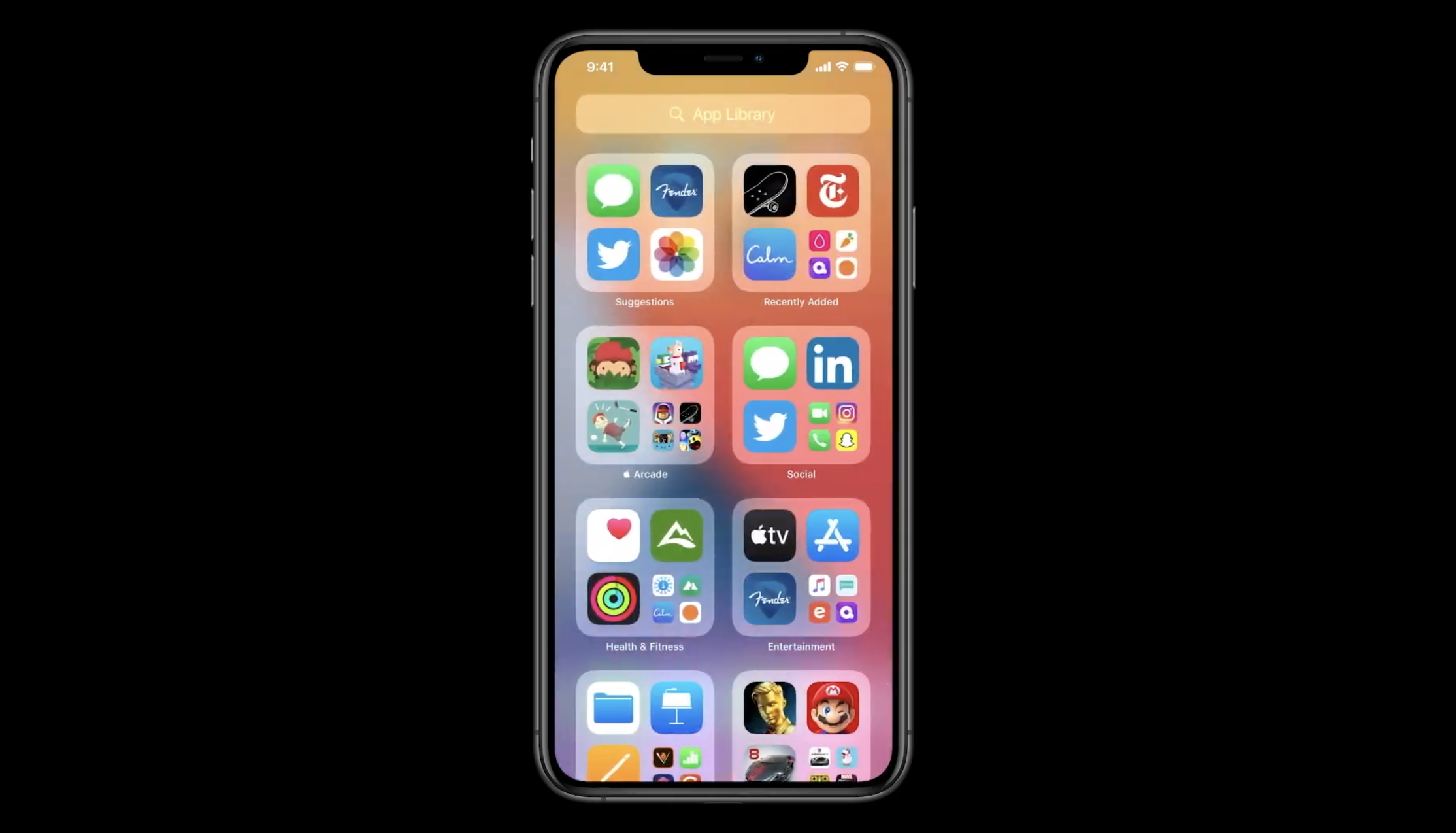
At the end of the home screen pages, there’s a new page called the App Library. All the apps that aren’t on your home screen are sorted in automatic categories, such as Apple Arcade.

The other feature that is going to have an impact on multitasking and the home screen is that you can use picture in picture on the iPhone just like on the iPad. You can keep a video in a corner of the screen and do something else on your phone.

Image Credits: Apple

Better group conversations in Messages

Messages is getting a much-needed update to compete with WhatsApp, Telegram and other popular messaging apps. You can now pin conversations at the top to access them more easily.

Conversations themselves are getting an upgrade as you can reply to individual messages. You can then tap on the reply to see the conversation as a separate thread. People can mention you and you can filter your notifications to mentions only.

Each conversation is now more customizable. You can set a photo or an emoji for a conversation. Apple also shows the icons of your contacts in a specific conversation. The most active people get a bigger icon.

Memoji is getting some new options, such as new hair options, new age options and face covers. There are new Memoji stickers as well, such as a hug sticker, a fist bump sticker and a blushing sticker.

Other apps

Apple is also adding new features to Maps. While the U.S. has received updated data, Apple is going to roll out better maps in other countries, based on its own data set. Up next, the U.K., Ireland and Canada will get much more detailed maps. And this is just the first step as the new data set opens up more possibilities.

“In iOS 14, the Maps team will be working with some of the most trusted brands to bring you guides,” Meg Frost, director Product Design of Apple Maps, said. You’ll soon be able to browse information from AllTrails, Zagat and more sources.

In some cities, Apple is going to roll out cycling as a transportation mode. It’ll take into consideration elevation. Cycling will be available in New York City, Los Angeles, San Francisco, Shanghai and Beijing at first. For walking directions, you can now say to avoid steps and steep hills.

For drivers, there will be more features as well, such as EV routing and more information about restricted city centers. And if your car supports CarPlay, there will be more types of apps in the future, such as parking apps, EV charging apps and food-ordering apps.

Car manufacturers will also be able to let you use your iPhone as a car key. It leverages the U1 chip on the most recent iPhone models. Interestingly, you’ll be able to share your key with a friend by sending it over iMessage.

Image Credits: Apple

Redesigned Siri and new Translate app

While Siri can be hit or miss, Apple is still iterating on the voice assistant. Siri will no longer take over the entire screen when you trigger it. It’ll be a small bubble at the bottom of the screen, which doesn’t obstruct the rest of the screen. Results appear at the top of the screen and appear like a notification.

You can now ask Siri to send audio messages using iMessage. And if you hate audio messages like me, keyboard dictation has been improved. Your voice is now processed on device, which should help when it comes to speed.

Siri lets you translate words already, but Apple is going one step further by releasing a Translate app. Like Google Translate, you can have a conversation in two different languages. You can translate from voice-to-text-to-voice. If you rotate your iPhone in landscape mode, each person has one side of the screen.

App fatigue

You know that feeling. When your friends ask you to download another app, you don’t want to open the App Store. That’s why Apple is launching App Clips. They are sort of mini apps that you can launch without installing an app. It’s a small part of an app that you can easily share.

There are many ways to share App Clips. You can launch those apps from the web, from Messages, from Maps, from NFC tags or from QR codes. Get ready to see stickers at cafés, on scooters or in museums. Scan a code or tap your phone on it and you get an app-like experience. If you want to dive deeper, you can download the full app from the App Library.

More focus on privacy

Apple is adding a slew of new privacy-centric features. For instance, there’ll be a new dot in the top-right corner to indicate that an app is using or has recently used your microphone or camera. There will be new privacy cards in the App Store description pages to tell you how your data is used before you download an app. Apps will also have to ask before they track you across other apps and websites.

As always, iOS 14 will be tested over the summer and should be available to everyone in September.

Image Credits: Apple


from RSSMix.com Mix ID 8176981 https://techcrunch.com/2020/06/22/apple-unveils-ios-14-with-home-screen-widgets/
http://www.gadgetscompared.com
from Tumblr https://ikonografico.tumblr.com/post/621662397210476545
via http://www.gadgetscompared.com
Spotify tests in-app offers, an interactive ad format for podcasts

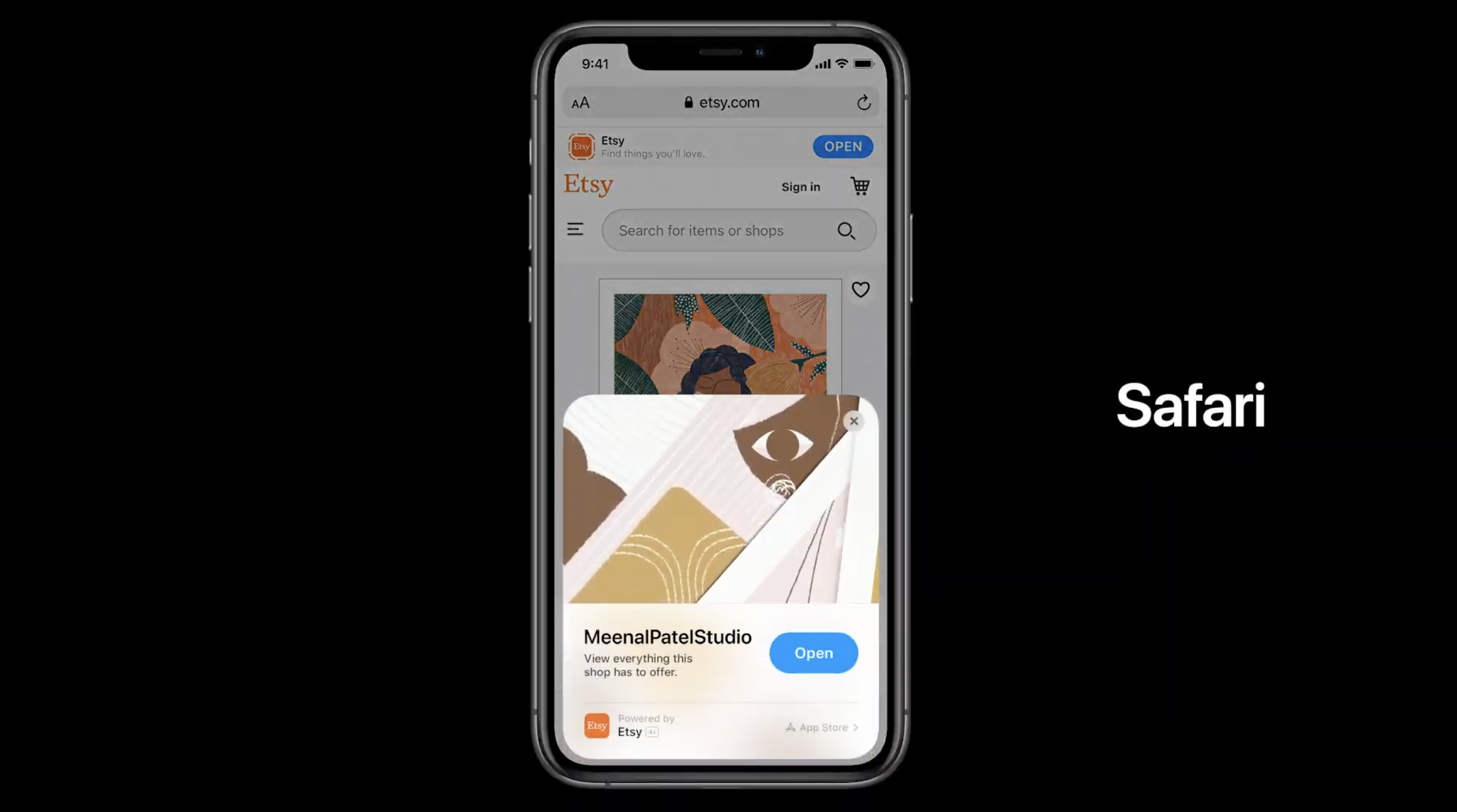
Spotify is testing a new, more interactive ad format designed for podcasts: the in-app offer. Instead of prompting listeners to remember a coupon code or visit a specific website address, the in-app offer allows users to redeem an offer at a time that’s convenient for them. This is done by way of a visual reminder within the Spotify app which displays the sponsors on the podcast episode’s page.

Below the podcast and description, a new section titled “Episode Sponsors” will appear, allowing listeners to then click through on the offer to redeem the coupon or other special deal. This will open the user’s browser to the advertiser’s landing page for immediate redemption, says Spotify.

“The average podcast listener has heard a countless number of ads ending with promo codes or show-specific websites, carefully repeated three times so as not to forget it. In-App Offers makes it vastly simpler for listeners to redeem deals whenever they come back to the app, and we can all benefit from one fewer ‘w-w-w-dot’ spelling lesson from our favorite podcast creators,” says Joel Withrow, Senior Product Manager of Podcast Monetization at Spotify, in a statement.

The product is designed to better fit with the way users actually listen to podcasts — usually, while they’re doing something else, like cooking, cleaning, working out, or driving for example. That means they often have to make a mental note of the offers they hear and want to research later. But this can be challenging.

The new product is in early alpha testing in the U.S. with Harry’s in Last Podcast on the Left and in Germany with HelloFresh in Herrengedeck. There isn’t yet a way to sign up to participate.

Image Credits: Spotify

The new feature builds on Spotify’s existing Streaming Ad Insertion (SAI) technology, introduced at beginning of 2020 at the Consumer Electronics Show in Las Vegas. SAI technology makes key data — like ad impressions, frequency, reach, plus anonymized age, gender and device type — available to podcasters and advertisers on Spotify for the first time. This sort of data was more difficult if not impossible, to collect via podcasts that were served only as downloads from RSS feeds.

The company explained at the time of launch the problem it aimed to solve was on the advertiser’s side — they didn’t not whether or not the ad they purchase is being consumed by the user.

SAI will be widely available to advertisers in the U.S. starting this summer, and is now available to select advertisers in Germany.

The addition of in-app offers to Spotify’s suite comes following a continued heavy investment in podcasts, podcast tools, and podcasting ad technology on the company’s part. The company recently announced an exclusive audio partnership with DC & Warner Bros. and the launch of podcast playlists, for example. Spotify also just landed a podcast deal with Kim Kardashian West, focused on criminal justice, and brought top podcast The Joe Rogan Experience to its platform exclusively.

Meanwhile, Spotify says it’s seeing triple-digit growth in podcast consumption, year-over-year, on its platform while podcasts, more broadly, are reaching 1 in 3 or 100 million Americans every month.

Spotify didn’t say when the new in-app offers ad experience would be publicly available.


from RSSMix.com Mix ID 8176981 https://techcrunch.com/2020/06/22/spotify-tests-in-app-offers-an-interactive-ad-format-for-podcasts/
http://www.gadgetscompared.com
from Tumblr https://ikonografico.tumblr.com/post/621651075254124544
via http://www.gadgetscompared.com

Watch Apple’s WWDC keynote live right here

Apple is holding a keynote today on the first day of its developer conference, and the company is expected to talk about a ton of software updates. WWDC is a virtual event this year, but you can expect the same amount of news, in a different format. At 10 AM PT (1 PM in New York, 6 PM in London, 7 PM in Paris), you’ll be able to watch the event as the company is streaming it live.

Rumor has it that the company plans to unveil new versions of its operating systems. Get ready for iOS 14 and its sibling iPadOS 14, a new version of macOS, some updates for watchOS and tvOS as well.

But the most interesting rumor of the year is that Apple could announce a major change for the Mac. The company could start using its own in-house ARM systems on a chip instead of Intel’s processors. It would have a ton of consequences for third-party apps running on your Mac as well as Mac hardware in general. Imagine a MacBook with a battery that lasts as long as what you get from an iPad. There could be some more hardware news, such as a new design for the iMac or some Tile-style hardware trackers.

You can watch the live stream directly on this page as Apple is streaming its conference on YouTube.

If you have an Apple TV, you can download the Apple Events app in the App Store. It lets you stream today’s event and rewatch old ones. The app icon was updated a few days ago for the event.

And if you don’t have an Apple TV and don’t want to use YouTube, the company also lets you live-stream the event from the Apple Events section on its website. This video feed now works in all major browsers — Safari, Microsoft Edge, Google Chrome and Mozilla Firefox.

Of course, you also can read TechCrunch’s live blog if you don’t want to stop everything and watch a video.


from RSSMix.com Mix ID 8176981 https://techcrunch.com/2020/06/22/watch-apples-wwdc-keynote-live-right-here/
http://www.gadgetscompared.com
from Tumblr https://ikonografico.tumblr.com/post/621620875318427648
via http://www.gadgetscompared.com

Friday, June 19, 2020

How Reliance Jio Platforms became India’s biggest telecom network

It’s raised $5.7 billion from Facebook. It’s taken $1.5 billion from KKR, another $1.5 billion from Vista Equity Partners, $1.5 billion from Saudi Arabia’s Public Investment Fund, $1.35 billion from Silver Lake, $1.2 billion from Mubadala, $870 million from General Atlantic, $750 million from Abu Dhabi Investment Authority, $600 million from TPG, and $250 million from L Catterton.

And it’s done all that in just nine weeks.

India’s Reliance Jio Platforms is the world’s most ambitious tech company. Founder Mukesh Ambani has made it his dream to provide every Indian with access to affordable and comprehensive telecommunications services, and Jio has so far proven successful, attracting nearly 400 million subscribers in just a few years.

The unparalleled growth of Reliance Jio Platforms, a subsidiary of India’s most-valued firm (Reliance Industries), has shocked rivals and spooked foreign tech companies such as Google and Amazon, both of which are now reportedly eyeing a slice of one of the world’s largest telecom markets.

What can we learn from Reliance Jio Platforms’s growth? What does the future hold for Jio and for India’s tech startup ecosystem in general?

Through a series of reports, Extra Crunch is going to investigate those questions. We previously profiled Mukesh Ambani himself, and in today’s installment, we are going to look at how Reliance Jio went from a telco upstart to the dominant tech company in four years.

The birth of a new empire

Months after India’s richest man, Mukesh Ambani, launched his telecom network Reliance Jio, Sunil Mittal of Airtel — his chief rival — was struggling in public to contain his frustration.

That Ambani would try to win over subscribers by offering them free voice calling wasn’t a surprise, Mittal said at the World Economic Forum in January 2017. But making voice calls and the bulk of 4G mobile data completely free for seven months clearly “meant that they have not gotten the attention they wanted,” he said, hopeful the local regulator would soon intervene.

This wasn’t the first time Ambani and Mittal were competing directly against each other: in 2002, Ambani had launched a telecommunications company and sought to win the market by distributing free handsets.

In India, carrier lock-in is not popular as people prefer pay-as-you-go voice and data plans. But luckily for Mittal in their first go around, Ambani’s journey was cut short due to a family feud with his brother — read more about that here.


from RSSMix.com Mix ID 8176981 https://techcrunch.com/2020/06/19/how-reliance-jio-platforms-became-indias-biggest-telecom-network/
http://www.gadgetscompared.com
from Tumblr https://ikonografico.tumblr.com/post/621367956398555137
via http://www.gadgetscompared.com